Sixfold Content
Product Updates
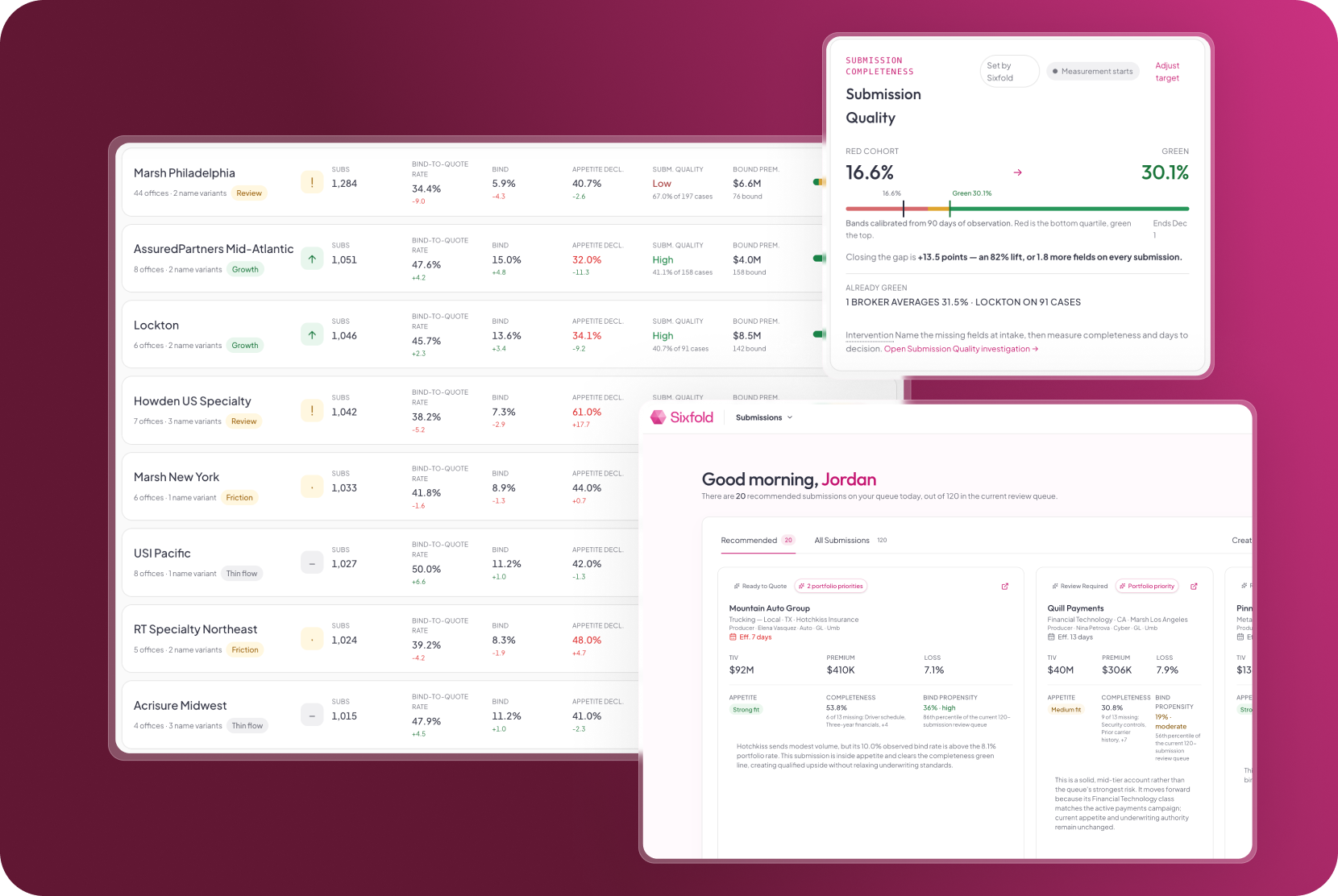
Introducing Distribution Intelligence
Sixfold is launching Distribution Intelligence, giving insurers the data and recommendations they need to proactively manage their distribution.



Stay informed, gain insights, and elevate your understanding of AI's role in the insurance industry with our comprehensive collection of articles, guides, and more.
.png)
A Guide to Life & Health Underwriting Technology in 2026
A practical breakdown of the five main AI and tech solutions available for Life & Health underwriting, and how to figure out which one actually fits what your team is trying to solve.
If you're a Chief Underwriting Officer, Innovation Lead, Head of IT, or have a similar role in the Life & Health underwriting space, you've probably come across all types of AI and tech solutions that claim to streamline life and health underwriting workflows. It can be overwhelming to understand the differences, what each solution actually does, how they help underwriters review cases more effectively, and whether they actually reduce mortality slippage and improve placement rates.
Most of them reduce the manual work involved in reviewing lengthy medical records and assessing cases, but they do it in different ways, addressing different parts of the underwriting process. For example, a solution built to increase straight-through processing rates of standard cases won't solve the same problem as one built to help underwriters assess table-rated cases faster.
Knowing which problem you're actually trying to solve is what determines which solution is right. Is it automating decision-making for standard risks? Is it getting a structured summary of all medical records? Or is it having risk insights and recommendations aligned to your underwriting guidelines?
This guide breaks down the main categories to help you understand what the best fit for you is.
When the Manual Approach Stops Scaling
Most Life & Health underwriting teams are facing some version of the same two core challenges. That’s what’s often driving the push toward new technology, even if those challenges might show up differently depending on team size or the mix of cases they underwrite.
- Capacity: There's a consistently high volume of applications that gets more intense during busy seasons, and not enough underwriters to handle them as quickly as needed. The capacity issues get compounded by an aging workforce, which means difficulties in hiring experienced underwriters. Straightforward cases sit in the same queue as complex ones, and turnaround times slow down. Failing to keep up can impact placement rates, giving other insurers the chance to get there first.
- Quality: The cases that actually reach underwriters take too long to assess, or two underwriters on the same case can reach different conclusions. Sometimes both. Slow decisions affect your bottom line. Inconsistent ones lead to mortality slippage and erode the value of your guidelines over time.
These are related problems, but they need different solutions: a tool that reduces the number of cases reaching your team does very little for the quality of decisions on the ones that do. A tool that helps underwriters read faster often doesn't make their decisions more consistent.
The Solutions Landscape
Here are the five main types of underwriting technology insurers use today to solve these problems.
Accelerated Underwriting Systems
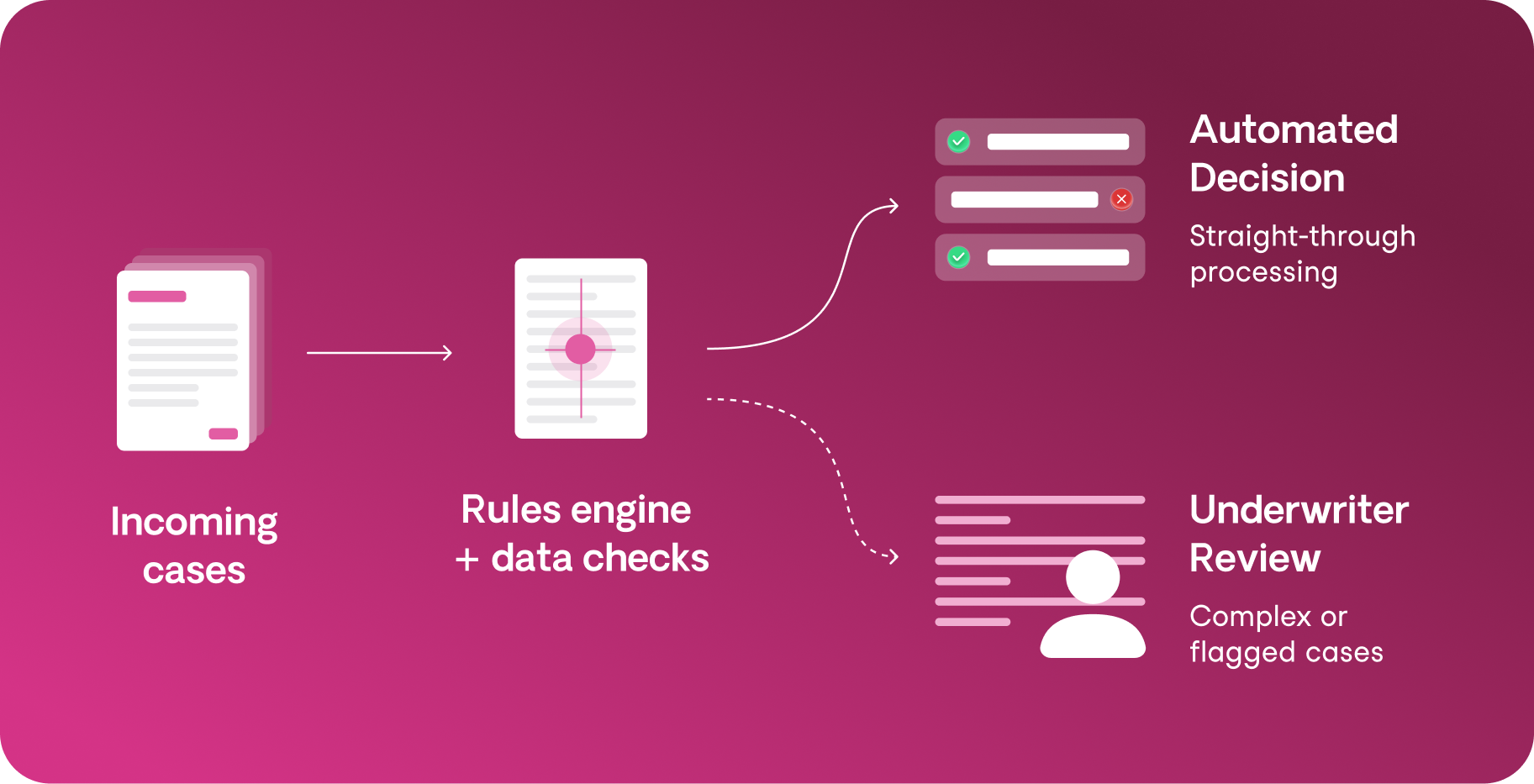
Description: Accelerated Underwriting (AU) systems are designed to maximize automated decision rates, allowing eligible applicants to get approved without requiring traditional medical exams and lab tests. Both large reinsurers and third-party technology vendors offer AU solutions that carriers can adopt and configure to their needs.
These systems handle straightforward cases quickly and consistently, and most insurers today already use this type of technology. But there are still many cases that are too complex for these solutions, whether it's because of a higher-risk diagnosis, the coverage amount needed, a medication flag, or missing information, and that require an underwriter's review. That's where AU reaches its limits.
With these systems, underwriters still have to assess complex cases manually, reviewing hundreds of pages of APS, EHRs, and lab results to understand the patient's clinical history.
Type of technology: Rules-based engine, often combined with predictive models and machine learning.
Best for: Insurers looking to increase the volume of applications that get decided automatically at point of sale, without manual underwriter involvement. Helps increase Straight Through Process rates, reduce turnaround time, and free up underwriters from reviewing less complex cases.
Watch out for: AU systems don't solve the complex case problem. The cases that get referred out still need to be reviewed by a human underwriter, and that process remains largely manual without additional tooling. With 41% of cases going straight to traditional underwriting and 88% of cases requiring some level of human review, that's a significant share that AU simply can't handle.¹
Reinsurer-Built Underwriting AI Assistants
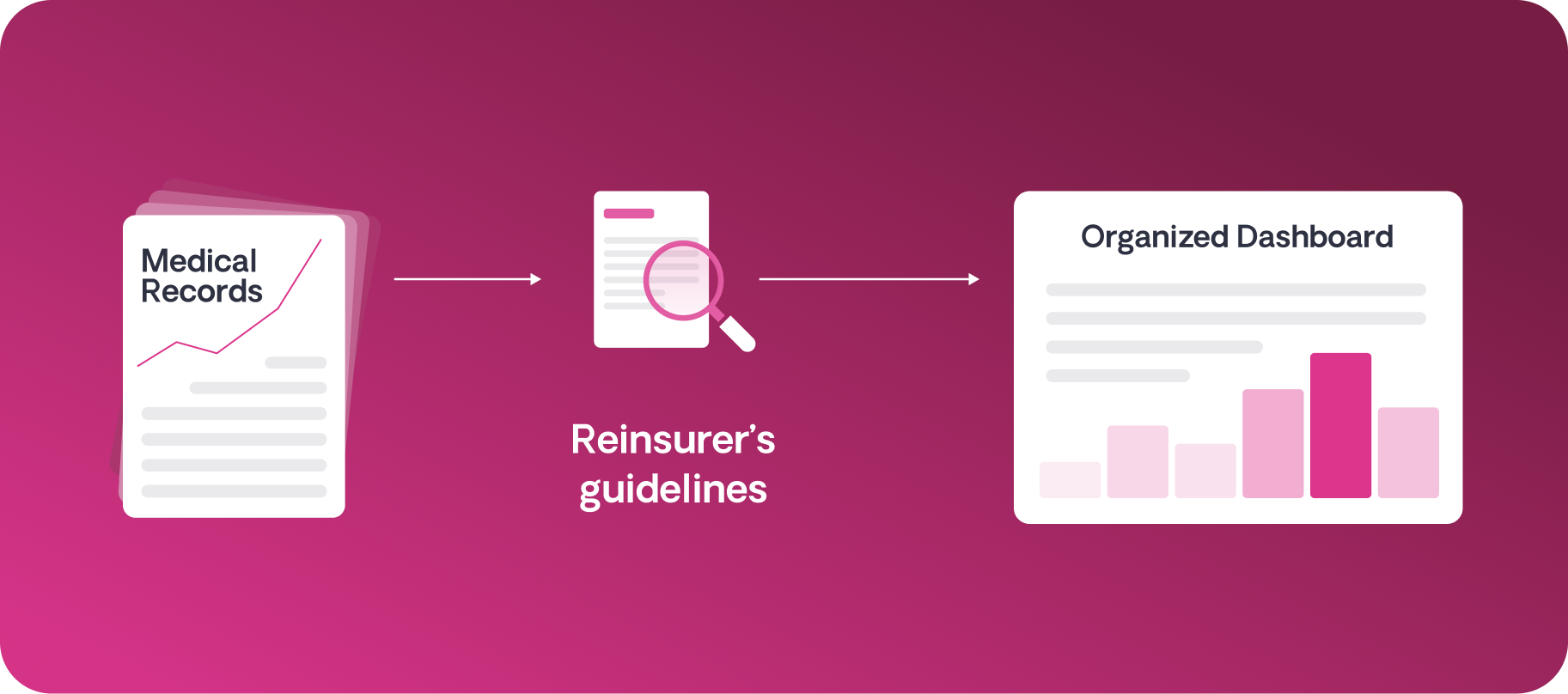
These tools are helpful if you're looking for an out-of-the-box summarization solution. The main thing to keep in mind is that they're typically anchored to the reinsurer's own guidelines, so customization options vary. They also often come bundled with the reinsurer's broader platform and services, so adopting one can mean a deeper commitment than just the tool itself.
With these systems, underwriters often still have to assess non-medical risks separately, manually leverage risk calculators, and return to the original APS or EHRs to fill in gaps.
Type of technology: OCR, NLP, and LLMsS for document ingestion and summarization, with some tools also incorporating structured decision logic for risk guidance.
Best for: Insurers who want a ready-to-use tool to help underwriters navigate referred cases faster, with medical information organized and presented in a structured, easy-to-read dashboard
Watch out for: These tools are typically built around the reinsurer's own guidelines, so customization options may vary. Adopting them often means signing up for the reinsurer's broader platform and services, which creates a level of vendor lock-in worth factoring in before making a decision.
Medical Record Summarization Tools
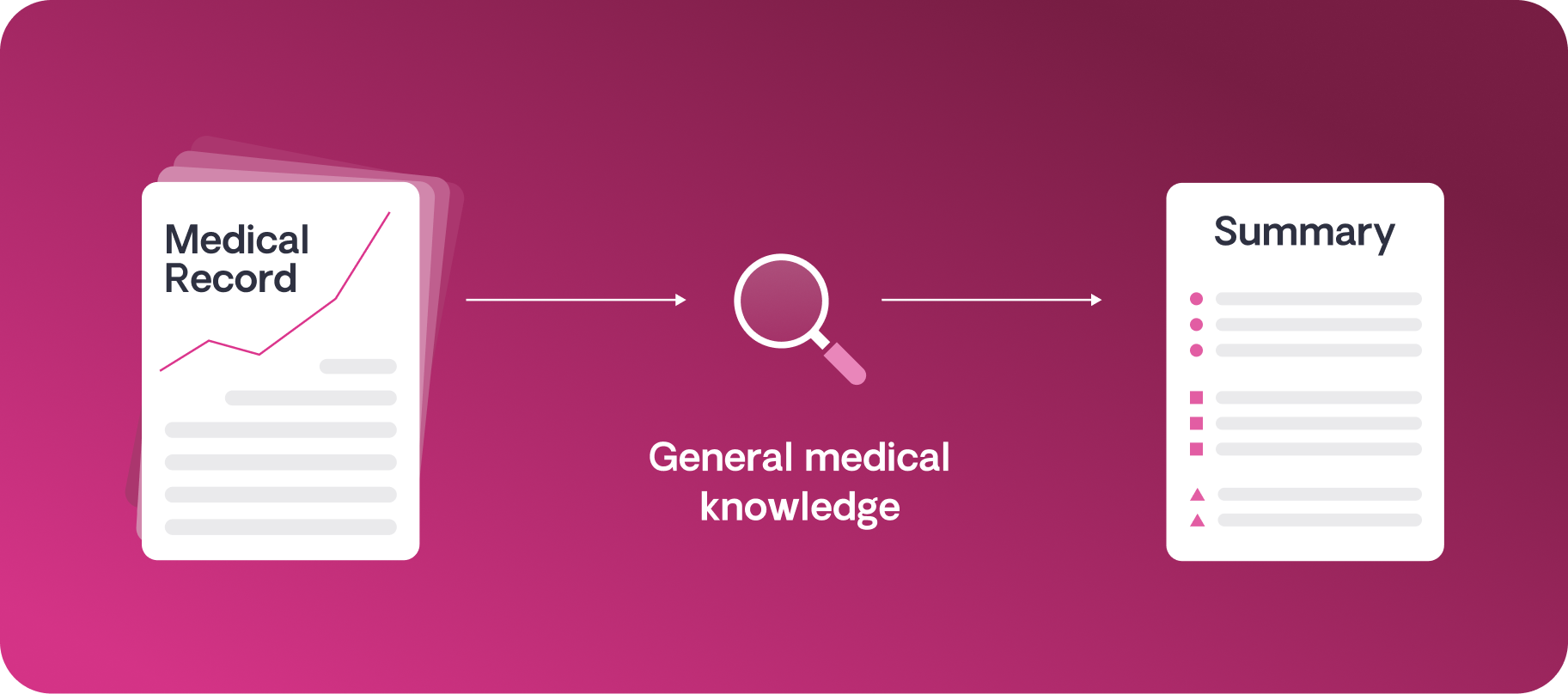
Beyond reinsurer-built tools, there are vendors focused specifically on medical record review. Not built exclusively for underwriting, these solutions are also used in claims, clinical, and legal workflows. They use AI to summarize and organize information from medical records, giving underwriters a more user-friendly view of an applicant's health history in one place.
Although they're good at giving an overall medical summary, all the information is surfaced regardless of relevance, which can still result in information overload. Underwriters still have to sift through often lengthy summaries to find what actually matters for their decision. These tools also aren't configured to a carrier's specific underwriting guidelines or appetite, so the insights they surface reflect a general medical view rather than what matters most to your team.
Type of technology: ML, NLP, LLMs, and AI agents, backed by a proprietary Medical Knowledge Base
Best for: Insurers looking for a standalone tool to help underwriters process medical records faster, without needing it to align with their specific underwriting guidelines
Watch out for: The information is comprehensive but not prioritized against your guidelines, and summaries can still be lengthy, so underwriters still have to figure out what's actually relevant to each case.
LLMs
.png)
Tools like ChatGPT or Claude are flexible, easy to use, and can analyze a wide range of documentation, including medical records. They're great for quick searches, general summarization, and easy enough to get started with so that an underwriter could set up a basic underwriting skill themselves.
The challenge is that they weren't built specifically for underwriting. Tailoring them for Life & Health underwriting requires significant time, money, and effort, and they may still not meet the explainability and auditability requirements that regulators increasingly expect.
Type of technology: LLMs
Best for: Quick searches, general summarization, or early-stage experimentation before committing to a purpose-built solution
Watch out for: Because they're not built for underwriting, outputs won't be as consistent or accurate as a purpose-built solution. Without significant customization, these tools won't align with your underwriting guidelines and won't be specifically designed to meet the regulatory and data protection standards required for use in production, increasing the risk of compliance issues.
Underwriting AI (Sixfold fits in here)
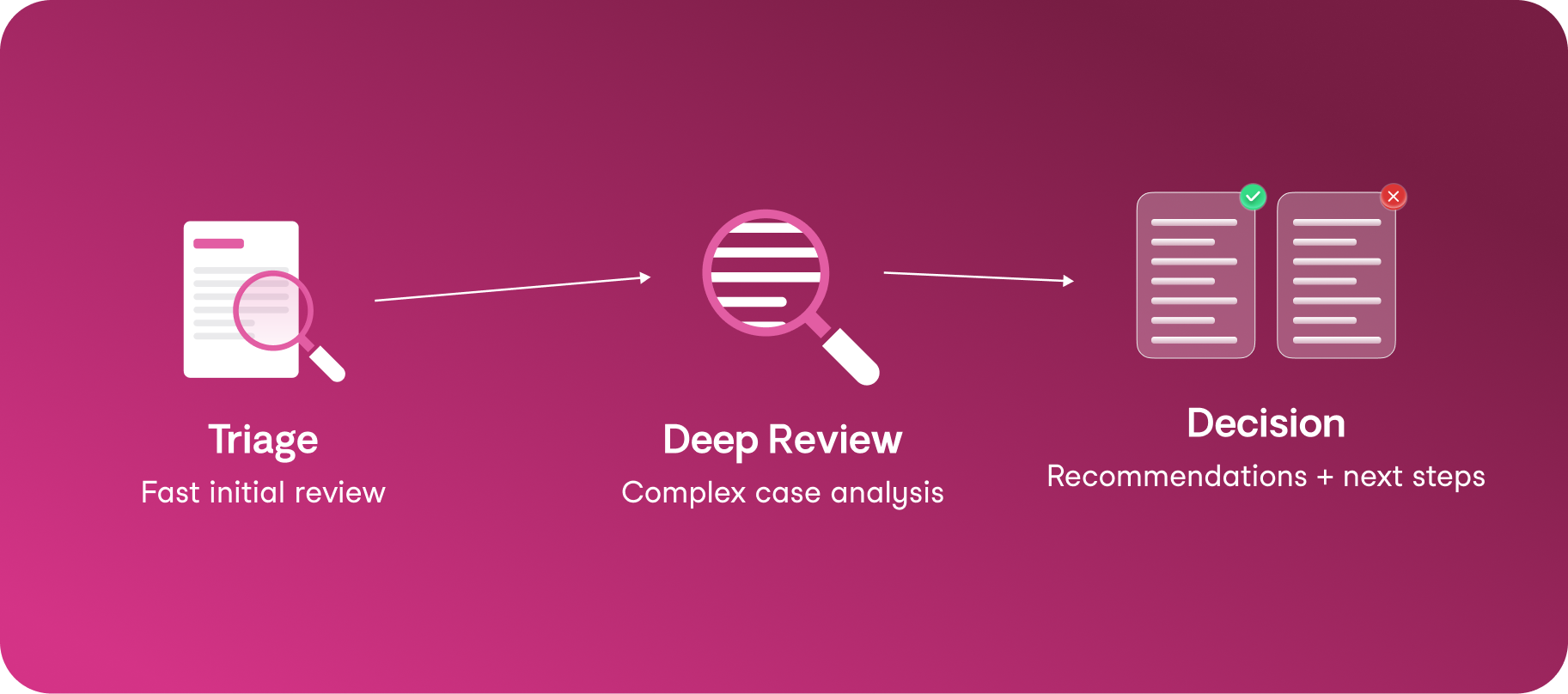
Sixfold generates risk insights and recommendations to support your team's decision-making, working directly within the systems you already use. It's designed to handle the full underwriting analysis of cases that reach your underwriters, from triage to deep review, including the most complex cases.
Rather than just summarizing information, Sixfold reasons across all relevant documents and surfaces the details your underwriters need, aligned to your specific guidelines. It works like a colleague that knows your book: tracking decisions over time, applying what it learns, and recommending best next steps. Keeping underwriters in control to agree or disagree with any assessment.
It can process any type of document, including messy, unstructured data, so there's no need for separate tools to extract and organize data first.
Type of technology: LLMs, AI agents, guideline-aligned risk engine
Best for: Insurers looking for underwriting AI that goes beyond summarization: improving speed without compromising underwriting quality. Aligns with your specific guidelines across the full underwriting workflow, with proven results (e.g. 50% efficiency gains for Guardian) and built to be compliant and fair for insurance underwriting from day one.
Watch out for: It's built for insurers who want AI that actually reasons and understands risk, not just summarizes information.
Side-by-Side Comparison
Below is a simple table showcasing the differences.
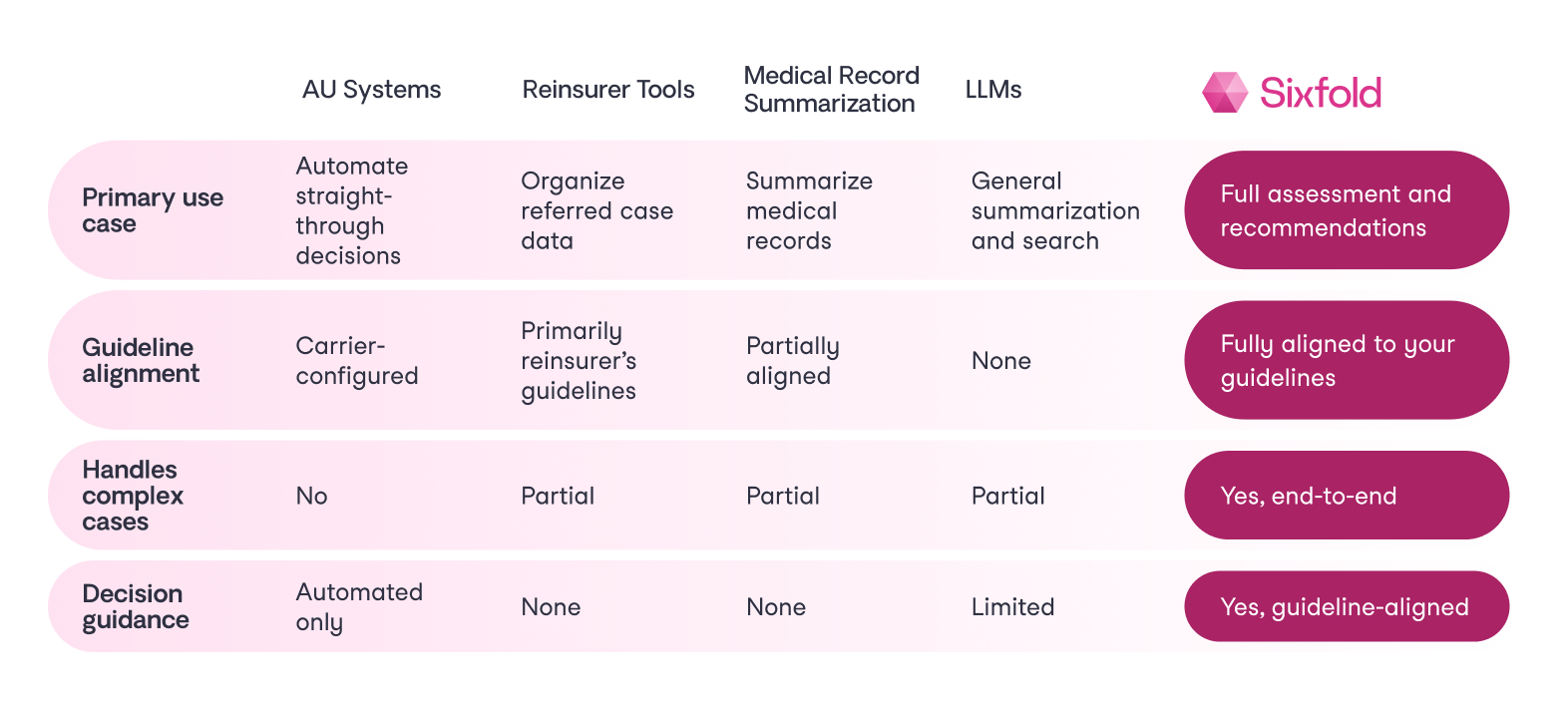
We hope this guide helped you better understand the different solutions in the market.
If Sixfold sounds like it could be the right fit for your team, reach out for a demo to see what it looks like in practice.
Learn more about Sixfold’s Life & Health product here.
━━━
FAQ
What is the difference between accelerated underwriting and automated underwriting in life insurance?
Accelerated underwriting (AU) is a Life & Health underwriting approach that allows eligible applicants to get approved faster, without requiring traditional medical exams and lab tests. It does this by using external data sources like electronic health records, prescription history, and MIB records to assess risk. Automated underwriting is a broader term referring to any rules-based system that makes decisions without manual underwriter involvement. In Life & Health, AU is the more precise term. According to Gen Re's 2025 survey, around 59% of individual life applications qualify for an accelerated underwriting path.
How long does it take to get value from an AI underwriting solution in L&H?
Purpose-built AI underwriting solutions are designed to deliver value faster than traditional technology implementations. Unlike legacy core system replacements that can take months or years, they integrate with existing systems and workflows, meaning carriers can reach production without lengthy implementation projects. The key variables are guideline configuration, data readiness, and how much the solution needs to be customized to the carrier's specific appetite and workflows.
What percentage of life and health cases still require human review despite automation?
According to Gen Re's 2025 U.S. Individual Life Next Gen Underwriting Survey of 30 carriers, 41% of applications were processed through a traditional underwriting path, 47% were eligible for accelerated underwriting, and only 12% qualified for fully automated decisioning. This means the vast majority of case volume still lands on underwriters' desks, making the quality of the manual review process as important as the automation layer above it.
What is mortality slippage in life insurance underwriting?
Mortality slippage is the financial loss that occurs when underwriters approve risks at better rate classes than their actual mortality profile warrants. It typically results from inconsistent decision-making across underwriters reviewing similar cases. According to Gen Re's 2025 Next Gen Analytics study, overall AU slippage improved to 12.3% in 2025 after several years of upward pressure. Over half of carriers estimate their mortality slippage at between 6% and 15%.
How do AI underwriting tools handle data protection in Life & Health?
Data protection standards vary significantly across solution types. General-purpose LLMs were not built with insurance-specific security or regulatory requirements in mind, making them unsuitable for production use without significant customization. Purpose-built underwriting AI solutions are designed to meet the data governance, auditability, and compliance standards that Life & Health regulators expect, including requirements under the EU AI Act and the NAIC Model Bulletin on AI Systems, which continues to be adopted by U.S. states.
What is vendor lock-in risk when adopting a reinsurer-built underwriting tool?
Vendor lock-in occurs when adopting a reinsurer's AI tool requires signing up for their broader platform and services, making it difficult to switch providers later without disrupting workflows. Reinsurer-built tools are anchored to the reinsurer's own guidelines and ecosystem, meaning the carrier's underwriting process becomes tied to that reinsurer relationship beyond just the tool itself.
How do placement rates connect to underwriting cycle times in life insurance?
Faster underwriting decisions directly improve placement rates. According to Gen Re's 2025 survey, 78% of applications approved through an accelerated workflow were ultimately placed, compared to 63% for fully underwritten cases. When cycle times slow, applicants may lapse, withdraw, or accept a competing offer from a carrier that moved faster, particularly healthy applicants who qualify for multiple carriers' accelerated underwriting programs simultaneously.
¹ Gen Re, 2025 U.S. Individual Life Next Gen Underwriting Survey
.avif)
New Life & Health Narrative: Meeting Underwriters At Every Step
Narrative is Sixfold's new capability for Life & Health, giving underwriters a customizable, structured summary at initial review. It surfaces the key details needed to move a case forward, reducing back and forth and simplifying triage before deeper analysis.
Life & Health underwriting is a constant balance between speed and quality: getting the right coverage to customers before they go somewhere else. One missed detail can change the whole quote. But the longer pricing takes, the greater the risk of applicant drop-off.
Accelerated underwriting helps with simpler cases that don't require additional evidence, but as recently reported by Gen Re, up to 88% of cases still need some type of human review.
Those cases still go through the same workflow: sorting through documents at initial review, going back to the advisor or broker when something's missing, and when the case is finally ready, reading through hundreds of pages of medical records like EHRs, APS, and lab results to piece together the full health picture before making a decision.
It's a lot of steps and a big manual workload that keeps underwriters from bringing in more premiums and getting back to customers faster with better coverage. That’s where Sixfold comes in; underwriting AI built to help at every step of the process, bringing together the details that matter to your team, and now with our new Narrative, a tailored initial analysis that simplifies triage and reduces the unnecessary back and forth, before the deeper analysis.
The First Look At a Case
At the initial review, underwriters are trying to answer one question: Do I have what I need to move this case forward? Most of the time, that means going through multiple documents just to find out, and when something's missing, at least 30 minutes are spent on a case they'll have to come back to later.
Our new Narrative capability for Life & Health is a focused, structured case summary tailored to what matters to your underwriting team, surfacing the information you want to see upfront to help underwriters with triage and to figure out next steps. Sixfold’s AI agents read through all the case documents, application, APS and labs, and pull together the relevant details into one structured view, so underwriters don't have to. Each narrative is configurable to your team's specific workflow, so what gets surfaced reflects what actually matters for your decisions.
Imagine a case where an applicant has hypertension or a history of elevated cholesterol. The underwriter immediately needs to know if they have all the information about blood pressure and what meds they're on. Does this applicant smoke? What is their family history? This is information they need before they even begin to assess the case.
The Narrative gives you exactly the information you need to know before you move on.
"We want to support underwriters at every point in their workflow. Sometimes that means a focused Narrative to help with triage and next steps. Sometimes that means a deep condition analysis across hundreds of pages. The point is, wherever an underwriter is in the process, Sixfold is there to help."
— Noah Grosshandler, Product Manager at Sixfold
On the reinsurer side, it's a similar story. Underwriters are spending precious time just organizing loosely assembled submissions from cedents because most times the cases come in an inconsistent format, requiring additional questions before quoting, many of which wouldn't even be necessary if the information were clearly structured upfront.
With Narrative, these questions are answered upfront. Fewer emails back and forth with brokers and faster responses.
The Full Clinical Story: Conditions Analysis
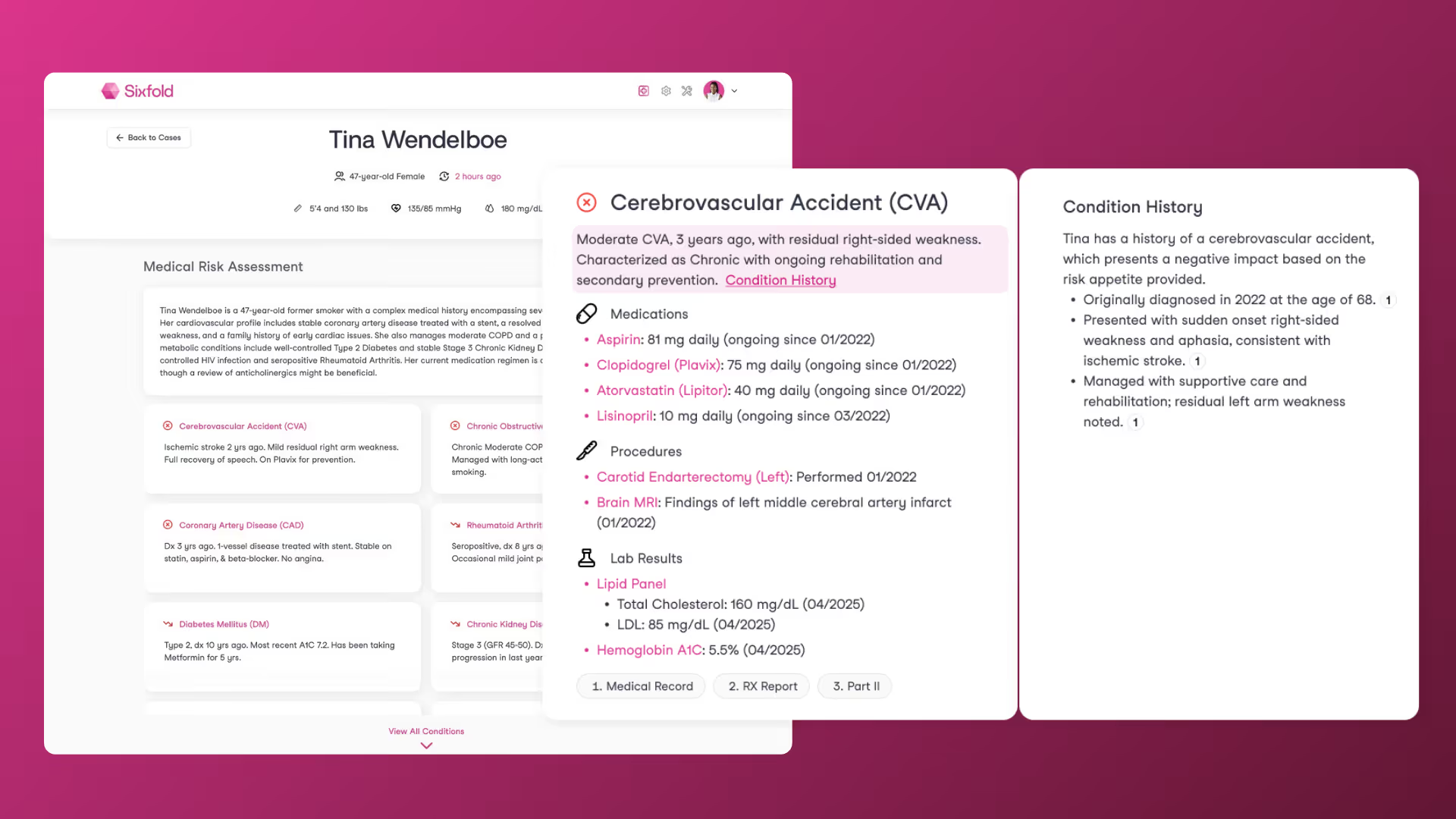
After triaging and making sure a case is ready to quote, underwriters go back to the manual review of hundreds of pages of medical records, trying to spot that one detail that will change the whole quote. It's pretty much like detective work, finding how a medicine connects to a diagnosis and what the impact is on that patient, trying to piece together the full medical story. Assessing history, severity, and how well a diagnosis is managed. Meanwhile, customers are waiting for a response.
That's where Sixfold's in-depth Conditions Analysis comes in. When the case is ready for a full review, our Conditions Analysis connects all the medical pieces, bringing together medications, labs, procedures, and diagnoses under each condition so underwriters can see the full clinical picture without jumping between documents. It highlights what's relevant to your underwriting guidelines, shows how conditions have progressed over time, and surfaces the clinical data that matters most for your decisions.
One example is a case where an applicant is taking Spironolactone, a common medication used to control high blood pressure, but also prescribed for hormonal acne. An underwriter would have to go through lengthy pages of documentation to find what dosage they're on, how long they've been taking it, and what it's actually being prescribed for. And that's just one medication. For complex cases, underwriters are doing this across multiple conditions with years of medical history.
With our Conditions Analysis, underwriters can spend their time on decision-making rather than document review and data gathering. Customers get faster and better quotes. Guardian, for example, saw a 50% reduction in review time using Sixfold.
When Speed is What Matters
Some of our customers work with higher-volume lines like structured settlements and annuities and often process over 10,000 cases per year; they don’t always need an in-depth Condition Analysis to move a case to the next step.
There are fewer key risk details that influence the analysis, so they have been able to use Narrative to move forward on up to 70% of their cases, consulting our full Conditions Analysis only for the most complex ones. For some teams, Narrative handles most of the heavy lifting of manual review.
"One of our customers built Narrative into their workflow for initial case review. It helps their underwriters get up to speed quickly and know exactly what needs attention. When a case requires deeper analysis, they move to our full Conditions Analysis, but Narrative gives them that strong starting point." — Justin Sorce, Customer Success Manager at Sixfold
Confident Underwriting Decisions
Whether it's a quick initial review or a deep dive into a complex case, Sixfold is there to help your team get to a confident underwriting decision faster.
And it works where your team already works, whether that's in our UI, a workbench, or a policy admin system. Every insight ties back to the source documents, so underwriters can verify what they're seeing. Built for underwriting since day one. HIPAA and SOC 2 certified, with single-tenant environments to keep your data secure. Rigorous AI fairness testing to meet evolving regulatory standards and grounded in our Responsible AI principles.
How AI is Improving Life & Health Underwriting
Life & health underwriting is slowed by manual submission triage and the work of reading dense medical evidence for risk assessment. AI underwriting platforms now read and reason through an entire submission before an underwriter even opens it.
The bottleneck in life & health underwriting
Life & health underwriting is slowed by manual submission triage and the work of reading dense medical evidence for risk assessment. AI underwriting platforms now read and reason through an entire submission before an underwriter even opens it.
Every life and health submission arrives as a stack of unstructured information, like application data and medical records such as attending physician statements, lab results, and prescription histories, that can run to hundreds, even thousands of pages. Historically, underwriters spent the bulk of their time finding, reading, and organizing that evidence before they could make a single risk decision. That manual effort is the real constraint, not the decision-making process itself.
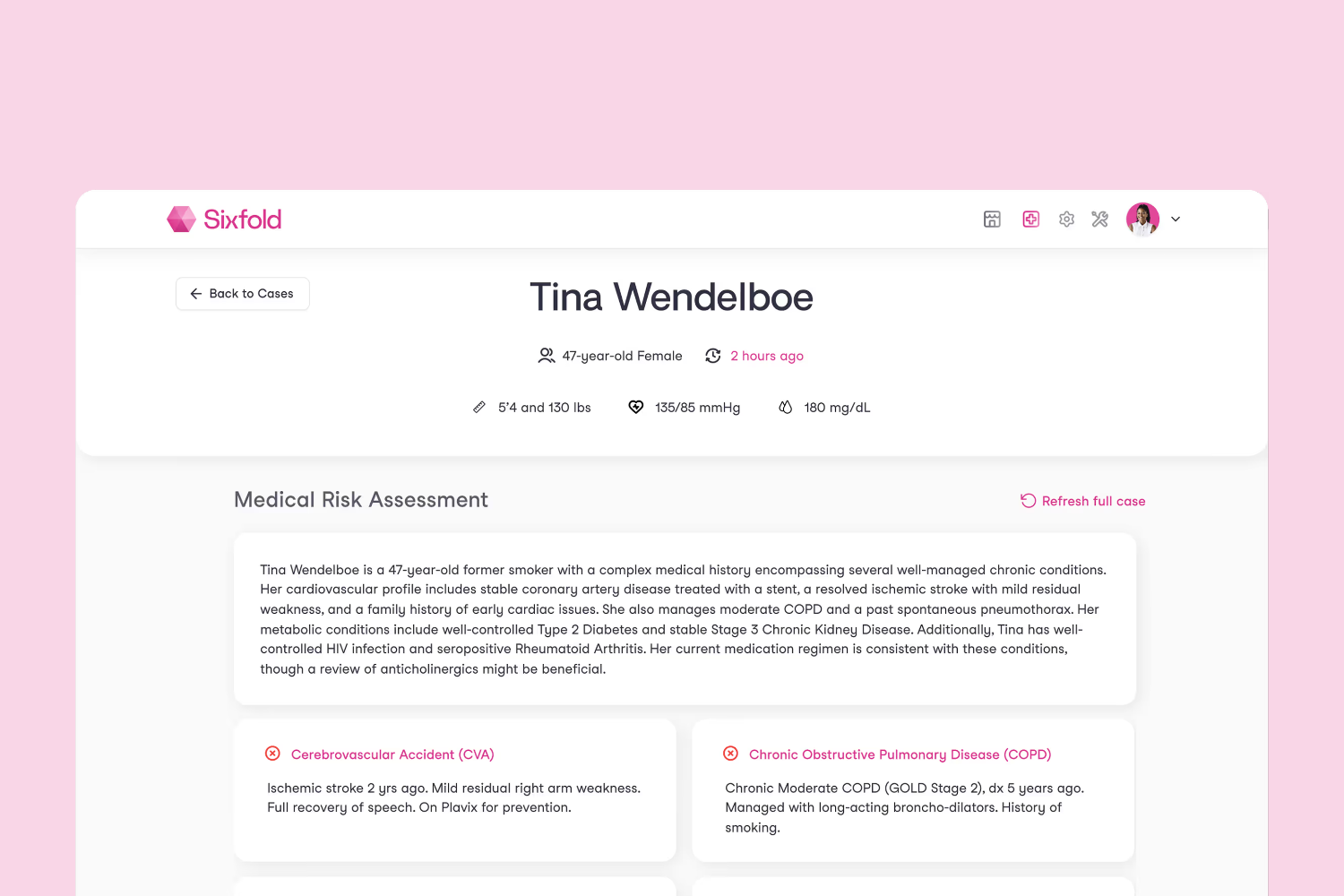
Sixfold changes that. Its AI agents read and reason across the full submission the way an experienced underwriter would, surfacing the relevant medical evidence aligned with the carrier's underwriting manual, flagging key risk factors, and delivering a clear health overview. All steps to support the underwriter's decision-making.
Using medical software to read records and find key information faster
Medical evidence software exists because reading through the records is the most time-consuming part of a life & health case analysis.
Sixfold processes attending physician statements, lab panels, and prescription data, extracts the clinically relevant findings, and ties them back to the risk factors that matter for the underwriting decision. Instead of skimming a 200-page record for a single relevant medical condition, the underwriter gets a structured, evidence-backed summary with a traceable source.
Because the system comes pre-trained with underwriting knowledge, it recognizes what matters most to a life or health risk from day one, rather than requiring months of configuration. It plugs into the underwriting workbench the team already uses, so the medical evidence summary appears within the existing workflow.
Reducing time spent in manual submission triage with AI
Doing the initial review of a submission, checking if all the information is available to proceed or if it needs more data from brokers or agents, is where underwriting teams spend the most time on operational work. An AI platform automates triage by ingesting each submission as it arrives, assessing completeness, pulling and organizing the medical evidence, and producing a preliminary recommendation before a human review.
The result is that when underwriters start the case review, it's already prioritized, and the risk assessment is complete, ready for a final underwriting decision. Underwriters get to spend their time on judgment, complex risk cases, and broker relationships rather than on sorting and data entry.
Across Sixfold customers, this contributes to a 50% reduction in turnaround time, hit ratios up 15% or more, and up to 30% more gross written premium per underwriter, because capacity is redirected from administrative triage to writing business.
L&H Frequently Asked Questions
How do life and health insurers use medical-evidence software to speed up the underwriting process?
Life insurers use Sixfold's AI to automatically read and interpret medical records, attending physician statements, lab results, and prescription histories. It extracts relevant findings, links them to risk factors, and presents an evidence-based summary, so underwriters can focus on the decision rather than digging into information. It provides a risk assessment ready for decision-making, including recommendations on what to do next in a case.
Sixfold comes pre-trained with underwriting knowledge from day one. It integrates directly with existing underwriting workbenches, keeping the source evidence visible for every conclusion. Customers see processing times 50% to 97% faster as a result.
How do underwriting teams reduce manual submission triage using AI platforms?
Underwriting teams reduce manual triage by having the AI platform ingest each submission on arrival, check completeness, organize the medical evidence, and automatically generate a risk assessment and next-step recommendations. Underwriters then start case review with cases that are already prioritized and pre-analyzed, focusing their time on risk judgment rather than sorting and data entry.
Having Sixfold help with triage, teams redirect capacity from administrative work to writing business. Sixfold customers report hit ratios up 15% or more and up to 30% more GWP per underwriter. Adoption stays high, over 90% of expected users, because the platform fits how underwriting actually works rather than forcing a new process.
What are the top tools for automating life underwriting decisions?
The top tools for automating Life and Health underwriting decisions are purpose-built underwriting AI platforms that reason across a full submission, automated medical evidence and record summarization software, and integrations into the underwriting workbench. The strongest options combine all three: decisioning, evidence analysis, and workflow fit.
About Sixfold
Sixfold is the first AI solution built specifically for insurance underwriting, in market since early 2023, and is live in production across 50 lines of business, including life & health lines. It has processed more than 1.5 million submissions globally and is used by more than 1,000 underwriters, from insurers like Guardian and New York Life.
New in Life & Health: Clear Condition Stories with Clinical Insights
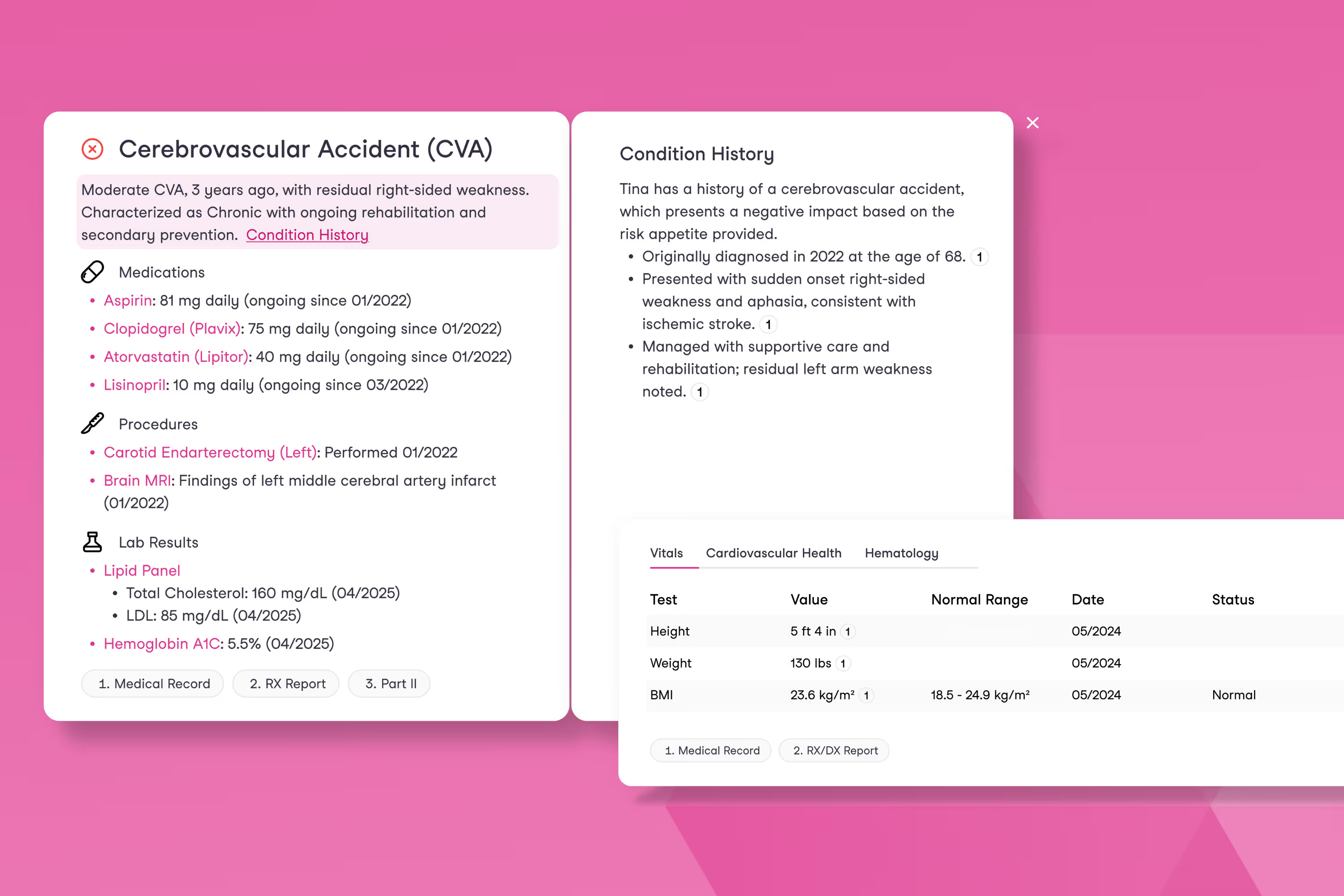
Introducing Conditions and Core Clinical Data for Life & Health: Our latest update helps underwriters see the full picture, faster. Conditions tie related facts to a diagnosis. Core Clinical Data brings key lab results into one view. The result? Quicker reviews, clearer decisions, and better outcomes.
Life & Health underwriters often have to go through hundreds of pages of medical documents to understand an applicant’s health profile, knowing that one missed detail could lead to the wrong coverage decision.
When we introduced our Life & Health Underwriting AI, we set out to give underwriters everything they need in one place: diagnoses, medications, and procedures pulled from applications and supporting documents, aligned to the insurer’s unique risk appetite. They no longer had to spend time manually going through medical documents.
But after getting feedback from underwriters across global insurers, we realized something important: presenting information alone isn't enough. What they really need is the full health story, with all the pieces connected. For example, if a medication appears, they need to know the full context around it: how often it was prescribed and any related diagnoses or procedures.
That’s why we’re upgrading our Underwriting AI with Conditional Insights and Clinical Data, designed to reflect the way underwriters think about the overall health profile.
What’s New?
Conditions: From Medical Facts to the Full Story

Conditions completely change how Sixfold’s insights are presented to underwriters.
Previously, all relevant data, like Personal Health, Medications, Procedures, and more, appeared as individual facts. While surfacing this information is essential, it didn’t show underwriters how it all connected.
The thing is, Life and Health underwriters don't analyze each fact in isolation; they think about how it fits into the bigger picture. What does this medication suggest? How severe is the condition? How does it all connect?
That’s why Sixfold now brings together all relevant information under a diagnosed condition, including:
- Medications and ongoing treatment
- Procedures and lab results
- The condition’s full history, with context and progression over time
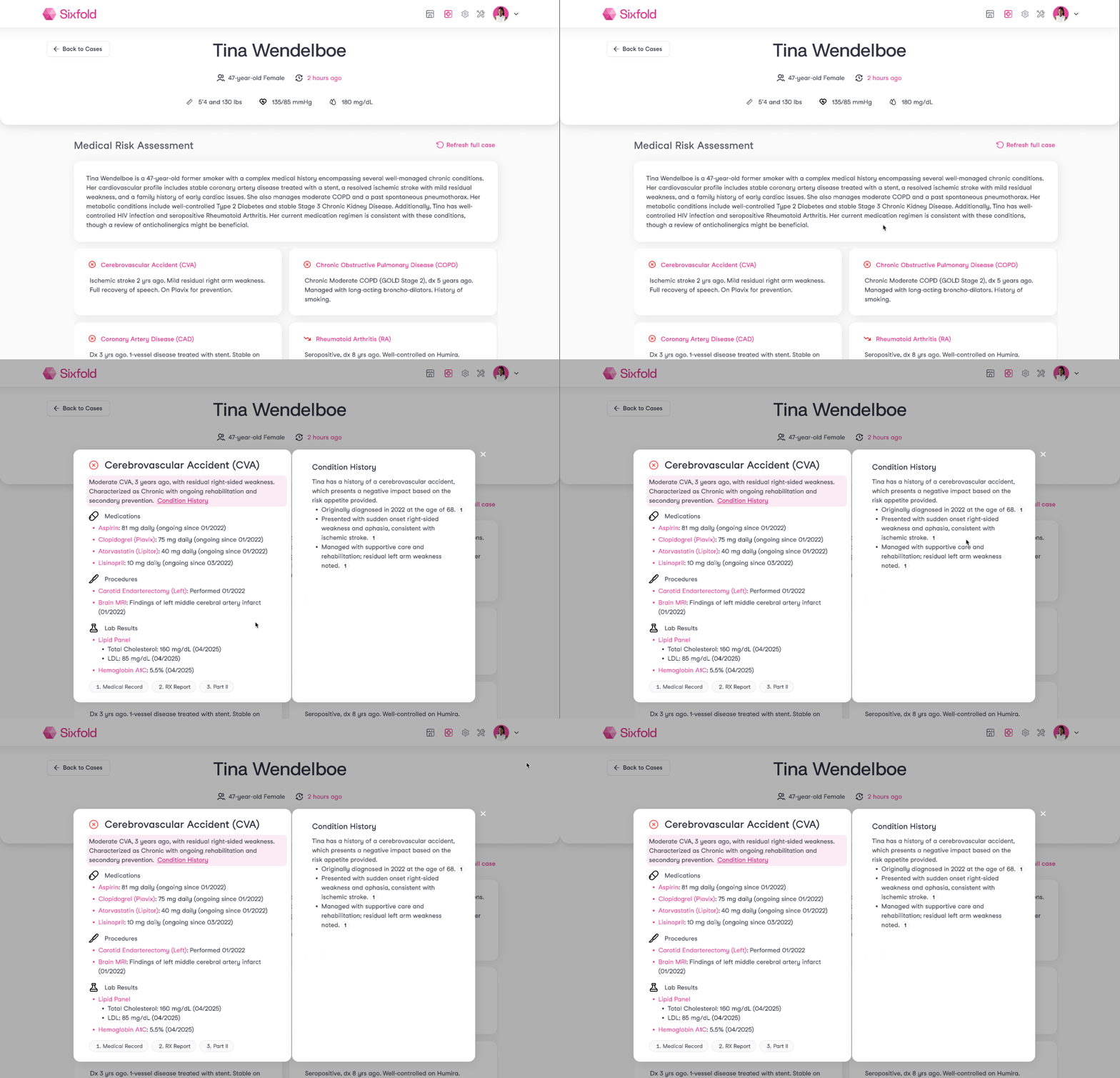
For example, take Gastritis, an inflammation of the stomach lining that can cause pain, indigestion, and discomfort. An applicant might have been diagnosed with it a while ago, is taking medication such as Pantoprazole, and could have undergone procedures like Endoscopies five years ago.
Instead of treating these details as in isolation, Sixfold now recognizes they’re all part of the same conditions story. This mirrors exactly how an experienced underwriter would naturally connect the dots, seeing not just health facts, but the bigger picture of an applicant’s health history.
“This release has been a huge focus for our team, and the feedback from early users has been very positive. They’ve shared firsthand how impactful it is to have a single experience that brings together every aspect of an applicant’s medical history.”
- Noah Grosshandler, Product Manager at Sixfold.
Want a closer look at how Conditions work? Join our live product demo on September 11th.
Core Clinical Data: Lab Insights and Historical Trends

Underwriters often have to go through dozens of lab results to answer: Does this applicant have an underlying condition? Are the results concerning? Could they worsen over time?
Core Clinical Data brings all of that information into one place, instantly. It pulls information found in lab results and medical records uploaded to Sixfold, presenting a pre-defined set of health indicators commonly tied to high-risk conditions such as: Vitals, Cardiovascular Health, and Hematology.
It gives underwriters instant and standardized insight: lab values, normal ranges, and historical progression, making it easier to assess the presence, progression, and severity of chronic conditions.
The impact? Core Clinical Data gives underwriters a snapshot of the applicant’s health at a glance, meaning time saved in reading lab reports that can be used to actually bind accounts. With immediate access to historical trends and key lab indicators, underwriters can make faster and more accurate decisions.
How Guardian Cut Review Time in Half
Guardian, one of the largest life insurers in the U.S., faced a common challenge: manual case reviews slowed down underwriters and created bottlenecks in the underwriting process.
By adopting Sixfold for its Disability line, Guardian was able to automatically extract medical data, triage information faster, and speed up case assessments end-to-end.
The impact: a 50% reduction in review time, freeing underwriters from being stuck reviewing medical records and letting them focus on risk decisions. Read more about the results Guardian has seen here.
Now, Guardian is expanding the program across more business lines, and you can see why! Join our Life & Health Product Demo on September 11th, where we’ll showcase how Sixfold works for life & health insurance underwriting.
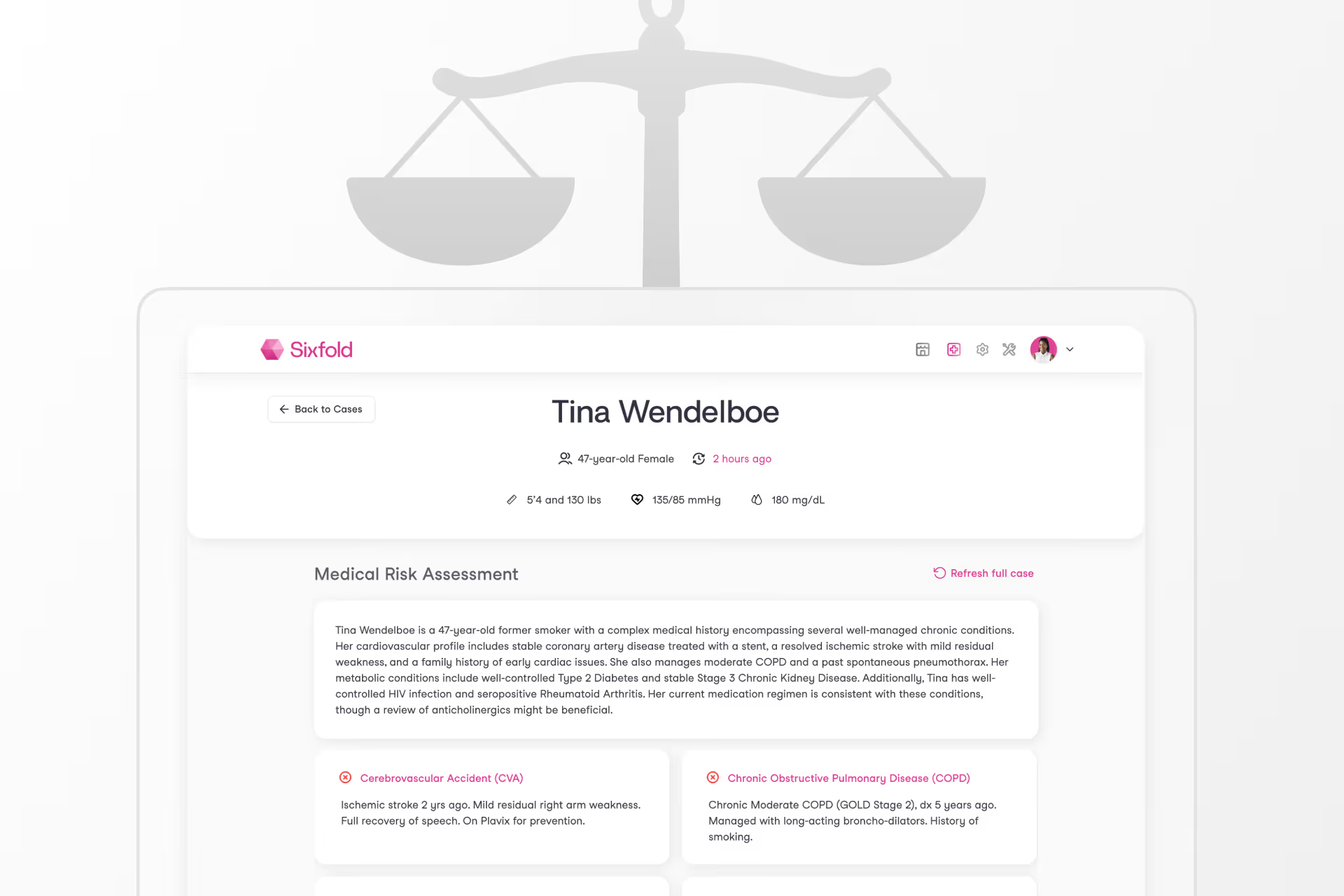
Sixfold's Approach to AI Fairness & Bias Testing
As AI becomes more embedded in insurance underwriting, ensuring fairness is a shared responsibility across carriers, vendors, and regulators. Sixfold's commitment to responsible AI means continuously exploring new ways to evaluate bias.
As AI becomes more embedded in the insurance underwriting process, carriers, vendors, and regulators share a growing responsibility to ensure these systems remain fair and unbiased.
At Sixfold, our dedication to building responsible AI means regularly exploring new and thoughtful ways to evaluate fairness.1
We sat down with Elly Millican, Responsible AI & Regulatory Research Expert, and Noah Grosshandler, Product Lead on Sixfold's Life & Health team, to discuss how Sixfold is approaching fairness testing in a new way.
Fairness As AI Systems Advance
Fairness in insurance underwriting isn’t a new concern, but testing for it in AI systems that don’t make binary decisions is.
At Sixfold, our Underwriting AI for life and health insurers don’t approve or deny applicants. Instead, it analyzes complex medical records and surface relevant information based on each insurer's unique risk appetite. This allows underwriters to work much more efficiently and focus their time on risk assessment, not document review.
“We needed to develop new methodologies for fairness testing that reflect how Sixfold works.”
— Elly Millican, Responsible AI & Regulatory Research Expert
While that’s a win for underwriters, it complicates fairness testing. When your AI produces qualitative outputs such as facts and summaries, rather than scores and decisions, most traditional fairness metrics won’t work. Testing for fairness in this context requires an alternative approach.
“The academic work around fairness testing is very focused on traditional predictive models, however Sixfold is doing document analysis,” explains Millican. “We needed to develop new methodologies for fairness testing that reflect how Sixfold works.”
“The academic work around fairness testing is very focused on traditional predictive models, however Sixfold is doing document analysis,” explains Millican. “We needed to develop new methodologies for fairness testing that reflect how Sixfold works.”
“Even selecting which facts to pull and highlight from medical records in the first place comes with the opportunity to introduce bias. We believe it’s our responsibility to test for and mitigate that,” Grosshandler adds.
While regulations prohibit discrimination in underwriting, they rarely spell out how to measure fairness in systems like Sixfold’s. That ambiguity has opened the door for innovation, and for Sixfold to take initiative on shaping best practices and contributing to the regulatory conversation.
A New Testing Methodology
To address the challenge of fairness testing in a system with no binary outcomes, Sixfold is developing a methodology rooted in counterfactual fairness testing. The idea is simple: hold everything constant except for a single demographic attribute and see if and how the AI’s output changes.2
“Ultimately we want to validate that medically similar cases are treated the same when their demographic attributes differ,”
— Noah Grosshandler, Product Manager @Sixfold
“We start with an ‘anchor’ case and create a ‘counterfactual twin’ who is identical in every way except for one detail, like race or gender. Then we run both through our pipeline to see if the medical information that’s presented in Sixfold varies in a notable or concerning way” Millican explains.
“Ultimately we want to validate that medically similar cases are treated the same when their demographic attributes differ,” Grosshandler states.
Proof-of-Concept
For the initial proof-of-concept, the team is focused on two key dimensions of Sixfold’s Life & Health pipeline.
1. Fact Extraction Consistency
Does Sixfold extract the same facts from medically identical underwriting case records that differ only in one protected attribute?
2. Summary Framing and Content Consistency
Does Sixfold produce diagnosis summaries with equivalent clinical content and emphasis for medically identical underwriting cases?
“It’s not just about missing or added facts, sometimes it’s a shift in tone or emphasis that could change how a case is perceived,” Millican explains. “We want to be sure that if demographic details are influencing outputs, it’s only when clinically appropriate. Otherwise, we risk surfacing irrelevant information that could skew decisions.”
Expanding the Scope

While the team’s current focus is on foundational fairness markers (race and gender), the methodology is designed to evolve. Future testing will likely explore proxy variables such as ZIP codes, names, and socioeconomic indicators, which might implicitly shape model behavior.
“We want to get into cases where the demographic signal isn’t explicit, but the model might still infer something. Names, locations, insurance types, all of these could serve as proxies that unintentionally influence outcomes,” Millican elaborates.
The team is also thinking ahead to version control for prompts and model updates, ensuring fairness testing keeps pace with an evolving AI stack.
“We’re trying to define what fairness means for a new kind of AI system,” explains Millican. “One that doesn’t give a single output, but shapes what people see, read, and decide.”
Sixfold isn’t just testing for fairness in isolation, it’s aiming to contribute to a broader conversation on how LLMs should be evaluated in high-stakes contexts like insurance, healthcare, finance, and more.
That’s why Sixfold is proactively bringing this work to the attention of regulatory bodies. By doing so, we hope to support ongoing standards development in the industry and help others build responsible and transparent AI systems.
“This work isn’t just about evaluating Sixfold, it’s about setting new standards for a new category of AI." Grosshandler concludes.
“This work isn’t just about evaluating Sixfold, it’s about setting new standards for a new category of AI. Regulators are still figuring this out, so we’re taking the opportunity to contribute to the conversation and help shape how fairness is monitored in systems like ours,” Grosshandler concludes.
Positive Regulatory Feedback
When we recently walked through our testing methodology and results with a group of regulators focused on AI and data, the feedback was both thoughtful and encouraging. They didn’t shy away from the complexity, but they clearly saw the value in what we’re doing.
“The fact that it’s hard shouldn’t be a reason not to try. What you’re doing makes sense... You’re scrutinizing something that matters.” said one senior policy advisor.
“The fact that it’s hard shouldn’t be a reason not to try. What you’re doing makes sense... You’re scrutinizing something that matters.”
— Senior Policy Advisor
One of the key themes that came up during the meeting was the unique nature of generative AI, and why it demands a different kind of oversight. As one senior actuary and behavioral data scientist put it: “Large language models are more qualitative than quantitative... A lot of technical folks don’t really get qualitative. They’re used to numbers. The more you can explain how you test the language for accuracy, the more attention it will get.”
That comment really resonated. It reflects the heart of our approach, we’re not just tracking metrics. We’re evaluating how language evolves, how facts can shift, and how risk is framed and communicated depending on the inputs.
The Road Ahead
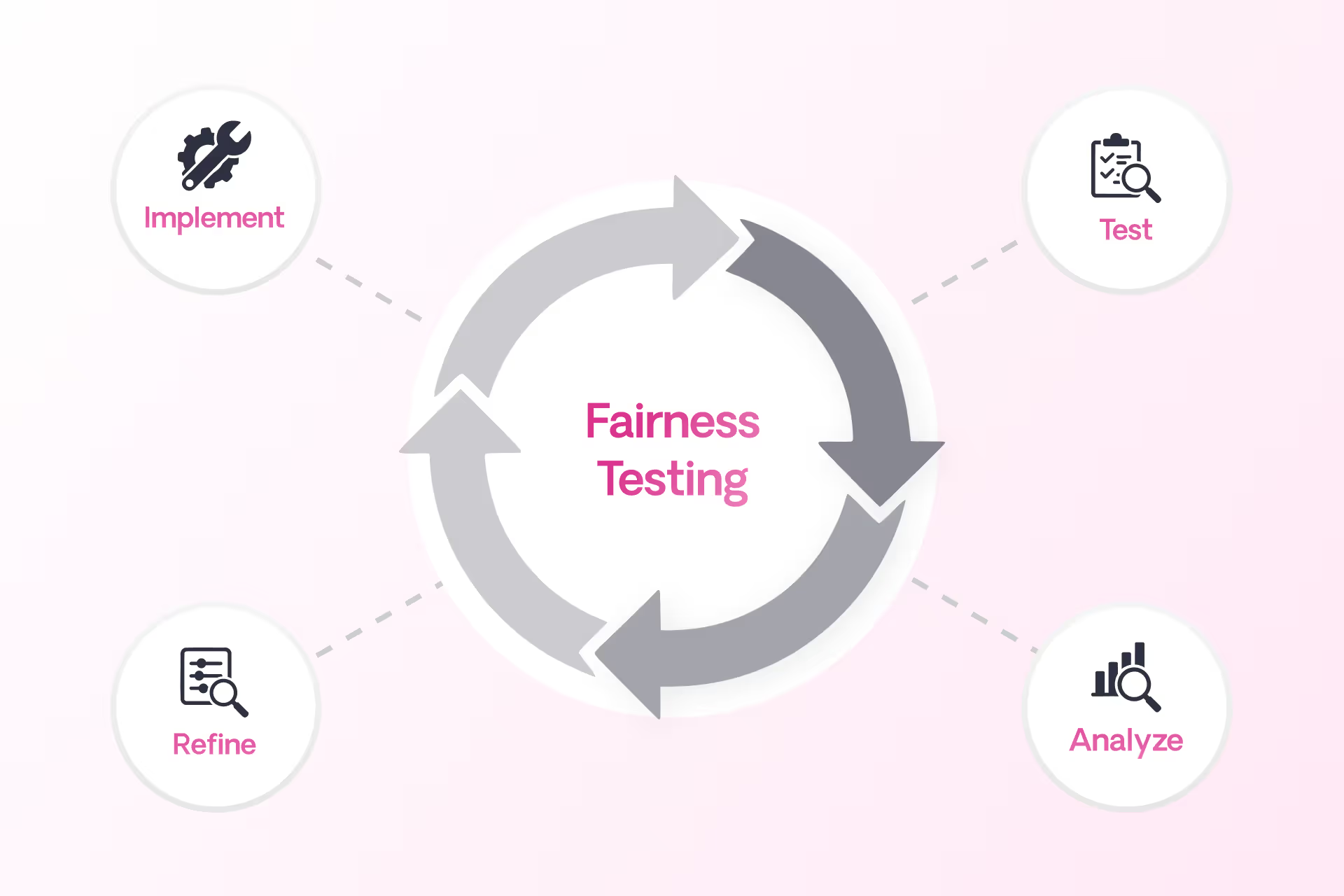
Fairness in AI isn’t a fixed destination, it’s an ongoing commitment. Sixfold’s work in developing and refining fairness and bias testing methodologies reflects that mindset.
As more organizations turn to LLMs to analyze and interpret sensitive information, the need for thoughtful, domain-specific fairness methods will only grow. At Sixfold, we’re proud to be at the forefront of that work.
Footnotes
1While internal reviews have not surfaced evidence of systemic bias, Sixfold is committed to continuous testing and transparency to ensure that remains the case as we expand and refine our AI systems.
2To ensure accuracy, cases involving medically relevant demographic traits, like pregnancy in a gender-flipped case, are filtered out. The methodology is designed to isolate unfair influence, not obscure legitimate medical distinctions.
.avif)
New in Life & Health: Track Sources & New Changes
Sixfold’s latest launch introduces two new features for Life & Health underwriters: with In-line Citations and New Case Facts, underwriters can easily trace where each fact came from and quickly spot what’s new in a case, making reviews faster, clearer, and more efficient.
Check Sources Instantly
Trust and transparency are essential when underwriters use AI in their daily work. Underwriters need to know that the information they rely on is accurate; otherwise, a policy decision could result in incorrect coverage, claims issues, or unnecessary risk for the carrier.
One of the best ways to build that confidence is by clearly showing the source of each piece of information. That’s why we’re excited to introduce a new In-line Citations feature for our Life & Health customers. This feature makes it easy to check the source behind any insight Sixfold surfaces.
So, how does it work?
When reviewing a case in Sixfold, underwriters can now see exactly where each fact came from, including the document and page number. Here’s what you’ll see when clicking into a fact card:
- Document category listed for each file.
- Page number shown on hover
- One-click access to the exact source page
- All of the documents where the fact was found
Our goal? To increase underwriter confidence and efficiency by clearly showing the source of medical and lifestyle facts within the insurance application analysis.
New Info? Now Flagged for You
In Life and Health underwriting, it’s common for some cases to take time, sometimes weeks, to gather all the documents needed for final analysis. The result? A lot of new information is coming in, and it’s not always clear what’s actually new facts.
That’s where our new capability, New Case Facts comes in.

Now, when new facts are surfaced within a case, you’ll see a bell icon next to the relevant fact card, a simple way to flag which facts came from the latest documents added. You can click into the fact to see more context, including which document category it came from.
This makes it easier to understand what’s been added, without having to reread the whole submission. It’s especially useful when multiple underwriters are collaborating on a case; one might start the analysis, while a colleague might actually finish it.
With new facts clearly marked, everyone can stay aligned and quickly assess what’s different and what it means for the overall risk profile of the applicant.
FEATURED REPORTS
Guides and Reports
A closer look at AI, adoption, and the future of underwriting.