Sixfold Content
Life & Health
Introducing the AI Underwriter for Life & Health
Sixfold is launching the AI Underwriter for Life & Health, an agent that turns medical evidence into a clear recommendation, with the rationale behind it.

%20(1500%20x%201200%20px).png)


Stay informed, gain insights, and elevate your understanding of AI's role in the insurance industry with our comprehensive collection of articles, guides, and more.
Working With the AI Underwriter
Hear directly from Melissa Butt, a 20+ year commercial property underwriter and VP of E&S Brokerage, Property, at Skyward Specialty, on what it's like to use the AI Underwriter.
Melissa Butt, Vice President E&S Brokerage, Property, at Skyward Specialty, has spent more than 20 years underwriting commercial property. She's been using the AI Underwriter on live submissions and we asked her what that’s been like.
First impressions
Melissa's assumption going in was that AI in underwriting meant workflow or operational automation, scrubbing data, prefilling fields. That assumption wasn't wrong, exactly. The tool does cut out a lot of manual legwork:
"It eliminated the screen jumping. You don't have to go from one system to another. Instead, it’s putting it all together so that you're reviewing the pertinent information, with the flexibility to align that information to your viewpoint."
For Melissa, what really changed her day-to-day life was what the AI Underwriter does after it's pulled relevant facts together, when it gets to the real underwriting work. It arrives with underwriting knowledge already built in, then layers in what it learns about a specific carrier's appetite and each underwriter's way of working. That combination is what builds a narrative shaped to underwriters’ own judgment:
"It applies what it knows and what it’s learned from you into a narrative aligned with your individual underwriting point of view."
That narrative comes paired with recommended next steps, and Melissa said she's acting on the next step recommendations more often than not. The AI Underwriter isn’t stopping at an appetite-aligned score or summary, it’s working through real underwriting considerations and next steps: declining a bad fit, flagging what's missing from a broker, initiating a referral.
"I frequently agree with the next steps. Maybe you have missing information and need to reach out to your broker, or an exposure is in a gray area and you should consult a peer or your guidelines. It can trigger a referral and help you narrate it, saving time, energy, clicks. All underwriters want to save clicks."
"Wow, it really knows underwriting” moments
When asked what moments stood out that made her excited to continue using Sixfold, here’s what Melissa had to say.
On a rare occupancy type her market doesn't see often:
"I got a very rare occupancy in one of my submissions, food irradiation. We don't see those a lot, even in our market. What really surprised me was not only did it understand what the food irradiation process was, it allowed me to understand the process, too. It said here's some additional information you may want or need, and here's some questions to go back and get answered from your broker."
On a routine loss-history check, where the AI Underwriter pulled in some surprising research:
"The system scrubbed the loss history we received, but it also went out and looked at the web for additional information. What it discovered was that the property was one of the few buildings on the block that did not recently have a fire, which was significant when writing property insurance."
A favorite feature
Melissa was most excited about the AI Underwriter’s chat interactivity:
"The chat interaction is huge. If I had to point to one thing that makes this tool the most functional, it’s the chat."
The reason: it lets her resolve a question the moment it comes up, without leaving the platform. The chat is connected to the same underlying analysis built for that submission, so digging deeper or providing additional context feeds right back into the narrative and next-step recommendations, as well as the AI Underwriter’s overall memory.
On one submission, the initial read on a recycling-related exposure was that the business was a metal processor. Melissa concluded it was actually a transfer station, and used the chat to guide the AI Underwriter in a new direction:
"I let the chat know it isn't a true recycling exposure, it's actually a transfer station, and asked how that changes the loss history, the rating, the narrative. It's similar to talking to a peer: hey, I'm not sure, what do you think? And the system responds."
Advice for a skeptical peer
We asked Melissa what she'd say to another underwriter who isn't sure what to make of something like this:
"Don't be afraid. Yes, it's technology. Yes, it's new. But it's not here for your job. It's here to make your job more efficient and to make your experience stronger. Treat it like you've treated every other tool in your arsenal as an underwriter: challenge it, try to break it, because then it's just going to become stronger. It's a tool. It's a peer. It will interact with you so that you are a stronger underwriter."
Learn more about Sixfold’s latest P&C offering, the AI Underwriter.
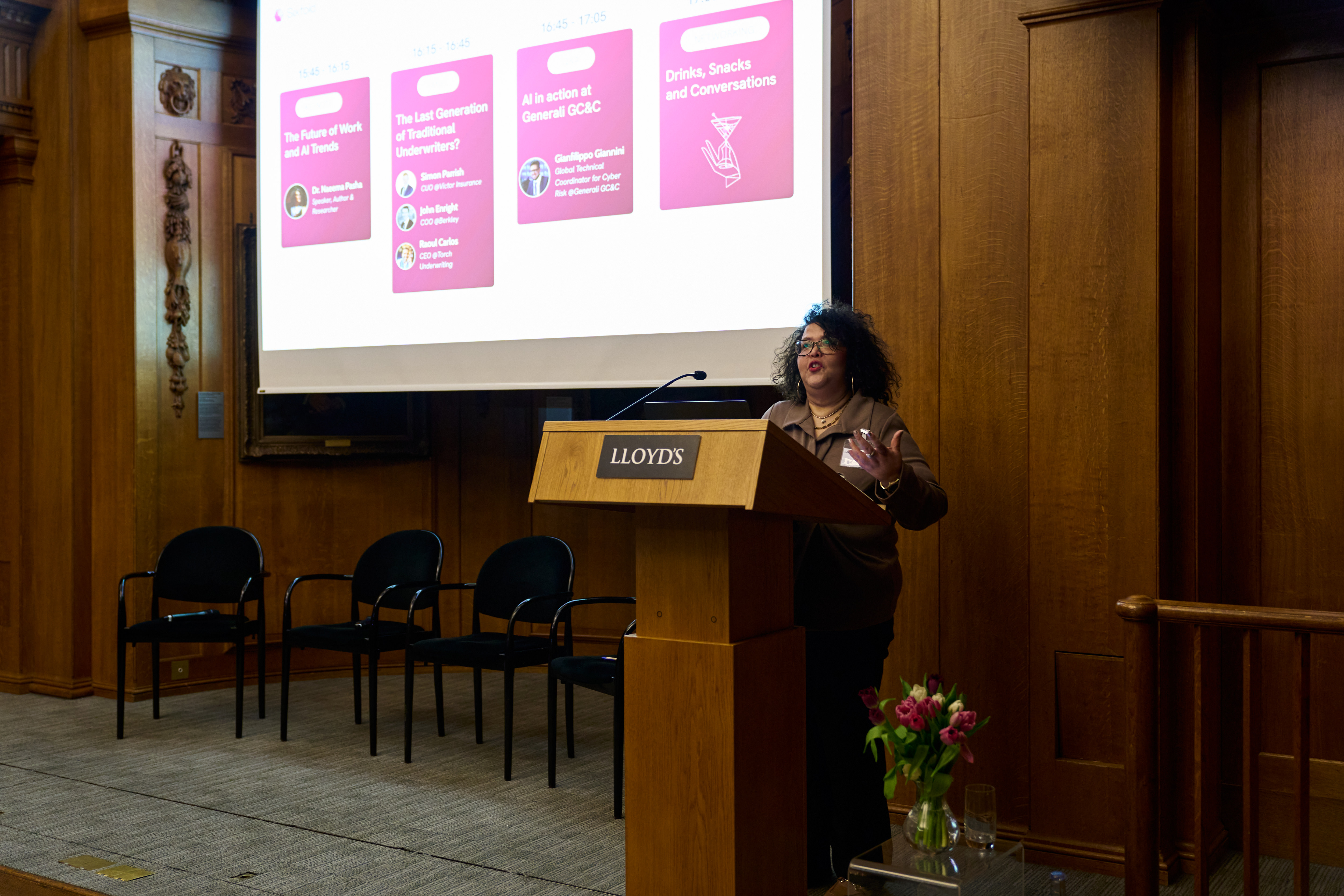
At Lloyd’s: The Future of Underwriting
Sixfold hosted an event at Lloyd’s in London focused on the next generation of underwriters, featuring speakers and insights from Berkley, Victor Insurance, Generali GC&C, and Torch Underwriting.
Yesterday, Sixfold hosted an event at Lloyd’s in London on the future of underwriting work.
The event started with a keynote from Dr. Naeema Pasha on the future of work across industries, along with findings from her research with Allianz. One of the key takeaways was that the future of insurance still needs to be focused on people. With AI becoming more present, the question is how to build trust, support empathy and skills development, and design roles for the next generation of talent.
“What stood out in my research with Allianz was how much people in the insurance industry care and are passionate about the industry and its future.“
─ Dr. Naeema Pasha, Researcher, Author and Writer
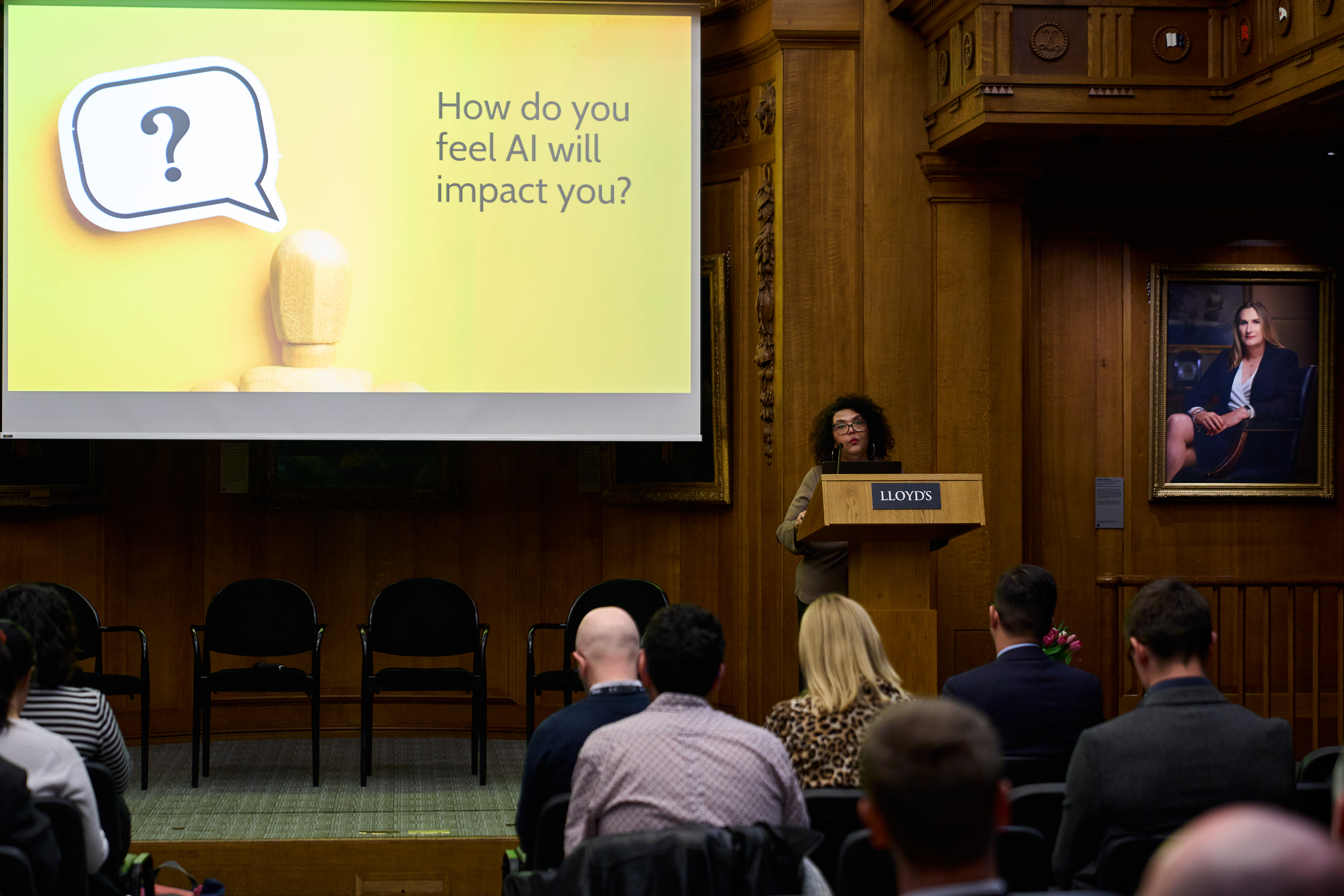
There was also a great question from an aspiring underwriter asking what skills are needed today. Soft skills came up a lot, things like curiosity and adaptability, but also something simple: get out there, engage with people in the industry, and ask questions.
At one point, the audience was asked if they would let a robot cut their hair. Most people wouldn’t. It’s a simple example, but it comes back to trust.
The panel discussion featured Simon Parris, CUO at Victor Insurance; John Enright, COO at Berkley; and Raoul Carlos, Founder & CEO at Torch Underwriting, and focused on whether this is the last generation of traditional underwriters.
They started by sharing where they are today when it comes to AI implementation. A clear theme was that adoption and engagement from underwriters really matters. Agentic AI is moving fast with a lot of potential, and there was a lot of discussion around how AI can improve broker relationships and risk assessments as a whole. Raoul talked about building AI into their foundation from day one, including the data layer needed to support institutional intelligence over time.
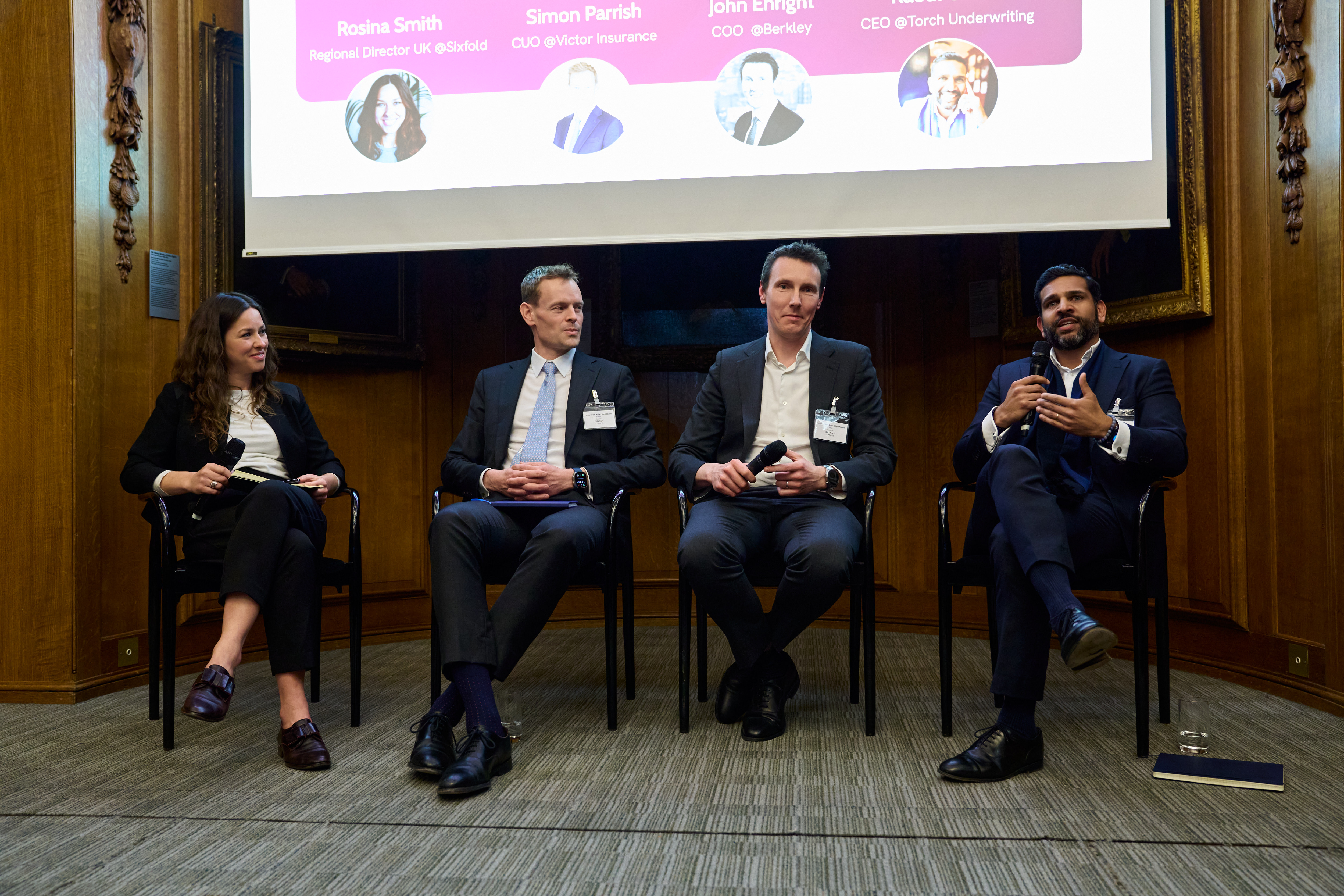
When it came to impact of AI, the conversation went beyond speed. Things like memorable engagement with brokers, pricing power through stronger relationships, more personal service, net promoter score, and the ability to think outside the box all came up. Better service and better products as well.
On hiring the future workforce, Raoul mentioned looking for curiosity and passion. Where the role used to be heavily focused on data wrangling, today it is much more about judgment, adaptability, creativity, and critical thinking. John highlighted integrity, trust, relationship skills, and the ability to work with a new toolkit. Simon mentioned market connections, strong underwriting fundamentals, and openness to new technology.
“The mechanics of how we work are changing, but this has happened hundreds of times throughout history.”
─ Raoul Carlos, Founder & CEO @Torch Underwriting
When asked what the underwriting role of the future might be called, the panel largely agreed it is still underwriting. Portfolio underwriting was mentioned, as well as next generation underwriter, but the core remains the same. From the audience, there were also questions around how to enter the industry. It is not just about academics. Apprenticeships matter. Continuous learning matters. And building teams with different perspectives and backgrounds still really matters.
On dealing with skepticism internally around AI, it was acknowledged that change can be uncomfortable. The advice was to make it part of the conversation, share examples, and host workshops. For insurance executives looking to learn more about AI, the message was to experiment and try it firsthand. Get into vibe coding, step outside of the comfort zone, and understand the opportunities by actually using the tools.
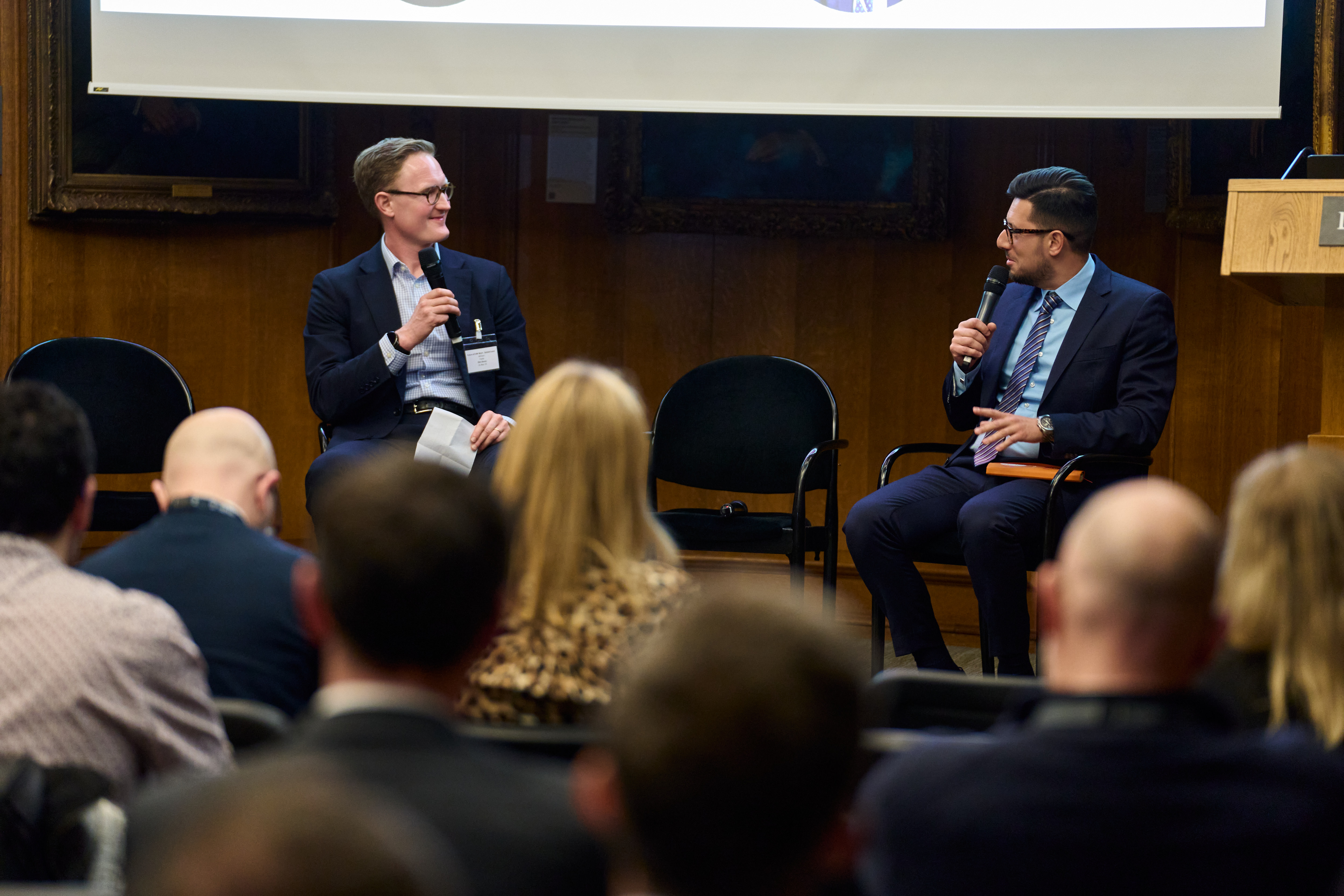
Lastly, Gianfilippo Giannini, Global Technical Coordinator Cyber Risk at Generali GC&C, took the stage for a Q&A and shared why they started looking for an AI vendor in the first place. They were operating in a soft market and needed to handle more submissions with the same headcount.
He also highlighted the importance of bringing underwriters in from the very beginning. The decision to choose Sixfold came down to security, privacy, a strong responsible AI framework, and a future proof roadmap, but also that the solution was clearly built for underwriting.
“Sixfold spoke the same language as us.”
─ Gianfilippo Giannini, Global Technical Coordinator Cyber Risk @Generali GC&C
There was some early skepticism from users, but once underwriters saw how it supported their day to day work, feedback quickly became very positive. At one point, underwriters who were not part of the pilot started asking when they could start using Sixfold as well.
Looking ahead, the focus for Generali GC&C when it comes to AI in underwriting is on data driven underwriting, with better visibility into portfolio trends and broker success rates.
Scaling AI in Underwriting: Lessons from Skyward & Zurich
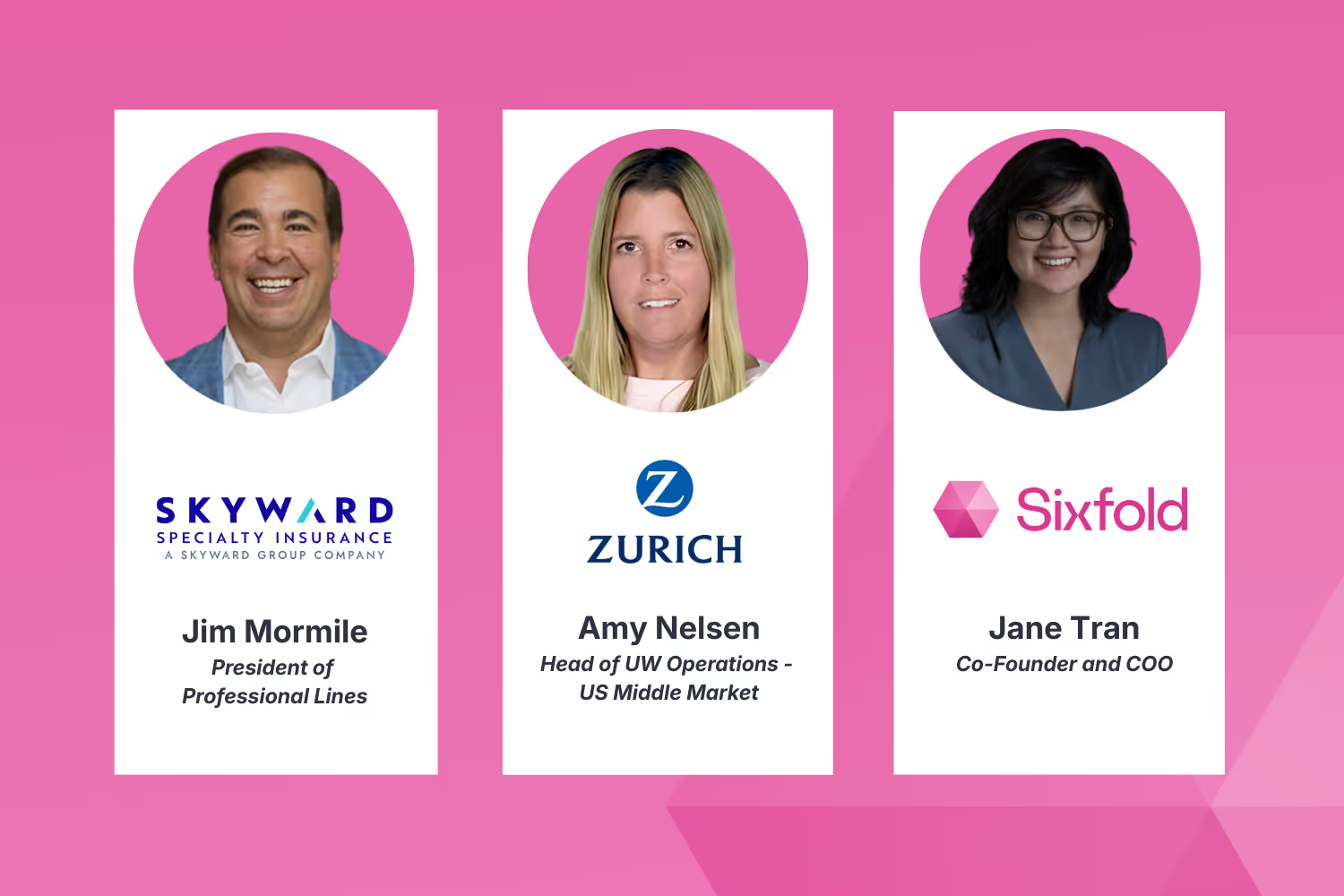
Most insurers have run an AI pilot. Far fewer have successfully scaled it. At a Sixfold webinar, Amy Nelsen at Zurich North America and Jim Mormile at Skyward Specialty shared what that journey actually looks like.
Most insurers have run an AI pilot. Far fewer have scaled one. At a recent Sixfold webinar, two carriers shared what it actually took to get there, and what production at scale really looks like.
Amy Nelsen, Head of UW Operations for US Middle Market at Zurich North America, and Jim Mormile, President of Professional Lines at Skyward Specialty, spoke about their experience rolling out Sixfold across their organizations.
Skyward is now live across more than 10 product lines with nearly 100 underwriters. Zurich has deployed across 30 US offices, with more than 200 underwriters using Sixfold in their daily workflow.
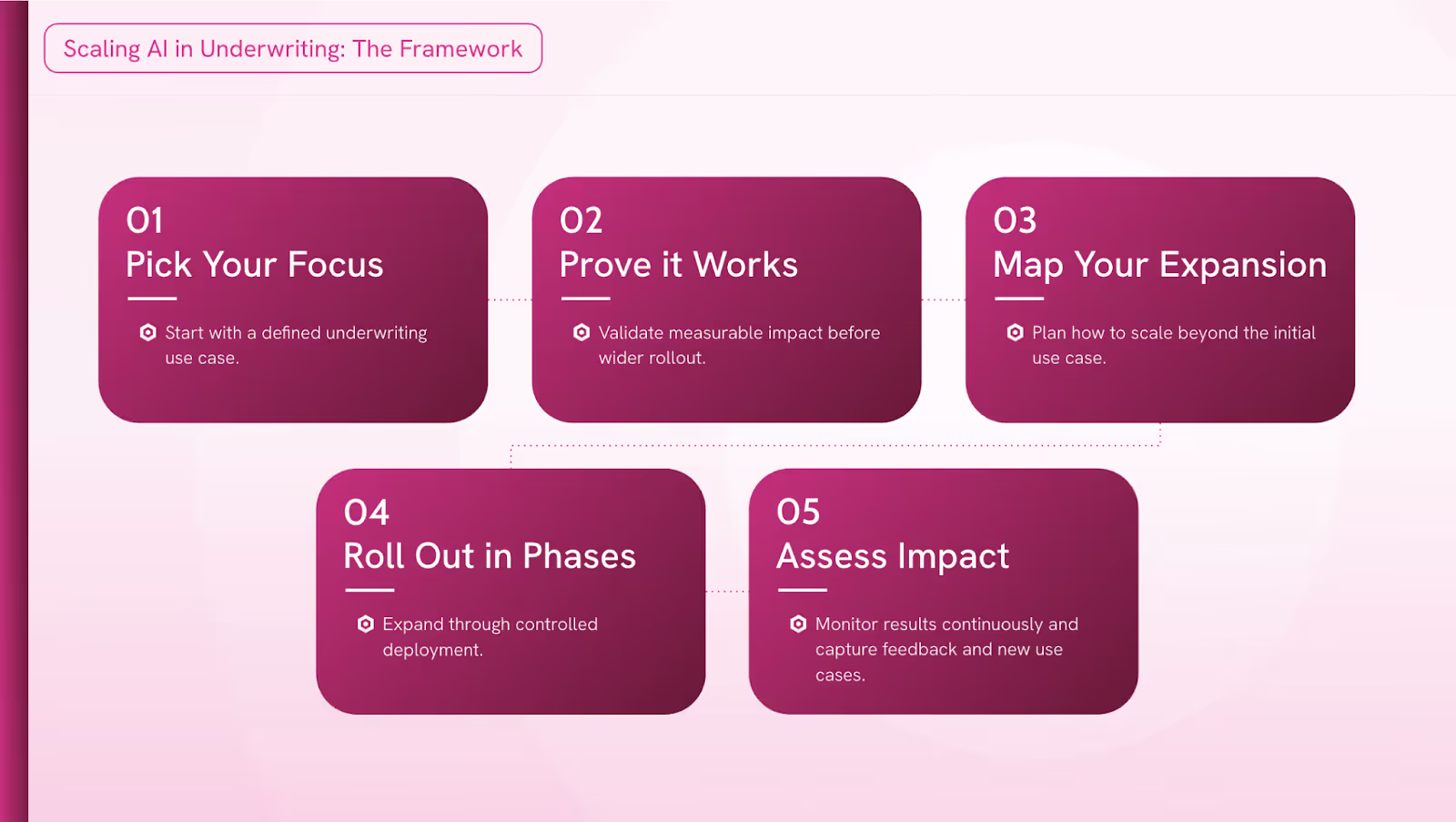
We walked through our five-step scaling framework with both of them to hear, in their own words, how each stage played out in practice.
Step 1: Pick Your Focus
The biggest mistake teams make is starting with AI and working backwards to find a problem. Both Amy and Jim were deliberate about doing the opposite, finding a genuine pain point first and then asking whether AI could solve it.
For Skyward, the problem was the triage wall. Underwriters were spending hours manually working through submissions just to determine basic appetite fit.
For Zurich it was starting with a use case which underwriters didn’t like doing: documentation.
"We had a healthcare risk where the underwriter got about a 75-page submission. It wasn't until page 56 to 59 that they realized the submission should not be covered since it was out of appetite."
─Jim Mormile @Skyward Specialty
Step 2: Prove It Works
Before scaling, you need a few signals that it's actually working, but that doesn't always come from a dashboard. Both Jim and Amy found that meaningful early indicators were user feedback.
For Jim, it was a veteran underwriter pulling him aside unprompted.
"The anecdotal evidence that really made us realize it was working: it was a veteran underwriter that came up to me and said, '[Sixfold] actually changed my day. It sped up my work progress and workflow'"
─Jim Mormile @Skyward Specialty
The follow-up signal was equally telling “underwriters stopped asking whether they should use Sixfold and started asking when it was coming to their line of business.” That's when Skyward knew it was time to expand.
Step 3: Map Your Expansion
Scaling AI isn't a single rollout but it's a series of decisions about sequencing, readiness, and change management. Both organizations took a structured approach, but in different ways.
Skyward scored each of their 16 lines of business across criteria like guideline robustness, process standardization, underwriting complexity, and, critically, how tech-forward the underwriting team was. They then hand-picked early adopters rather than opening the floodgates.
Zurich took a geographic approach, piloting across four offices before expanding countrywide, and intentionally included underwriters at different levels of tech comfort so they could anticipate resistance before it became a problem at scale.
Both teams also addressed job security fears head-on.
"It's less about the underwriting role becoming irrelevant, and more about if you handle a $10M book of business versus a $20M book of business."
─Amy Nelsen @Zurich North America
Jim's approach was to be explicit about what AI wouldn't do: no automated decision-making, no replacing the underwriter's final judgment. The framing was always about giving underwriters better information, not replacing their expertise.
Step 4: Roll Out in Phases
Both teams learned that trying to do too much too fast creates fatigue, and fatigue kills adoption. Skyward actually hit pause on one line of business after underwriters started showing signs of frustration. Rather than pushing through, leadership made the call to step back.
A few months later, that team came back ready to re-engage, pulled in by the FOMO of watching other lines of business benefit.
On the flip side, Skyward's phased approach led to real efficiency gains in deployment speed. Their first two lines of business took 12 to 14 weeks from introduction to production. By the time they were rolling out subsequent lines, they'd cut that down to eight weeks.
Amy's experience at Zurich echoed the same takeaway on speed:
"The most amazing part is how fast you can get from just a concept to deployment with Sixfold."
─Amy Nelsen @Zurich North America
Step 5: Assess Impact
Once AI is live in production, measuring success means looking at two things in parallel: business outcomes and output quality. Neither alone tells the full story.
For Jim at Skyward, that meant tracking time to quote and number of quotes out the door, but also running a monthly accuracy review and a sentiment score across underwriting teams.
"We constantly look at both ends of the spectrum: the ROI metrics, and whether the accuracy is there to give our underwriters the information they need to make better decisions."
─Jim Mormile @Skyward Specialty
Amy's approach at Zurich was similar, and revealing in its simplicity. Sixfold's success isn't measured separately from the business; it's measured through the business. When AI becomes embedded enough that you stop evaluating it as a standalone tool and start measuring it through your core business metrics, that's when you know it's really working.
"We're measuring our business outcomes like how many quotes underwriters are getting out the door and how much business have they bound. We also meet with Sixfold every month to look at quality metrics."
─Amy Nelsen @Zurich North America
The Final Wisdom
Scaling AI in underwriting isn't primarily a technology challenge, it's a people and process challenge. Both Amy and Jim closed with the same underlying message: be prepared for that thing change quickly in the world of AI, don't be afraid to fail, and don't stay stuck in proof-of-concept mode forever.
The insurers that will succed at scaling AI are the ones that move deliberately, learn fast, and bring their underwriters along for the ride from day one.
Watch the video recording of the entire webinar here.
.avif)
AXIS Adopts Sixfold’s Purpose-Built AI Solution
Sixfold, the AI solution designed to streamline end-to-end risk assessments for underwriters, announced its partnership with AXIS, a global leader in specialty insurance and reinsurance, a collaboration that has yielded positive results in its initial roll out.
October 18, 2024 - Sixfold, the AI solution designed to streamline end-to-end risk assessments for underwriters, announced its partnership with AXIS, a global leader in specialty insurance and reinsurance, a collaboration that has yielded positive results in its initial rollout. Within the first month of deployment, AXIS underwriters leveraged Sixfold’s solution to improve efficiency, accurately classifying businesses and aligning cases with their risk appetite.
“This partnership is all about leveraging AI to empower our underwriters and even further enhance the service we provide to our customers. We were searching for a solution that could reliably deliver precision, and Sixfold has done just that and more.
The real game-changer has been the time savings—freeing up valuable hours so our underwriters can zero in on the work that drives results while ultimately benefiting the customer” said Josh Fishkind, Head of Innovation at AXIS.
“Our goal is to provide meaningful ROI for all our customers, and AXIS has already begun to see these benefits,” said Alex Schmelkin, Sixfold's Founder & CEO. “We look forward to continuing our partnership as AXIS discovers more ways Sixfold can enhance their underwriting processes.”
Read the full customer story here and check out the Insurance Post article covering our work with AXIS.
FEATURED REPORTS
Guides and Reports
A closer look at AI, adoption, and the future of underwriting.