A Guide to Life & Health Underwriting Technology in 2026
.png)
If you're a Chief Underwriting Officer, Innovation Lead, Head of IT, or have a similar role in the Life & Health underwriting space, you've probably come across all types of AI and tech solutions that claim to streamline life and health underwriting workflows. It can be overwhelming to understand the differences, what each solution actually does, how they help underwriters review cases more effectively, and whether they actually reduce mortality slippage and improve placement rates.
Most of them reduce the manual work involved in reviewing lengthy medical records and assessing cases, but they do it in different ways, addressing different parts of the underwriting process. For example, a solution built to increase straight-through processing rates of standard cases won't solve the same problem as one built to help underwriters assess table-rated cases faster.
Knowing which problem you're actually trying to solve is what determines which solution is right. Is it automating decision-making for standard risks? Is it getting a structured summary of all medical records? Or is it having risk insights and recommendations aligned to your underwriting guidelines?
This guide breaks down the main categories to help you understand what the best fit for you is.
When the Manual Approach Stops Scaling
Most Life & Health underwriting teams are facing some version of the same two core challenges. That’s what’s often driving the push toward new technology, even if those challenges might show up differently depending on team size or the mix of cases they underwrite.
- Capacity: There's a consistently high volume of applications that gets more intense during busy seasons, and not enough underwriters to handle them as quickly as needed. The capacity issues get compounded by an aging workforce, which means difficulties in hiring experienced underwriters. Straightforward cases sit in the same queue as complex ones, and turnaround times slow down. Failing to keep up can impact placement rates, giving other insurers the chance to get there first.
- Quality: The cases that actually reach underwriters take too long to assess, or two underwriters on the same case can reach different conclusions. Sometimes both. Slow decisions affect your bottom line. Inconsistent ones lead to mortality slippage and erode the value of your guidelines over time.
These are related problems, but they need different solutions: a tool that reduces the number of cases reaching your team does very little for the quality of decisions on the ones that do. A tool that helps underwriters read faster often doesn't make their decisions more consistent.
The Solutions Landscape
Here are the five main types of underwriting technology insurers use today to solve these problems.
Accelerated Underwriting Systems
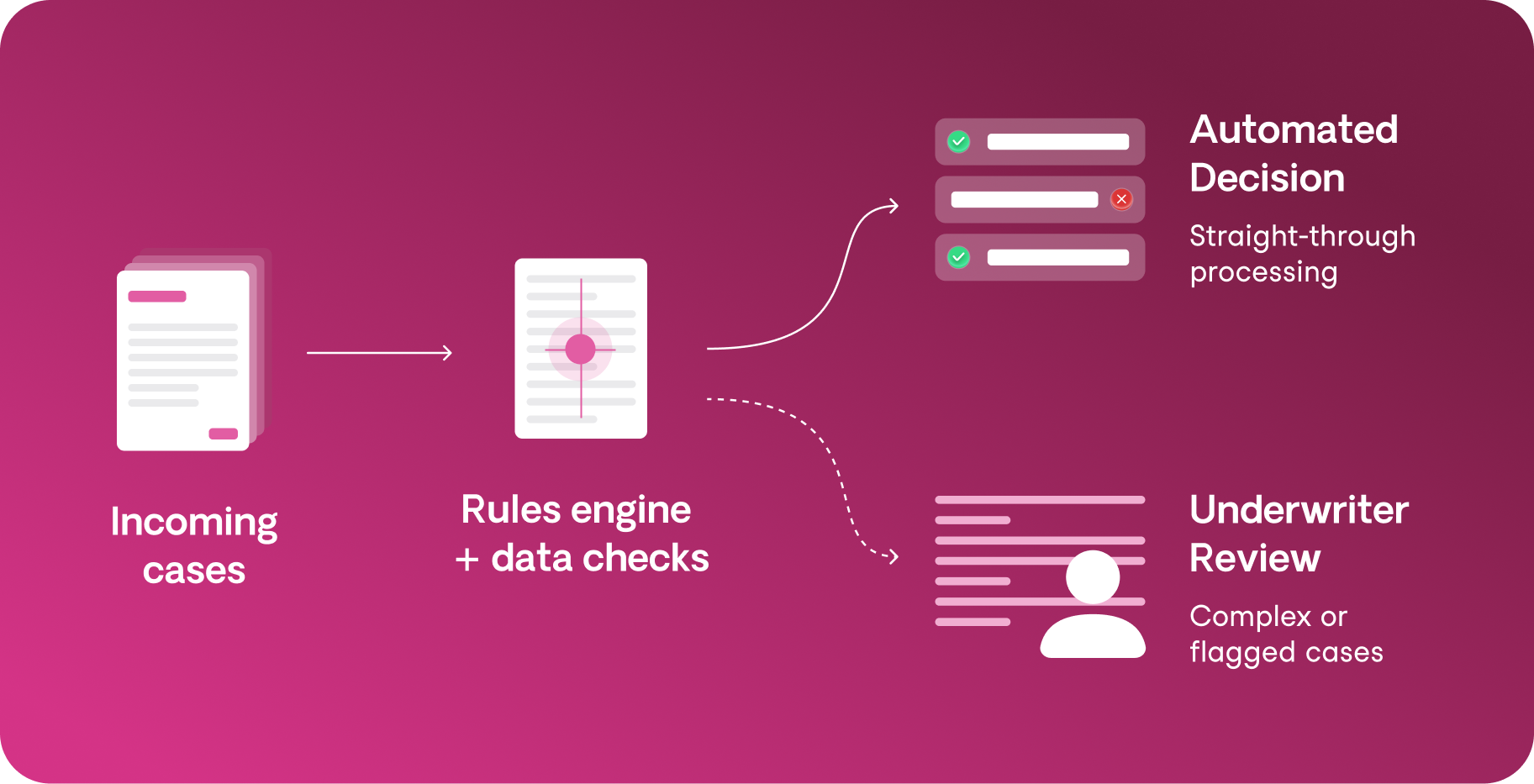
Description: Accelerated Underwriting (AU) systems are designed to maximize automated decision rates, allowing eligible applicants to get approved without requiring traditional medical exams and lab tests. Both large reinsurers and third-party technology vendors offer AU solutions that carriers can adopt and configure to their needs.
These systems handle straightforward cases quickly and consistently, and most insurers today already use this type of technology. But there are still many cases that are too complex for these solutions, whether it's because of a higher-risk diagnosis, the coverage amount needed, a medication flag, or missing information, and that require an underwriter's review. That's where AU reaches its limits.
With these systems, underwriters still have to assess complex cases manually, reviewing hundreds of pages of APS, EHRs, and lab results to understand the patient's clinical history.
Type of technology: Rules-based engine, often combined with predictive models and machine learning.
Best for: Insurers looking to increase the volume of applications that get decided automatically at point of sale, without manual underwriter involvement. Helps increase Straight Through Process rates, reduce turnaround time, and free up underwriters from reviewing less complex cases.
Watch out for: AU systems don't solve the complex case problem. The cases that get referred out still need to be reviewed by a human underwriter, and that process remains largely manual without additional tooling. With 41% of cases going straight to traditional underwriting and 88% of cases requiring some level of human review, that's a significant share that AU simply can't handle.¹
Reinsurer-Built Underwriting AI Assistants
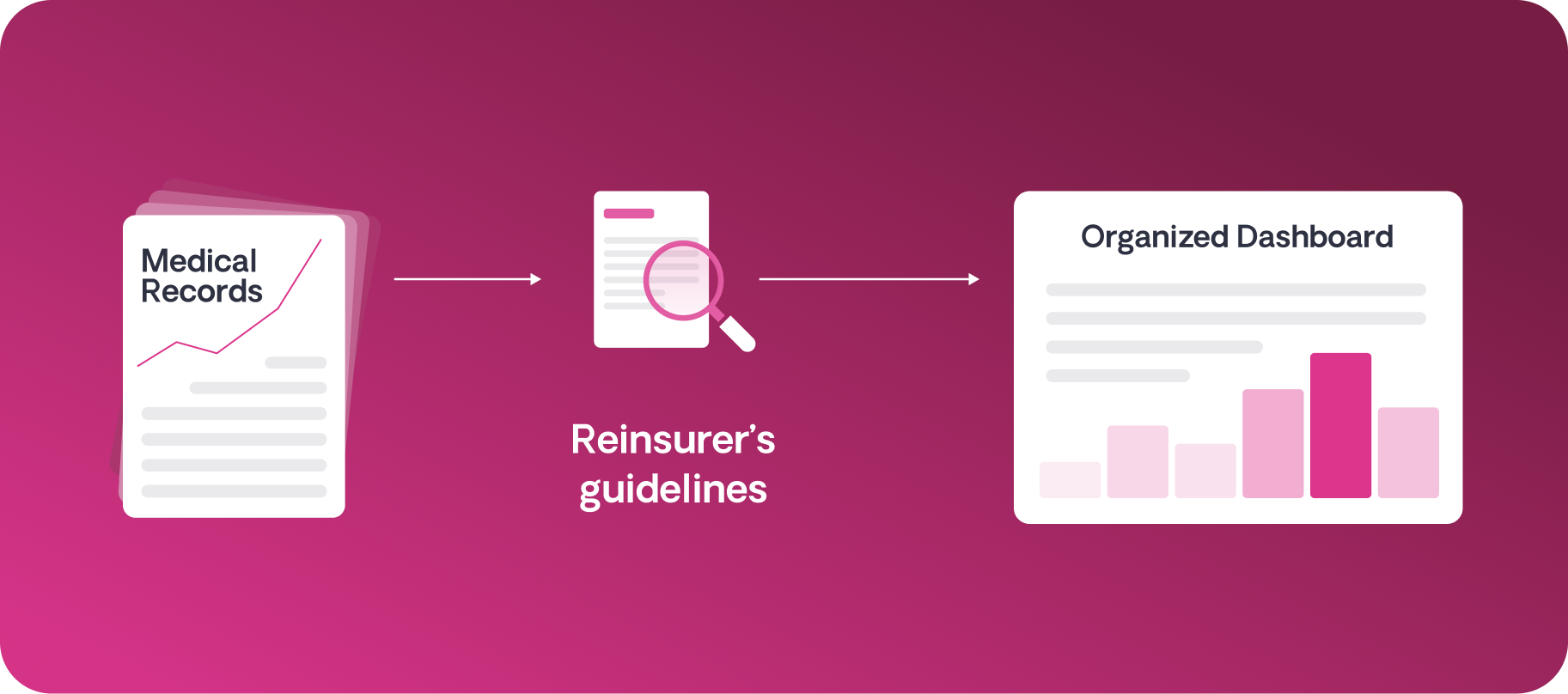
These tools are helpful if you're looking for an out-of-the-box summarization solution. The main thing to keep in mind is that they're typically anchored to the reinsurer's own guidelines, so customization options vary. They also often come bundled with the reinsurer's broader platform and services, so adopting one can mean a deeper commitment than just the tool itself.
With these systems, underwriters often still have to assess non-medical risks separately, manually leverage risk calculators, and return to the original APS or EHRs to fill in gaps.
Type of technology: OCR, NLP, and LLMsS for document ingestion and summarization, with some tools also incorporating structured decision logic for risk guidance.
Best for: Insurers who want a ready-to-use tool to help underwriters navigate referred cases faster, with medical information organized and presented in a structured, easy-to-read dashboard
Watch out for: These tools are typically built around the reinsurer's own guidelines, so customization options may vary. Adopting them often means signing up for the reinsurer's broader platform and services, which creates a level of vendor lock-in worth factoring in before making a decision.
Medical Record Summarization Tools
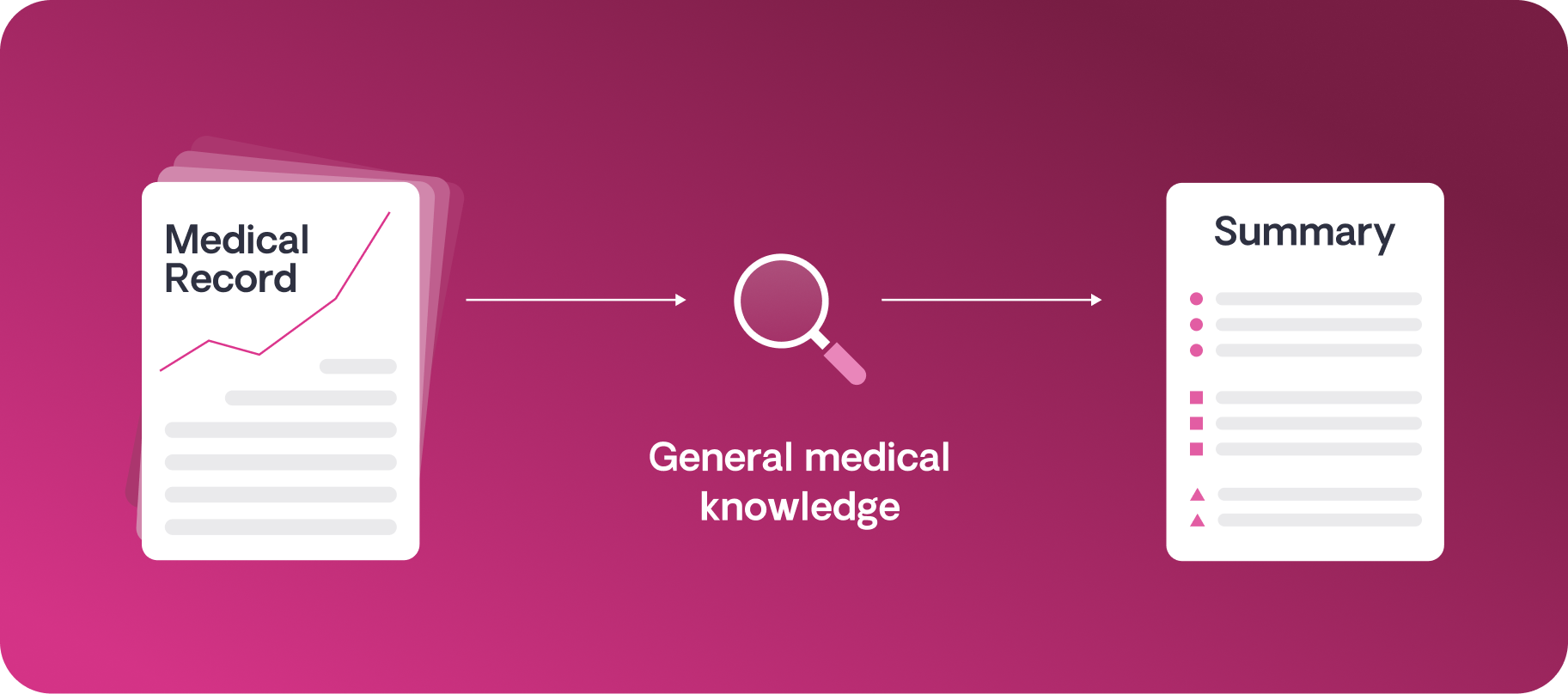
Beyond reinsurer-built tools, there are vendors focused specifically on medical record review. Not built exclusively for underwriting, these solutions are also used in claims, clinical, and legal workflows. They use AI to summarize and organize information from medical records, giving underwriters a more user-friendly view of an applicant's health history in one place.
Although they're good at giving an overall medical summary, all the information is surfaced regardless of relevance, which can still result in information overload. Underwriters still have to sift through often lengthy summaries to find what actually matters for their decision. These tools also aren't configured to a carrier's specific underwriting guidelines or appetite, so the insights they surface reflect a general medical view rather than what matters most to your team.
Type of technology: ML, NLP, LLMs, and AI agents, backed by a proprietary Medical Knowledge Base
Best for: Insurers looking for a standalone tool to help underwriters process medical records faster, without needing it to align with their specific underwriting guidelines
Watch out for: The information is comprehensive but not prioritized against your guidelines, and summaries can still be lengthy, so underwriters still have to figure out what's actually relevant to each case.
LLMs
.png)
Tools like ChatGPT or Claude are flexible, easy to use, and can analyze a wide range of documentation, including medical records. They're great for quick searches, general summarization, and easy enough to get started with so that an underwriter could set up a basic underwriting skill themselves.
The challenge is that they weren't built specifically for underwriting. Tailoring them for Life & Health underwriting requires significant time, money, and effort, and they may still not meet the explainability and auditability requirements that regulators increasingly expect.
Type of technology: LLMs
Best for: Quick searches, general summarization, or early-stage experimentation before committing to a purpose-built solution
Watch out for: Because they're not built for underwriting, outputs won't be as consistent or accurate as a purpose-built solution. Without significant customization, these tools won't align with your underwriting guidelines and won't be specifically designed to meet the regulatory and data protection standards required for use in production, increasing the risk of compliance issues.
Underwriting AI (Sixfold fits in here)
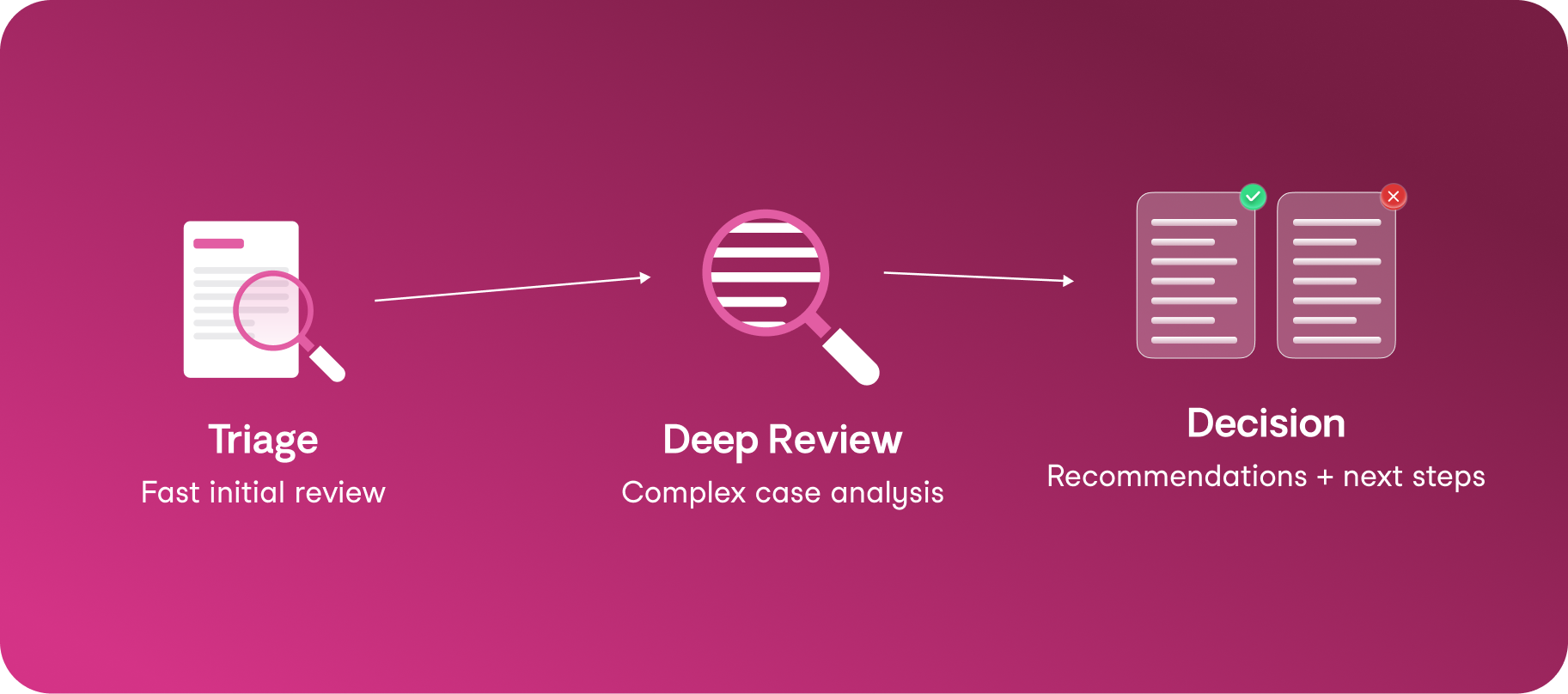
Sixfold generates risk insights and recommendations to support your team's decision-making, working directly within the systems you already use. It's designed to handle the full underwriting analysis of cases that reach your underwriters, from triage to deep review, including the most complex cases.
Rather than just summarizing information, Sixfold reasons across all relevant documents and surfaces the details your underwriters need, aligned to your specific guidelines. It works like a colleague that knows your book: tracking decisions over time, applying what it learns, and recommending best next steps. Keeping underwriters in control to agree or disagree with any assessment.
It can process any type of document, including messy, unstructured data, so there's no need for separate tools to extract and organize data first.
Type of technology: LLMs, AI agents, guideline-aligned risk engine
Best for: Insurers looking for underwriting AI that goes beyond summarization: improving speed without compromising underwriting quality. Aligns with your specific guidelines across the full underwriting workflow, with proven results (e.g. 50% efficiency gains for Guardian) and built to be compliant and fair for insurance underwriting from day one.
Watch out for: It's built for insurers who want AI that actually reasons and understands risk, not just summarizes information.
Side-by-Side Comparison
Below is a simple table showcasing the differences.
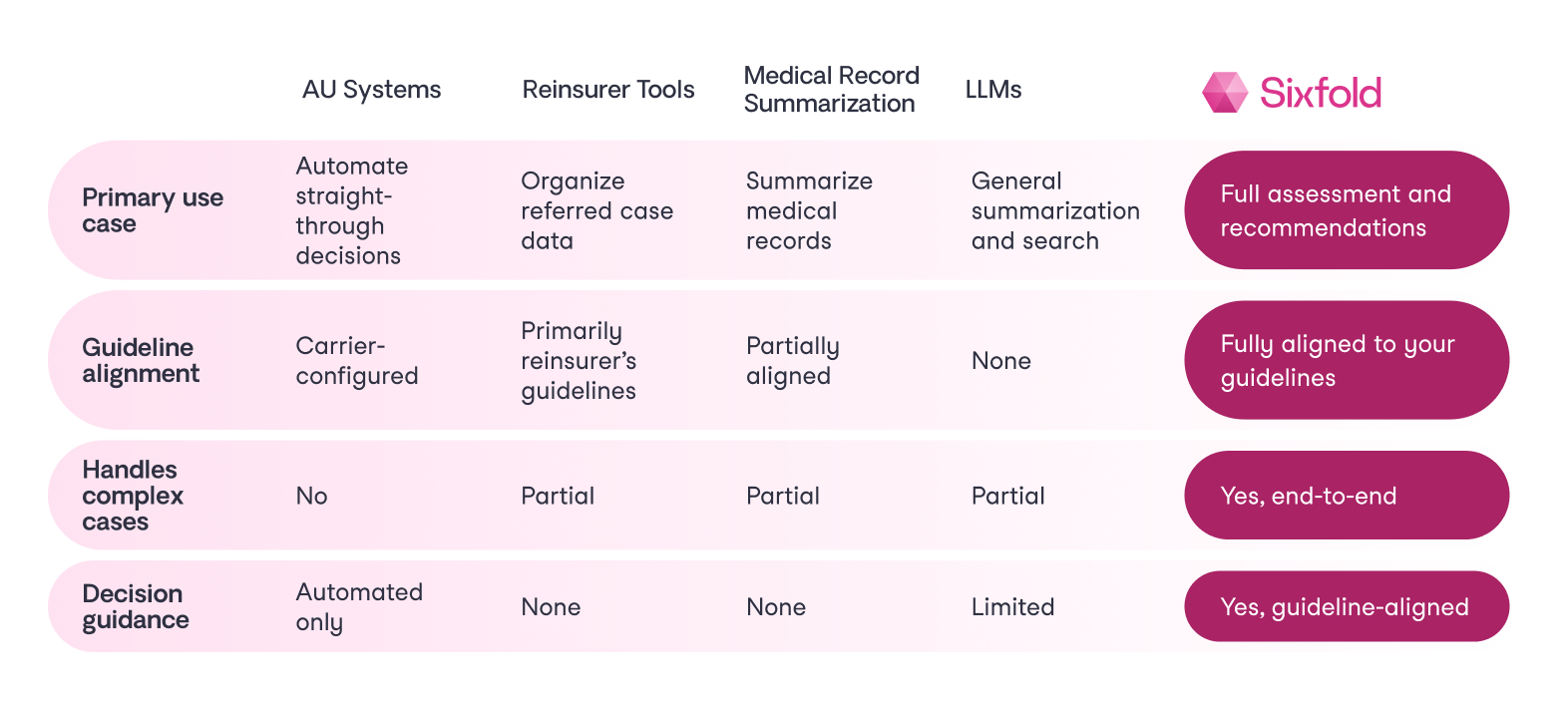
We hope this guide helped you better understand the different solutions in the market.
If Sixfold sounds like it could be the right fit for your team, reach out for a demo to see what it looks like in practice.
Learn more about Sixfold’s Life & Health product here.
━━━
FAQ
What is the difference between accelerated underwriting and automated underwriting in life insurance?
Accelerated underwriting (AU) is a Life & Health underwriting approach that allows eligible applicants to get approved faster, without requiring traditional medical exams and lab tests. It does this by using external data sources like electronic health records, prescription history, and MIB records to assess risk. Automated underwriting is a broader term referring to any rules-based system that makes decisions without manual underwriter involvement. In Life & Health, AU is the more precise term. According to Gen Re's 2025 survey, around 59% of individual life applications qualify for an accelerated underwriting path.
How long does it take to get value from an AI underwriting solution in L&H?
Purpose-built AI underwriting solutions are designed to deliver value faster than traditional technology implementations. Unlike legacy core system replacements that can take months or years, they integrate with existing systems and workflows, meaning carriers can reach production without lengthy implementation projects. The key variables are guideline configuration, data readiness, and how much the solution needs to be customized to the carrier's specific appetite and workflows.
What percentage of life and health cases still require human review despite automation?
According to Gen Re's 2025 U.S. Individual Life Next Gen Underwriting Survey of 30 carriers, 41% of applications were processed through a traditional underwriting path, 47% were eligible for accelerated underwriting, and only 12% qualified for fully automated decisioning. This means the vast majority of case volume still lands on underwriters' desks, making the quality of the manual review process as important as the automation layer above it.
What is mortality slippage in life insurance underwriting?
Mortality slippage is the financial loss that occurs when underwriters approve risks at better rate classes than their actual mortality profile warrants. It typically results from inconsistent decision-making across underwriters reviewing similar cases. According to Gen Re's 2025 Next Gen Analytics study, overall AU slippage improved to 12.3% in 2025 after several years of upward pressure. Over half of carriers estimate their mortality slippage at between 6% and 15%.
How do AI underwriting tools handle data protection in Life & Health?
Data protection standards vary significantly across solution types. General-purpose LLMs were not built with insurance-specific security or regulatory requirements in mind, making them unsuitable for production use without significant customization. Purpose-built underwriting AI solutions are designed to meet the data governance, auditability, and compliance standards that Life & Health regulators expect, including requirements under the EU AI Act and the NAIC Model Bulletin on AI Systems, which continues to be adopted by U.S. states.
What is vendor lock-in risk when adopting a reinsurer-built underwriting tool?
Vendor lock-in occurs when adopting a reinsurer's AI tool requires signing up for their broader platform and services, making it difficult to switch providers later without disrupting workflows. Reinsurer-built tools are anchored to the reinsurer's own guidelines and ecosystem, meaning the carrier's underwriting process becomes tied to that reinsurer relationship beyond just the tool itself.
How do placement rates connect to underwriting cycle times in life insurance?
Faster underwriting decisions directly improve placement rates. According to Gen Re's 2025 survey, 78% of applications approved through an accelerated workflow were ultimately placed, compared to 63% for fully underwritten cases. When cycle times slow, applicants may lapse, withdraw, or accept a competing offer from a carrier that moved faster, particularly healthy applicants who qualify for multiple carriers' accelerated underwriting programs simultaneously.
¹ Gen Re, 2025 U.S. Individual Life Next Gen Underwriting Survey