Sixfold Content
Life & Health
AI in Underwriting: Lessons from Leaders on What's Working
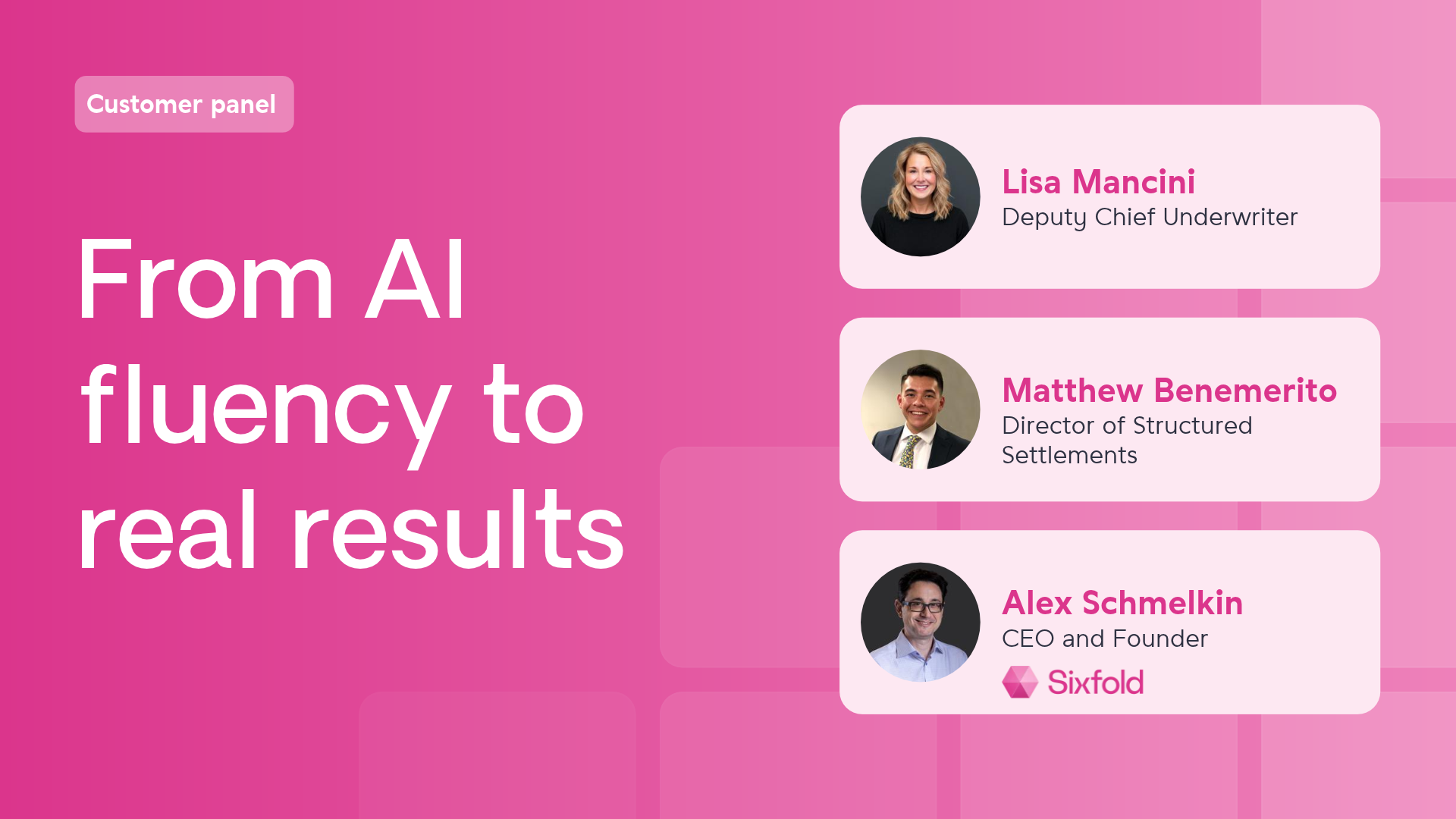
Leaders from New York Life's structured settlements team and PartnerRe share how they moved from AI fluency to real results, and what it took to get underwriters on board.



Explore all Resources
Stay informed, gain insights, and elevate your understanding of AI's role in the insurance industry with our comprehensive collection of articles, guides, and more.
Scaling AI in Underwriting: Lessons from Skyward & Zurich
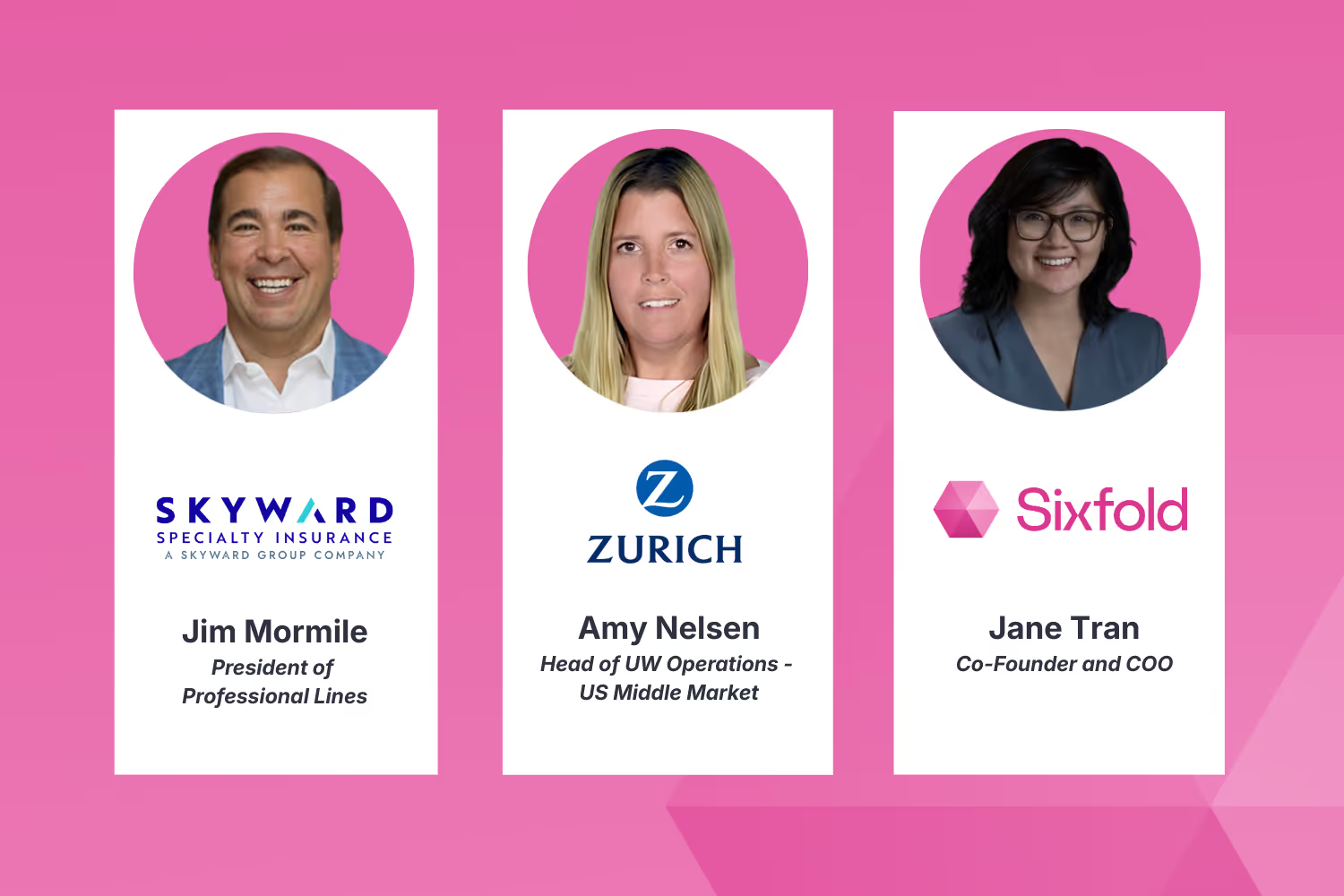
Most insurers have run an AI pilot. Far fewer have successfully scaled it. At a Sixfold webinar, Amy Nelsen at Zurich North America and Jim Mormile at Skyward Specialty shared what that journey actually looks like.
Most insurers have run an AI pilot. Far fewer have scaled one. At a recent Sixfold webinar, two carriers shared what it actually took to get there, and what production at scale really looks like.
Amy Nelsen, Head of UW Operations for US Middle Market at Zurich North America, and Jim Mormile, President of Professional Lines at Skyward Specialty, spoke about their experience rolling out Sixfold across their organizations.
Skyward is now live across more than 10 product lines with nearly 100 underwriters. Zurich has deployed across 30 US offices, with more than 200 underwriters using Sixfold in their daily workflow.
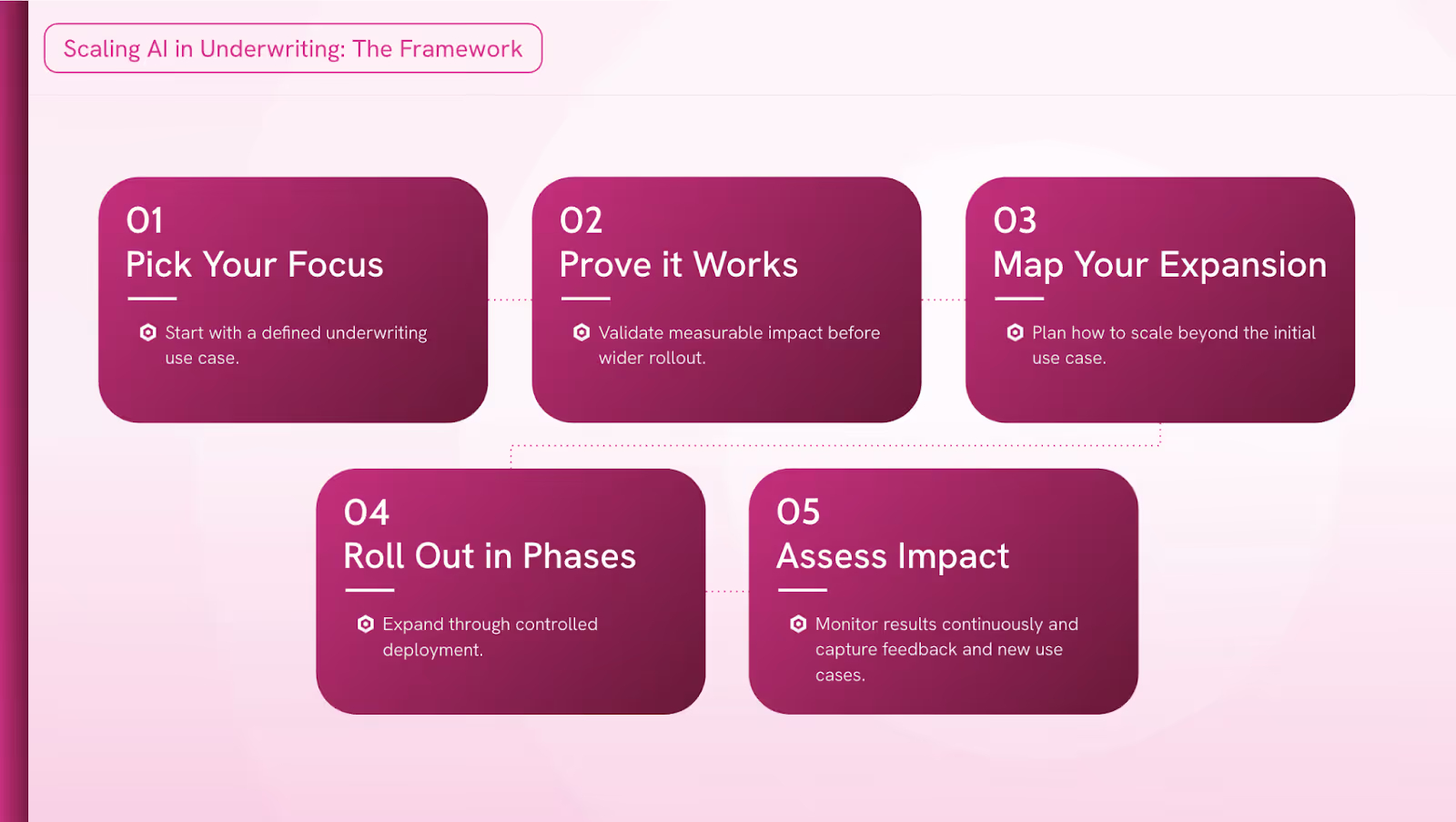
We walked through our five-step scaling framework with both of them to hear, in their own words, how each stage played out in practice.
Step 1: Pick Your Focus
The biggest mistake teams make is starting with AI and working backwards to find a problem. Both Amy and Jim were deliberate about doing the opposite, finding a genuine pain point first and then asking whether AI could solve it.
For Skyward, the problem was the triage wall. Underwriters were spending hours manually working through submissions just to determine basic appetite fit.
For Zurich it was starting with a use case which underwriters didn’t like doing: documentation.
"We had a healthcare risk where the underwriter got about a 75-page submission. It wasn't until page 56 to 59 that they realized the submission should not be covered since it was out of appetite."
─Jim Mormile @Skyward Specialty
Step 2: Prove It Works
Before scaling, you need a few signals that it's actually working, but that doesn't always come from a dashboard. Both Jim and Amy found that meaningful early indicators were user feedback.
For Jim, it was a veteran underwriter pulling him aside unprompted.
"The anecdotal evidence that really made us realize it was working: it was a veteran underwriter that came up to me and said, '[Sixfold] actually changed my day. It sped up my work progress and workflow'"
─Jim Mormile @Skyward Specialty
The follow-up signal was equally telling “underwriters stopped asking whether they should use Sixfold and started asking when it was coming to their line of business.” That's when Skyward knew it was time to expand.
Step 3: Map Your Expansion
Scaling AI isn't a single rollout but it's a series of decisions about sequencing, readiness, and change management. Both organizations took a structured approach, but in different ways.
Skyward scored each of their 16 lines of business across criteria like guideline robustness, process standardization, underwriting complexity, and, critically, how tech-forward the underwriting team was. They then hand-picked early adopters rather than opening the floodgates.
Zurich took a geographic approach, piloting across four offices before expanding countrywide, and intentionally included underwriters at different levels of tech comfort so they could anticipate resistance before it became a problem at scale.
Both teams also addressed job security fears head-on.
"It's less about the underwriting role becoming irrelevant, and more about if you handle a $10M book of business versus a $20M book of business."
─Amy Nelsen @Zurich North America
Jim's approach was to be explicit about what AI wouldn't do: no automated decision-making, no replacing the underwriter's final judgment. The framing was always about giving underwriters better information, not replacing their expertise.
Step 4: Roll Out in Phases
Both teams learned that trying to do too much too fast creates fatigue, and fatigue kills adoption. Skyward actually hit pause on one line of business after underwriters started showing signs of frustration. Rather than pushing through, leadership made the call to step back.
A few months later, that team came back ready to re-engage, pulled in by the FOMO of watching other lines of business benefit.
On the flip side, Skyward's phased approach led to real efficiency gains in deployment speed. Their first two lines of business took 12 to 14 weeks from introduction to production. By the time they were rolling out subsequent lines, they'd cut that down to eight weeks.
Amy's experience at Zurich echoed the same takeaway on speed:
"The most amazing part is how fast you can get from just a concept to deployment with Sixfold."
─Amy Nelsen @Zurich North America
Step 5: Assess Impact
Once AI is live in production, measuring success means looking at two things in parallel: business outcomes and output quality. Neither alone tells the full story.
For Jim at Skyward, that meant tracking time to quote and number of quotes out the door, but also running a monthly accuracy review and a sentiment score across underwriting teams.
"We constantly look at both ends of the spectrum: the ROI metrics, and whether the accuracy is there to give our underwriters the information they need to make better decisions."
─Jim Mormile @Skyward Specialty
Amy's approach at Zurich was similar, and revealing in its simplicity. Sixfold's success isn't measured separately from the business; it's measured through the business. When AI becomes embedded enough that you stop evaluating it as a standalone tool and start measuring it through your core business metrics, that's when you know it's really working.
"We're measuring our business outcomes like how many quotes underwriters are getting out the door and how much business have they bound. We also meet with Sixfold every month to look at quality metrics."
─Amy Nelsen @Zurich North America
The Final Wisdom
Scaling AI in underwriting isn't primarily a technology challenge, it's a people and process challenge. Both Amy and Jim closed with the same underlying message: be prepared for that thing change quickly in the world of AI, don't be afraid to fail, and don't stay stuck in proof-of-concept mode forever.
The insurers that will succed at scaling AI are the ones that move deliberately, learn fast, and bring their underwriters along for the ride from day one.
Watch the video recording of the entire webinar here.

Sixfold Raises $30M Series B
Sixfold has raised a $30M Series B to accelerate the next phase of growth in building the AI Underwriter. The round was led by Brewer Lane, with strategic investment from Guidewire and continued support from Bessemer Venture Partners and Salesforce Ventures.
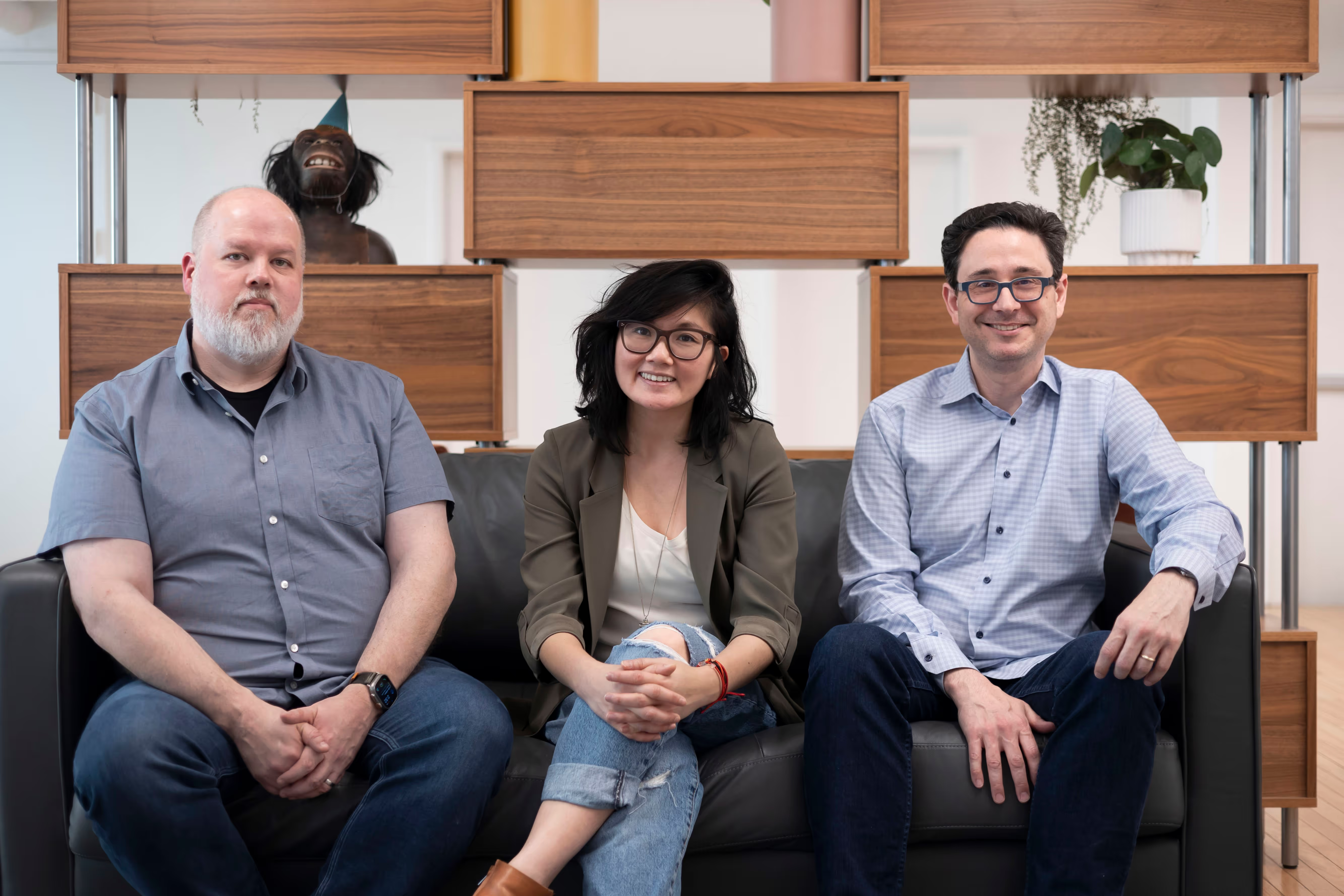
In 2023, Brian, Jane, and I set out to build AI for underwriting. Not as another helper tool, but as the foundation for how underwriting should actually work going forward.
At the time, a few people thought we were crazy. But we believed underwriting was ready. And we believed underwriters deserved better.
That idea has now become real.
Today, I’m excited to share that Sixfold just raised a $30M Series B, led by Brewer Lane, with strategic investment from Guidewire, and continued support from Bessemer Venture Partners and Salesforce Ventures.
From Idea → The AI Underwriting Brain
Fast forward, we’ve built what we originally set out to build:
An underwriting AI brain that global carriers rely on every day.
Sixfold is already trusted by insurers like Zurich North America, Skyward Specialty, Guardian, Generali GC&C, AXIS, and Mosaic.
We’ve processed over 1 million submissions, across 40+ lines of business, supporting insurers representing $265B in gross written premium.
Sixfold is live across North America, the UK, Europe, Latin America, and Australia, underwriting risks across Property & Casualty and Life & Health. Production underwriting at global scale.
AI underwriting isn’t coming someday. It’s here, and Sixfold is leading it.
Underwriters Run the Book, Not the Tasks
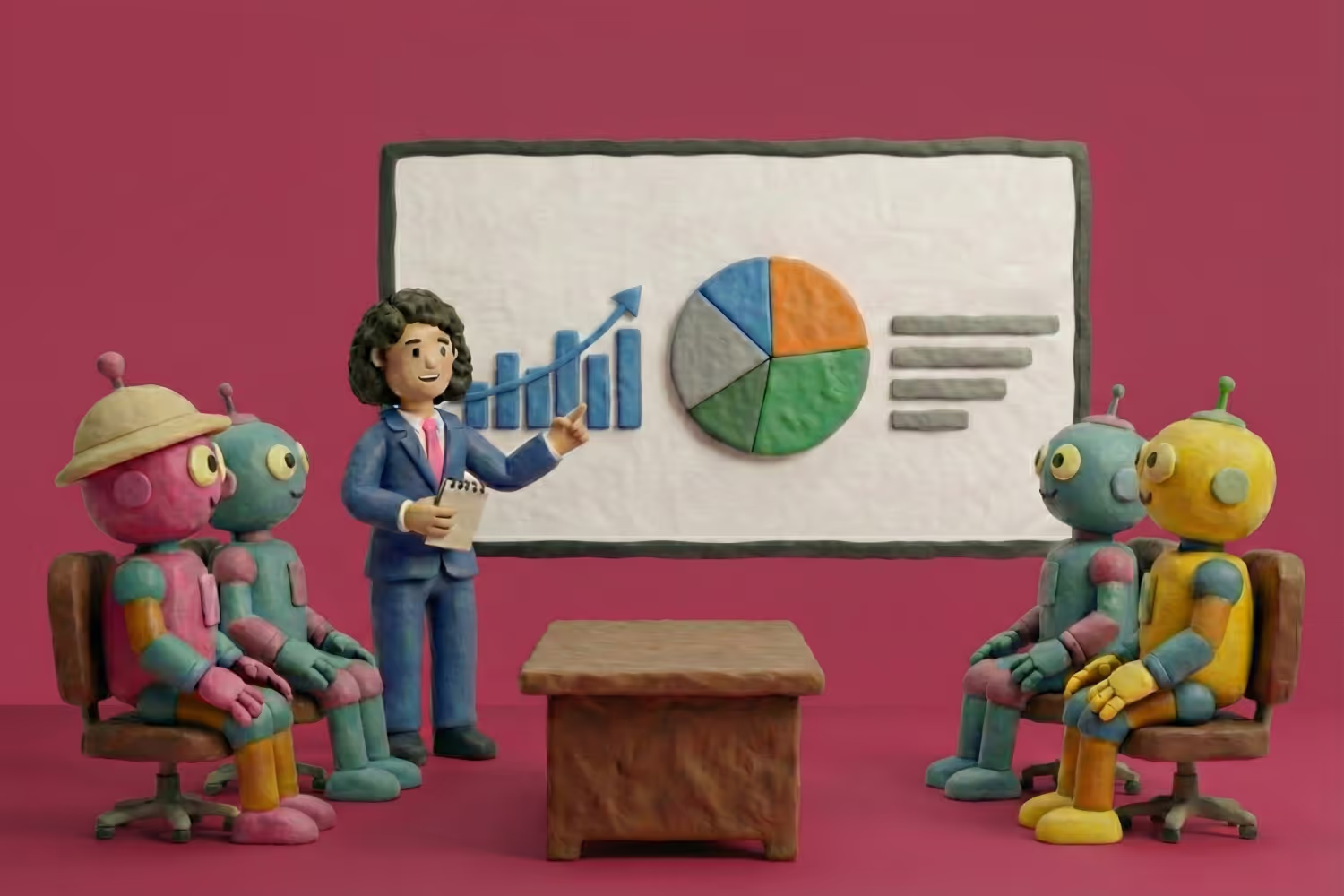
We’ve already started to see the shift. Underwriters are no longer spending their days processing information. Instead, they’re making decisions. AI agents execute the work end-to-end. Humans focus on judgment, portfolio performance, and market opportunities.
Or put more simply:
Underwriting operations run on Sixfold. People run the strategy.
That’s the AI Underwriter.
Why Customers Love Sixfold
One of the biggest reasons Sixfold has scaled so quickly is that we don’t ask insurers to rip and replace everything.
Sixfold integrates directly into the tools underwriters already live in. Their workbenches, policy admin systems, existing workflows, and, of course, email inboxes.
Near-zero time to value isn’t a slogan. It’s how we’ve earned trust across the industry.
This Isn’t Theory — It’s Happening Now
What makes this moment exciting is that it’s no longer hypothetical.
Customers are already seeing major impact:
- Skyward deployed Sixfold across 11 underwriting teams and cut quote response time by 35%
- Zurich rolled Sixfold out to 200+ underwriters, saving up to 2 hours per submission
And the real win is what happens next:
- Underwriters are happier because they get time back
- Carriers respond faster with better quotes and better coverage
- Agents and brokers prefer working with those carriers
- Teams win more business and select risk more intelligently
- Competitive advantage starts showing up in combined ratio
Sixfold becomes the underwriting tool you can’t live without.
That’s what “AI transformation” looks like when it’s real.
Why Series B Now
We’ve proven autonomous AI works in real underwriting environments. Now it’s time to scale.
This funding lets us go faster on what matters most:
- More autonomous underwriting agents
- Deeper integrations into carrier workflows
- Portfolio-level visibility
- Global expansion across markets where demand is already there
Underwriting remains the most complex and important function in insurance.
We’re rebuilding it with AI at the core and underwriters in control.
Bring on even more #Funderwriting!
Think post was originally posted on LinkedIn
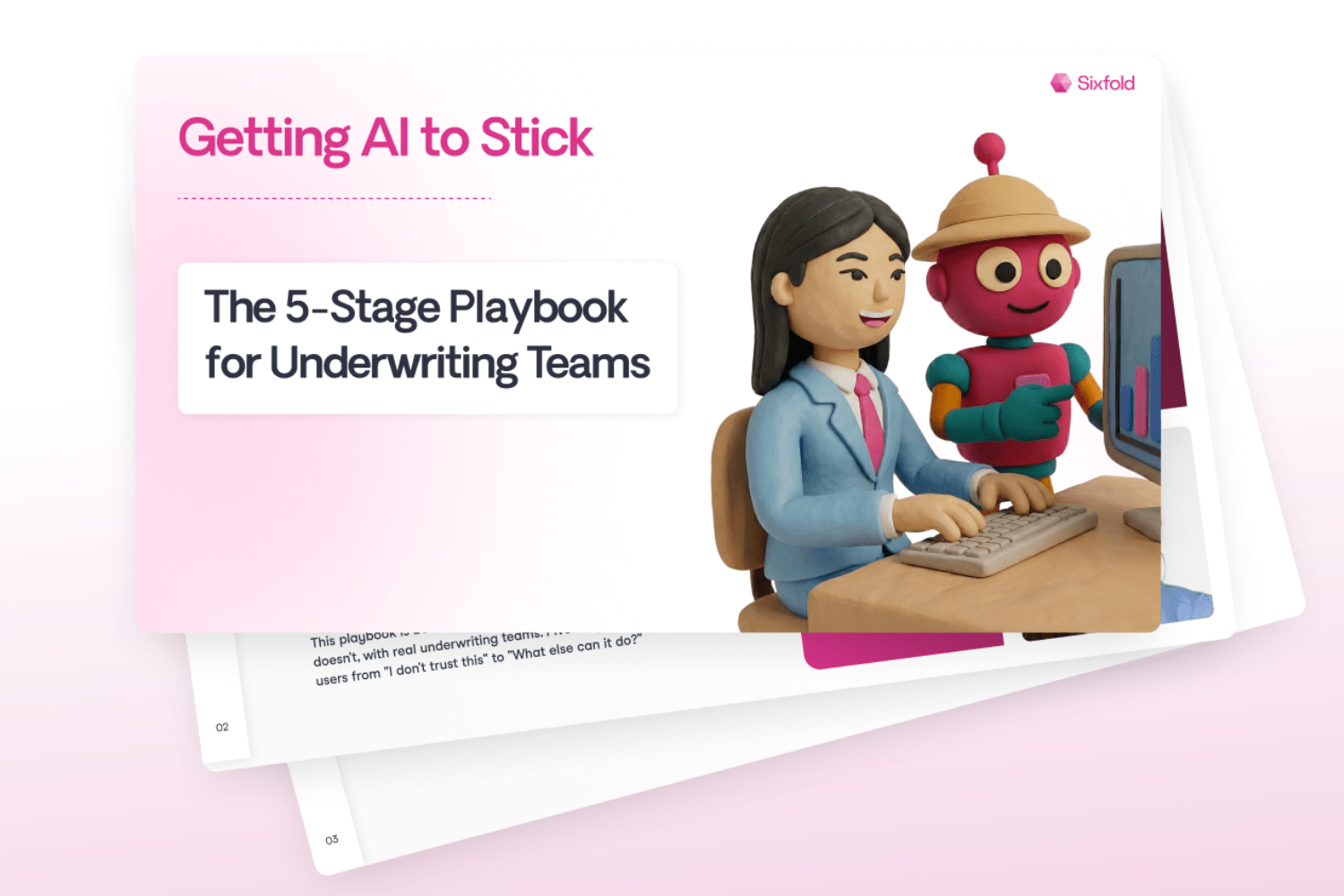
AI Adoption Guide for Underwriting Teams
Over the past few years, we've worked with more than 50 underwriting teams to bring AI into their day-to-day operations. So we've put together a 5-stage guide that covers what successful AI adoption actually looks like, from picking the right starting point to building trust and scaling across your team.
Over the past few years at Sixfold, we've helped more than 50 underwriting teams bring AI into their day-to-day work. From global carriers to innovative MGAs, teams ranging from five to 200 people across P&C, Life & Health, and specialty lines.
Different customers with different needs, but one common pattern: the teams that succeed with AI aren't the ones waiting for a perfect solution. They're the ones who start. They take the project out of the product roadmap and bring AI into how their team actually works, into the culture, the habits, the daily routine.
The goal is to take manual work off underwriters' plates so they have time to focus on complex decisions, bind more premium, and strengthen broker relationships. The secret is to simply start.
From our experience working with underwriters on a daily basis, one thing is clear: successful adoption doesn't come from trying to solve everything at once. It starts with one clear, impactful pain point.
Achieveing a successful start
- Pick a pain point that underwriters already feel every day. Something that eats up hours, like digging through pages of documents to find one relevant detail about a risk. When underwriters see real value, they'll use it and share the wins with their peers.
- Get leadership buy-in from leaders who understand why it matters, not leaders who add AI just to check a box. Leaders who actively support underwriters as they try something new make the difference.
And just as important: underwriters need to see what's in it for them. Concrete changes to their day-to-day work, not abstract efficiency gains.
“We focused on a use case underwriters actually asked for. And then accuracy became everything. If they can't trust the output, it doesn't matter how cool the technology is.”
─ Amy Nelsen, Head of UW Operations, Middle Market at Zurich North America
That's just the first step. We've put together a 5-stage guide that covers what comes next, from building trust, making it effortless to use, to spreading adoption across the team.
Download the guide here
How AI is Improving Life & Health Underwriting
Life & health underwriting is slowed by manual submission triage and the work of reading dense medical evidence for risk assessment. AI underwriting platforms now read and reason through an entire submission before an underwriter even opens it.
The bottleneck in life & health underwriting
Life & health underwriting is slowed by manual submission triage and the work of reading dense medical evidence for risk assessment. AI underwriting platforms now read and reason through an entire submission before an underwriter even opens it.
Every life and health submission arrives as a stack of unstructured information, like application data and medical records such as attending physician statements, lab results, and prescription histories, that can run to hundreds, even thousands of pages. Historically, underwriters spent the bulk of their time finding, reading, and organizing that evidence before they could make a single risk decision. That manual effort is the real constraint, not the decision-making process itself.
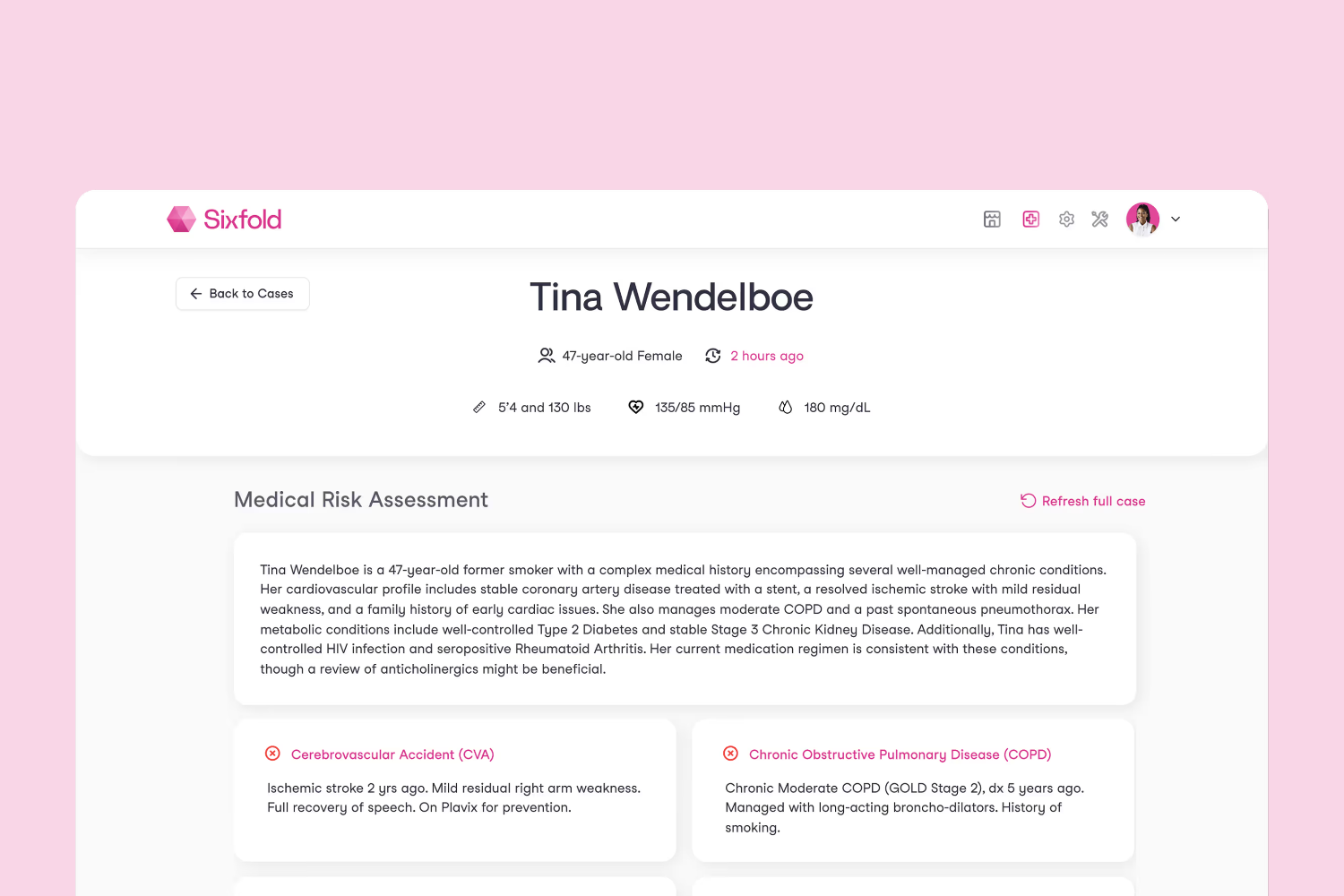
Sixfold changes that. Its AI agents read and reason across the full submission the way an experienced underwriter would, surfacing the relevant medical evidence aligned with the carrier's underwriting manual, flagging key risk factors, and delivering a clear health overview. All steps to support the underwriter's decision-making.
Using medical software to read records and find key information faster
Medical evidence software exists because reading through the records is the most time-consuming part of a life & health case analysis.
Sixfold processes attending physician statements, lab panels, and prescription data, extracts the clinically relevant findings, and ties them back to the risk factors that matter for the underwriting decision. Instead of skimming a 200-page record for a single relevant medical condition, the underwriter gets a structured, evidence-backed summary with a traceable source.
Because the system comes pre-trained with underwriting knowledge, it recognizes what matters most to a life or health risk from day one, rather than requiring months of configuration. It plugs into the underwriting workbench the team already uses, so the medical evidence summary appears within the existing workflow.
Reducing time spent in manual submission triage with AI
Doing the initial review of a submission, checking if all the information is available to proceed or if it needs more data from brokers or agents, is where underwriting teams spend the most time on operational work. An AI platform automates triage by ingesting each submission as it arrives, assessing completeness, pulling and organizing the medical evidence, and producing a preliminary recommendation before a human review.
The result is that when underwriters start the case review, it's already prioritized, and the risk assessment is complete, ready for a final underwriting decision. Underwriters get to spend their time on judgment, complex risk cases, and broker relationships rather than on sorting and data entry.
Across Sixfold customers, this contributes to a 50% reduction in turnaround time, hit ratios up 15% or more, and up to 30% more gross written premium per underwriter, because capacity is redirected from administrative triage to writing business.
L&H Frequently Asked Questions
How do life and health insurers use medical-evidence software to speed up the underwriting process?
Life insurers use Sixfold's AI to automatically read and interpret medical records, attending physician statements, lab results, and prescription histories. It extracts relevant findings, links them to risk factors, and presents an evidence-based summary, so underwriters can focus on the decision rather than digging into information. It provides a risk assessment ready for decision-making, including recommendations on what to do next in a case.
Sixfold comes pre-trained with underwriting knowledge from day one. It integrates directly with existing underwriting workbenches, keeping the source evidence visible for every conclusion. Customers see processing times 50% to 97% faster as a result.
How do underwriting teams reduce manual submission triage using AI platforms?
Underwriting teams reduce manual triage by having the AI platform ingest each submission on arrival, check completeness, organize the medical evidence, and automatically generate a risk assessment and next-step recommendations. Underwriters then start case review with cases that are already prioritized and pre-analyzed, focusing their time on risk judgment rather than sorting and data entry.
Having Sixfold help with triage, teams redirect capacity from administrative work to writing business. Sixfold customers report hit ratios up 15% or more and up to 30% more GWP per underwriter. Adoption stays high, over 90% of expected users, because the platform fits how underwriting actually works rather than forcing a new process.
What are the top tools for automating life underwriting decisions?
The top tools for automating Life and Health underwriting decisions are purpose-built underwriting AI platforms that reason across a full submission, automated medical evidence and record summarization software, and integrations into the underwriting workbench. The strongest options combine all three: decisioning, evidence analysis, and workflow fit.
About Sixfold
Sixfold is the first AI solution built specifically for insurance underwriting, in market since early 2023, and is live in production across 50 lines of business, including life & health lines. It has processed more than 1.5 million submissions globally and is used by more than 1,000 underwriters, from insurers like Guardian and New York Life.
Sixfold's 100 Billion Token Milestone
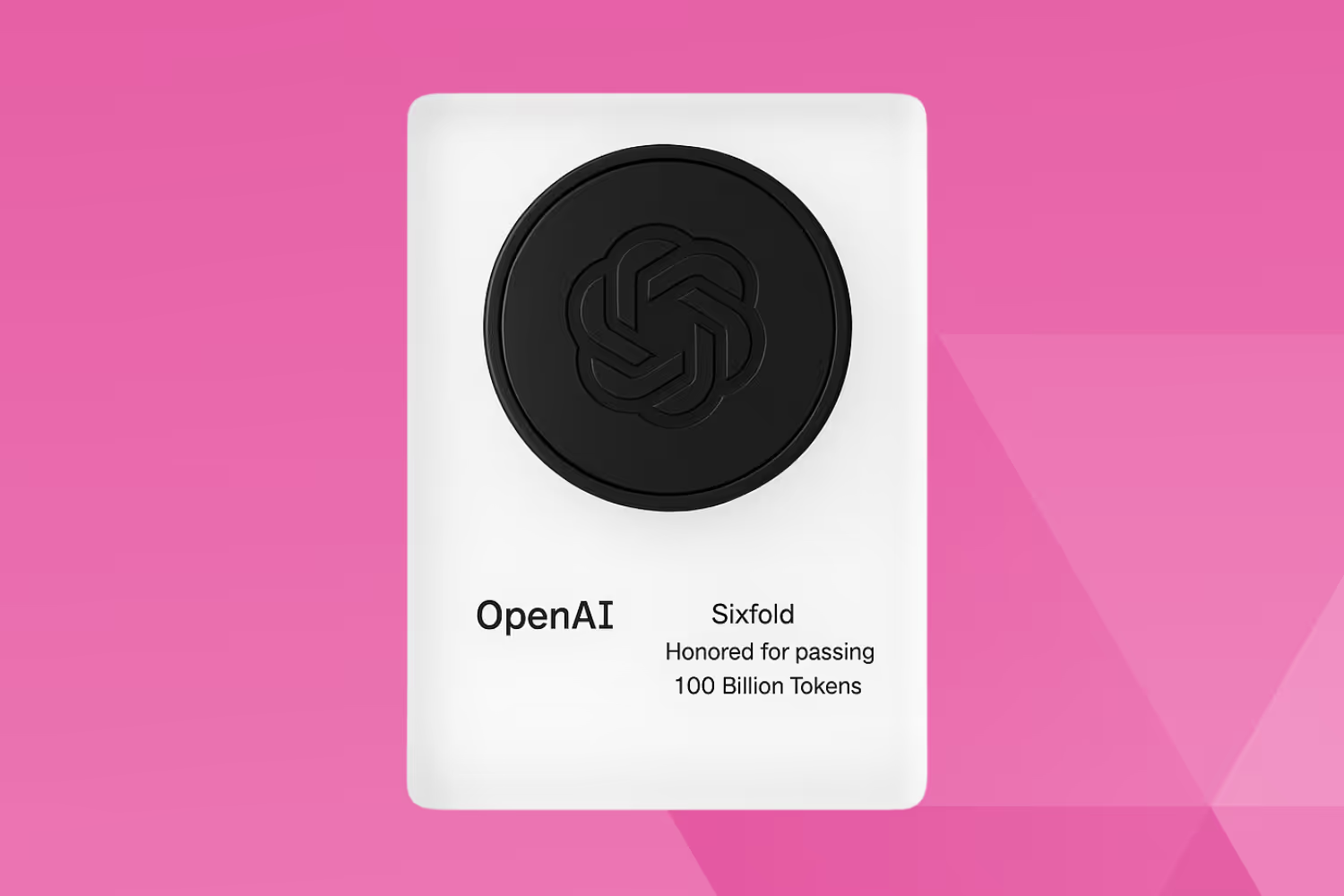
Sixfold was featured at OpenAI’s Dev Day Keynote, recognized for crossing 100 billion tokens processed. We sat down with our Senior AI Engineer, Drew Das, to talk about what that milestone really means for underwriting.
Sixfold was featured on the big screen at Open AI’s DevDay 2025, recognized for surpassing 100 billion tokens processed. To make it even better, Senior AI Engineer, Drew Das, was honored among global developers for his contributions.
This is a huge milestone for Sixfold, a reflection of the real impact our AI is making in underwriting. But what does 100 billion tokens actually mean in practice? We sat down with Drew to find out.
Can you start by explaining what exactly OpenAI recognized Sixfold for at Dev Day, and what it felt like to see your name up on the screen?
Seeing my name on stage felt like public validation of the engineering team’s hard work. Sixfold is operating at the frontier of large-scale AI in insurance underwriting. We’re not a pilot anymore; we’re in production.
It also hit home the responsibility that comes with it. Yes, we’ve built scale, but now we have to make sure what we produce is high quality and meaningfully used. Sixfold isn’t experimenting with LLMs; we’re running them reliably where accuracy, latency, and auditability really matter.
We’re not a pilot anymore; we’re in production.
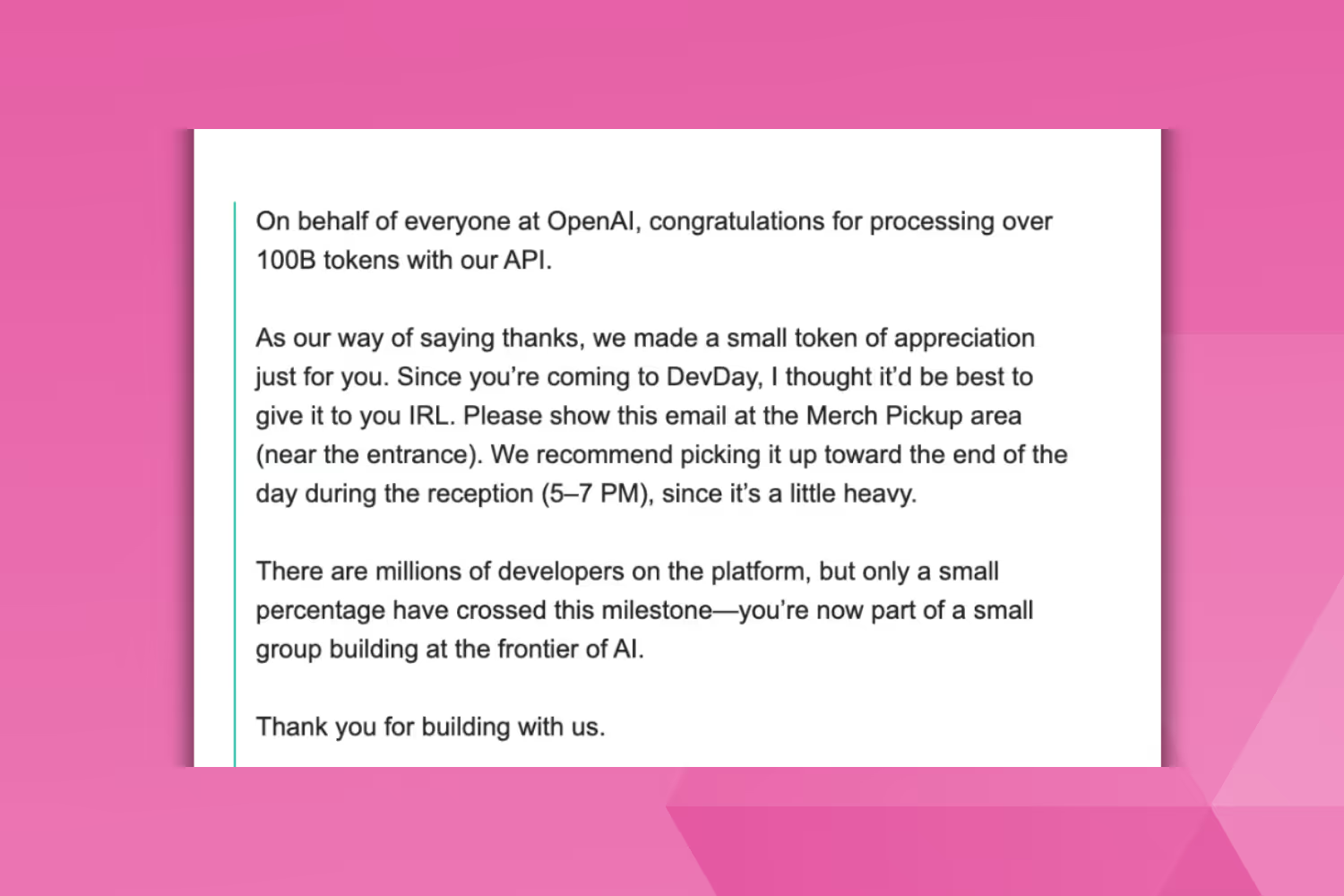
What does “100 billion tokens” actually represent in Sixfold’s day-to-day work?
Each token is a fragment of understanding, a piece of text, data, or context that our models interpret and turn into something underwriters can act on.
It signals the volume of underwriting data, documents, broker submissions, and risk information that our platform analyzes and processes through generative AI workflows.
Hitting 100 billion means we’ve moved many workflows off manual underwriting review and into AI. When repetitive work is reduced, underwriters spend more time on relationships, strategy, and higher-value decisions.
Hitting 100 billion means we’ve moved many workflows off manual underwriting review and into AI. When repetitive work is reduced, underwriters spend more time on relationships, strategy, and higher-value decisions.
So… what’s next, another 100 billion tokens?
Token count is becoming table stakes. What matters now is how those tokens are applied and the outcomes they create.
We’re focusing on deeper workflow integration, bringing AI agents that go beyond risk assessment to support decisions, automate workflows, and deliver real-time underwriting intelligence. Our Research Agent is a great example of that.
Considering the high-stakes nature of insurance, every risk insight and decision generated by Sixfold must be auditable and traceable. Our solution isn’t just built for scale, but for governance.
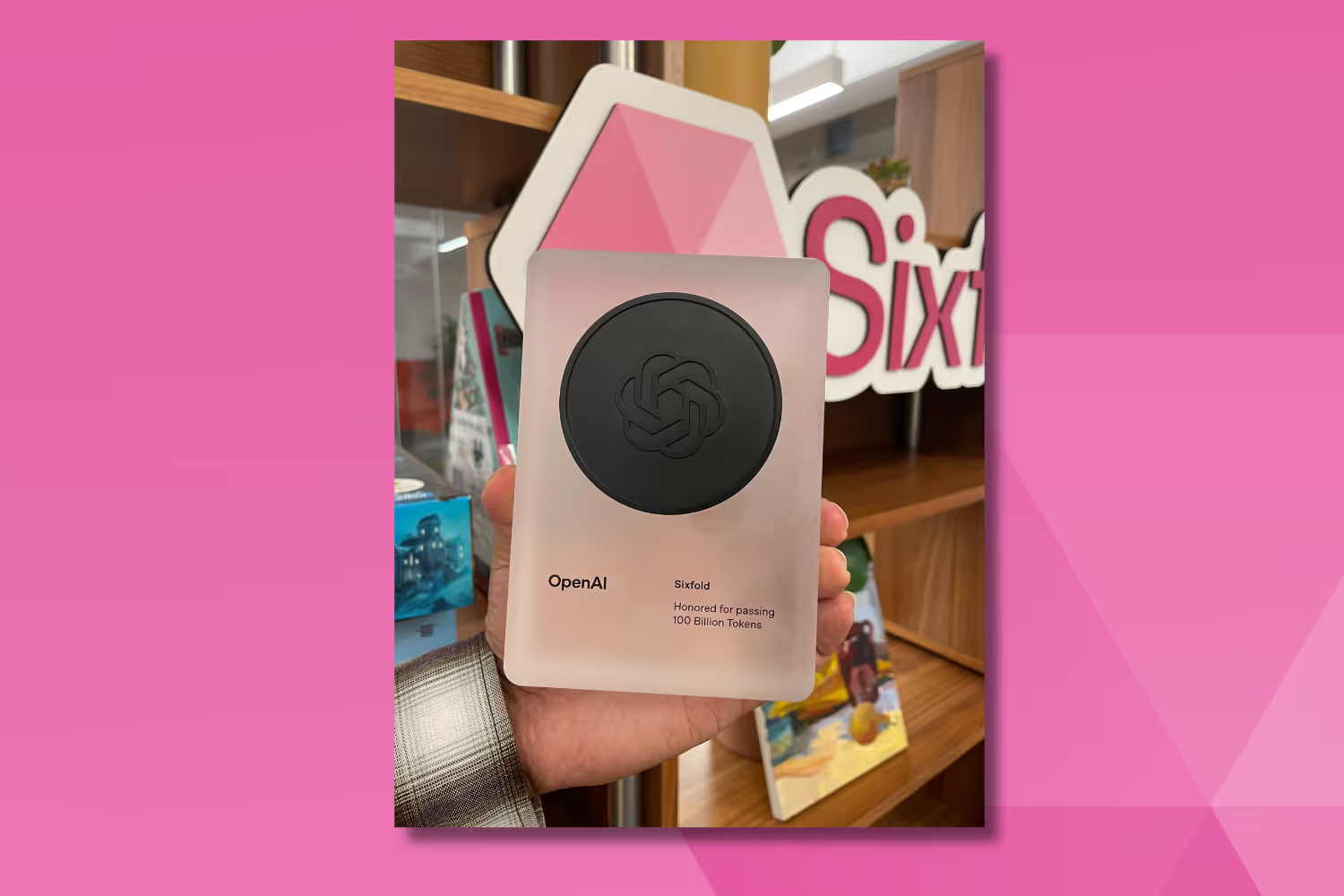
On the engineering side, what does it take to run something at that scale?
From an engineering perspective, scale brings complexity. We’re constantly balancing latency, cost, and accuracy.
Many AI projects stop at the “cool demo” stage, but we’re pushing through the messy engineering: hybrid search, re-ranking, prompt tuning, and evaluation, all happening under the hood.
Scaling means better signals, more edge cases surfaced, and faster model learning. It’s a flywheel that keeps getting smarter.
Scaling means better signals, more edge cases surfaced, and faster model learning. It’s a flywheel that keeps getting smarter.
Referral Agent: From “To-Do” to “Done” in Seconds
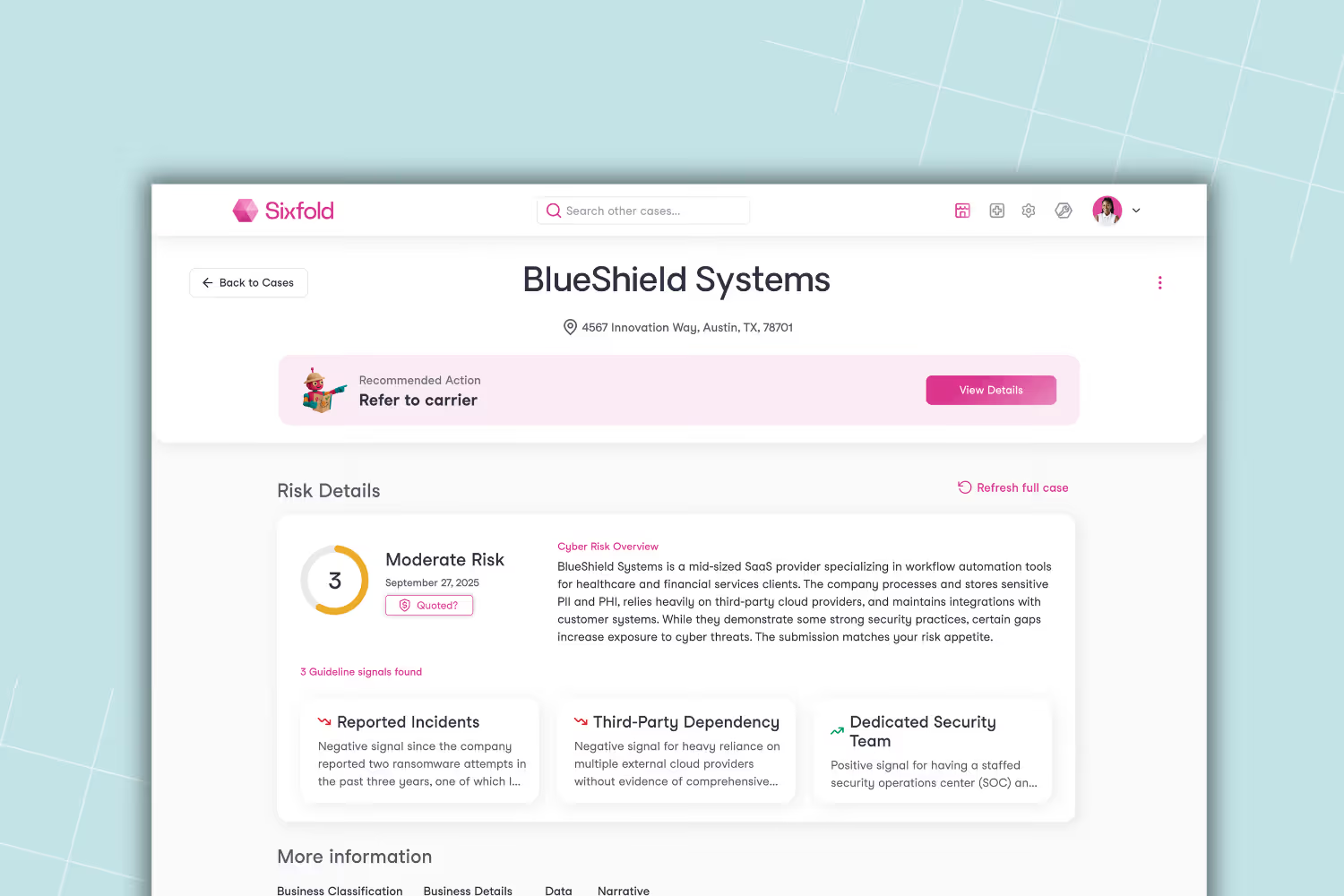
Sixfold is shifting from insight to action. Our AI has helped underwriters surface risks, highlight insights, and guide decisions, but now we’re taking the next step with a suite of agents designed to clear bottlenecks in the underwriting process. First up: Referral Agent.
Since AI’s introduction in underwriting, it has been about surfacing information: flagging risks, highlighting important insights, and providing recommendations. But there's always been a gap between AI that knows what needs to be done and AI that actually does it.
Sixfold is building AI agents that close that gap: agents that work alongside underwriters to move cases forward autonomously. Referral Agent marks a shift in what Sixfold can do for your underwriting team, starting with one of the biggest bottlenecks we hear about from underwriters: referrals.
“We’re no longer just telling underwriters what to do; we’re helping them do it. This launch represents a major shift in how we drive efficiency and consistency in underwriting — turning “here's what you need to know’ into “here’s what we’ve already done about it”. The Referral Agent is just the beginning of that vision.”
- Alex Schmelkin, Founder and CEO of Sixfold
Where 40% of Cases Get Stuck
When we asked underwriters about their biggest workflow frustrations, referrals came up again and again.
Every underwriter knows this routine: you spot a case that needs escalation, and suddenly you're building a package. Pull the rules. Cross-reference submission details. Write a detailed email explaining your reasoning. Make sure the approver, such as senior underwriter, has everything they need to make a decision.
It's necessary work, but it takes about an hour per case. With up to 40% of applications requiring escalation, underwriters can spend half their day packaging referrals instead of evaluating risk.
The ripple effects hurt everyone. Brokers wait days for responses while referrals sit in approval queues. Approvers get packages missing key details and have to circle back with questions. What should be a quick handoff becomes a multi-day process that slows everyone down.
AI That Completes the Loop
Referral Agent transforms how this process works. Instead of stopping at identification that a case needs referral, it handles the next steps as well. It executes referrals on its own: flags when a case needs escalation, assembles the complete referral package and drafts a ready-to-send email in your preferred tone.
The underwriter's role changes from package preparation to package review, freeing up time from admin work and letting them focus on more strategic decisions.
The repetitive process that used to take 60 minutes? It now takes 1 minute.
How it works
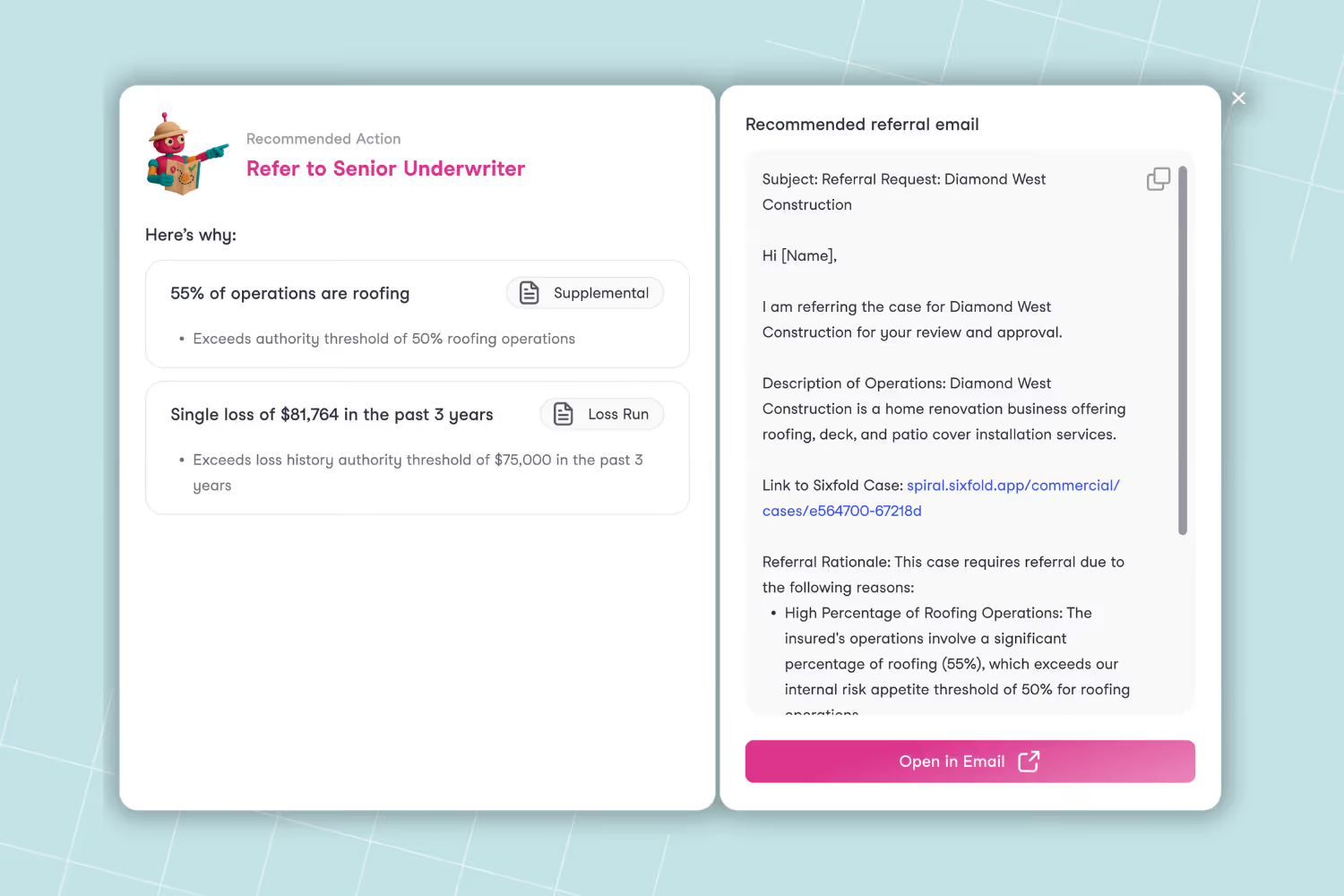
Sixfold knows the insurer’s unique risk appetite, applies what it’s learned, and clearly shows if and why a referral is required after case analysis is completed.
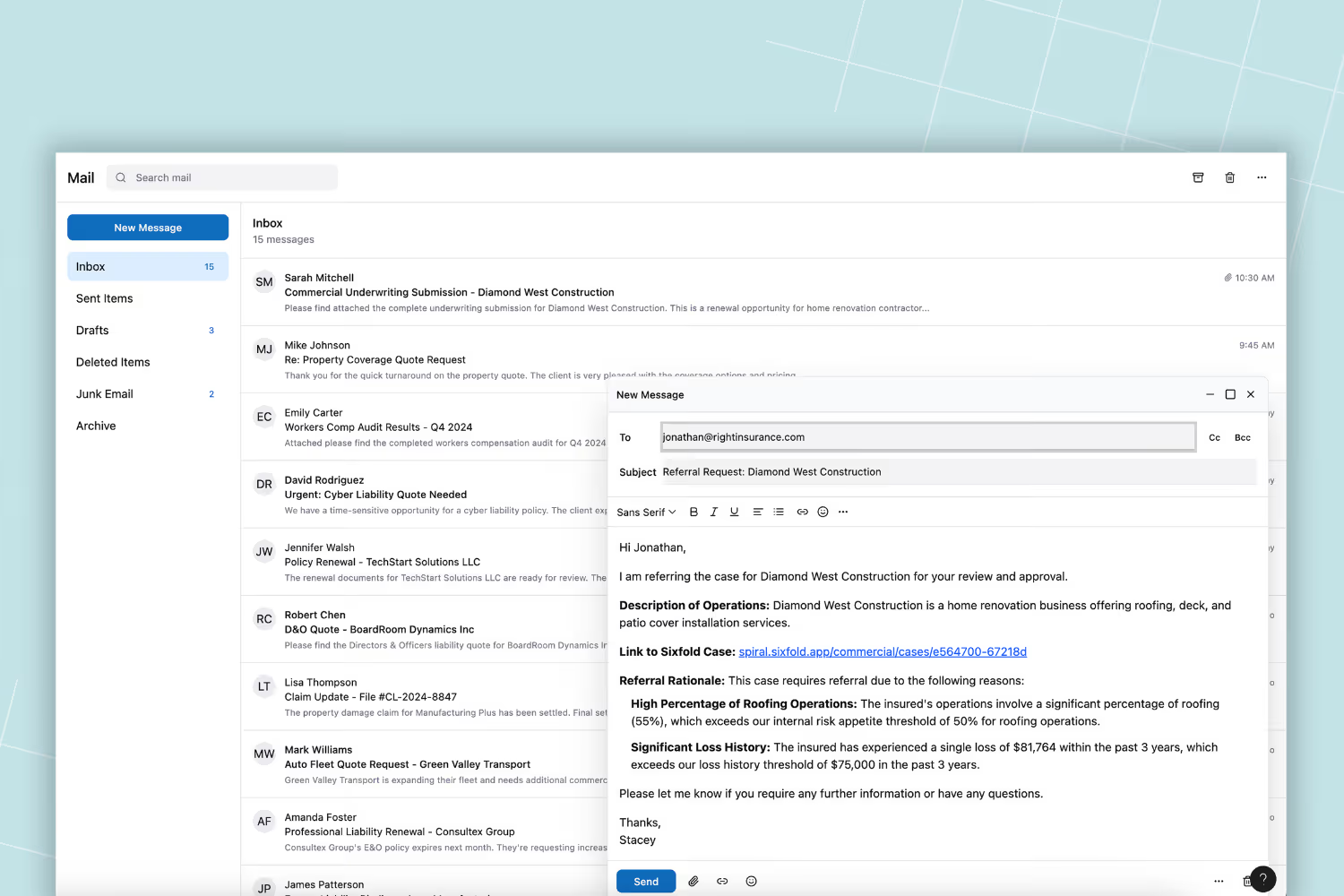
When the agent flags a case for escalation, it constructs a complete referral package in email form: a business summary including the company's operational focus and a structured rationale section that walks through each referral guideline breach step-by-step, citing the exact percentages, dollar amounts, and policy thresholds that might have triggered the referral requirement.
With this launch, we’re making the underwriter’s inbox part of the workflow. Underwriters can just forward a broker’s email, with attachments, straight to Sixfold, and the risk assessment kicks off automatically. When it’s time to refer, a pre-drafted email is done, ready to be sent with a single click from the underwriter’s default email provider.
Benefits by Role
For Referrers
- Always know when to refer
- No more repetitive referral tasks
- Hours back every day for actual underwriting
For Approvers
- Every referral is standardized, making it easier to review
- With complete referral packages, you can decide faster - often same-day
- Automatic audit trail for compliance and training
For Insurers
- Referral guidelines are applied consistently across every team
- Quotes out faster → happier brokers → improved hit ratios
- A process that scales with every underwriter hired
The Broader Vision
Referral Agent is part of a shift in what Sixfold can do for your team. In 2024, Sixfold gave underwriters a brain that reads and assesses; now Sixfold equips them with a brain that acts: AI agents that move cases forward on their own.
Each Sixfold agent plugs into your existing workflow to solve a specific bottleneck. Backlog of referrals? Deploy Referral Agent. Team spending hours researching online? The Research Agent does it in minutes. Endless broker negotiations slowing you down? The Negotiation Agent (coming soon) handles it. Use them individually or stack them together,
“Every underwriter knows that sinking feeling of a growing referral queue. With the Referral Agent, that queue clears itself. It proves that AI can take action, not just give advice. It's the first of many agents that free underwriters from processor work so they can become portfolio strategists."
- Lana Jovanovic, Head of Product @Sixfold
Experience It Live: Try Referral Agent at ITC Vegas in October. Forward an email, watch the risk assessment run, and generate a referral in real time. Book your ITC meeting with Sixfold, or schedule a digital demo.
FEATURED REPORTS
Guides and Reports
A closer look at AI adoption, governance, and the future of underwriting.