Sixfold Content
Product Updates
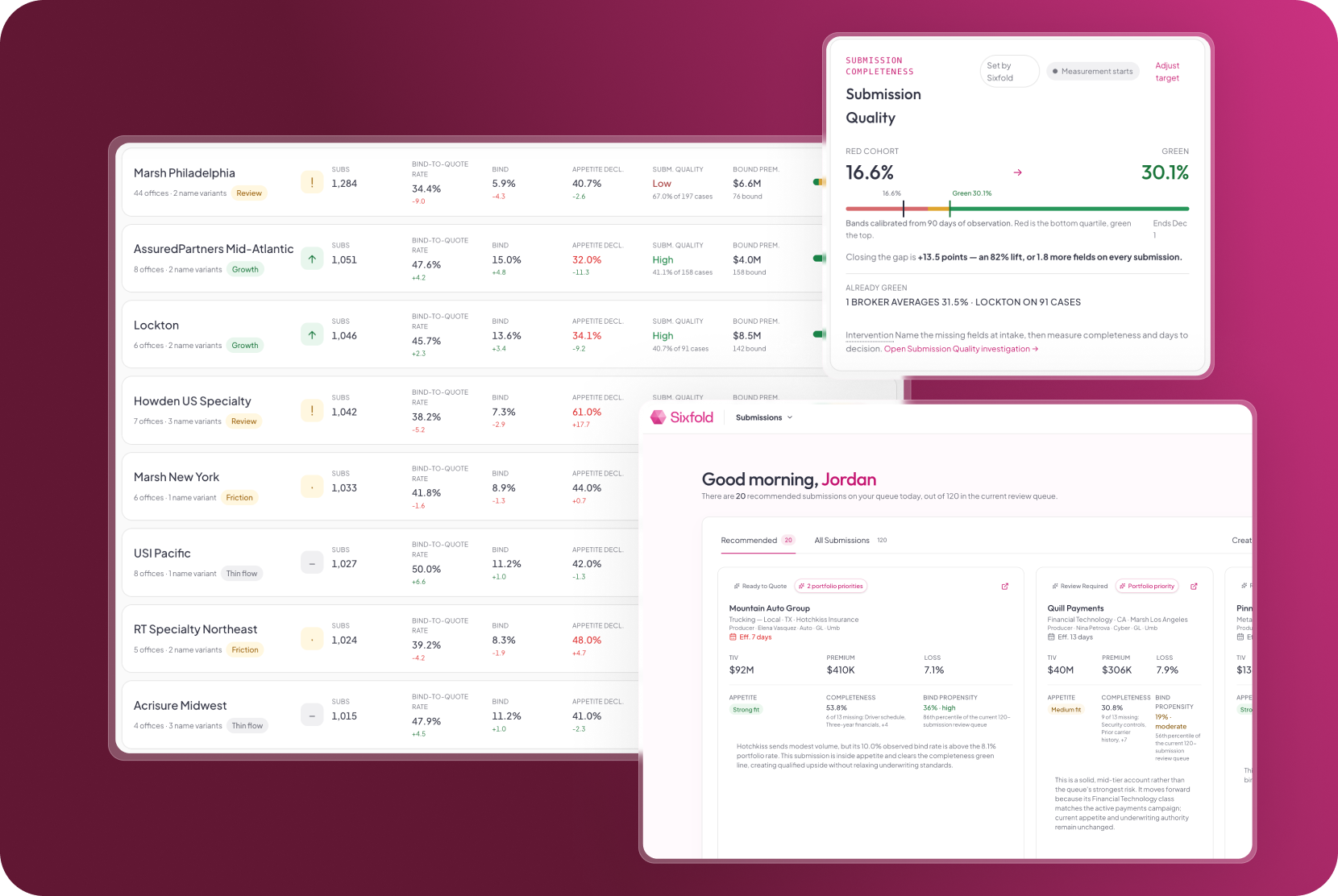
Introducing Distribution Intelligence
Sixfold is launching Distribution Intelligence, giving insurers the data and recommendations they need to proactively manage their distribution.



Stay informed, gain insights, and elevate your understanding of AI's role in the insurance industry with our comprehensive collection of articles, guides, and more.
.png)
What AI Fluency Means for Underwriters
Most underwriting teams already use AI, but few have a plan for working with it well. Here is what AI fluency actually means, and the four skills that make up an AI fluent underwriter.
AI has now been implemented across most underwriting teams. Sixfold’s research report with insights from more than 500 underwriters and executives showed that 70% of teams now use AI in their daily workflows.
So AI is officially part of how underwriting work gets done today. That means that every underwriting team is asking some version of the same question right now: what does a good working relationship with AI actually look like? Not how to turn it on, but how to work with it well, day to day, file by file.
Like any skill, it has to be built.
Why This Is a New Skill
Older automation tools did exactly what they were told. Point them at a task and they run it. AI showing up in underwriting today is different. It can triage a submission, flag what is missing, and put together a recommendation with real reasoning behind it, without being walked through every step. That is closer to delegating to a colleague than operating a tool.
Delegating well is a skill. So is knowing when to double check someone's work, and knowing what you are still accountable for once you sign off. Underwriters already have this skill. They use it every time they train a new hire or rely on a broker's summary of a risk.
AI fluency is that same skill, applied to a new kind of colleague.
What AI Fluency Actually Means
Anthropic defines AI fluency as the ability to work with AI systems in ways that are effective, efficient, ethical, and safe. Applied to underwriting, that becomes something more specific: knowing what to hand to an AI colleague and what to keep for yourself, how to direct it well, how to tell if its work holds up, and taking real accountability for what to sign off on.
A good underwriting AI solution should be easy to pick up on day one. Fluency is not about learning the tool. It is the expertise an underwriter builds working alongside it over time, the same way a new analyst gets sharper the longer they work with a good manager.
Adoption Is Not the Same as Fluency
Most underwriting leaders are already tracking adoption: how many underwriters log in, how many submissions run through AI, how many hours it touches in a week. Those numbers matter, but they measure something different from fluency.
Adoption asks whether the team is using it. Fluency asks whether the team is using it well. Usage is easy to measure and easy to report. Fluency takes watching how people work, not just how often they log in.
The Four Levels of AI Fluency
Underwriting teams tend to land somewhere on a spectrum of these levels.
Resistant. Uses AI only when required, defaults back to the old process whenever there is a choice. Keeps AI at arm's length.
Compliant. Follows instructions, nothing more.
Experimenter. Curious. Pushes it to see what it can do.
Fluent. Treats AI like a team member: directs it, corrects it when it is wrong, and lets it take on more of the file as it proves itself.
The goal is not to force everyone to the top overnight. It is to give people a clear path from wherever they are now to fluent.
The Four Skills of an AI Fluent Underwriter
Fluency breaks down into four concrete skills.
- Two of them, delegation and direction, your team has probably already set some defaults for.
- Two of them, discernment and diligence, are yours alone, file by file, no matter what your team has decided above you.
1. Delegation: Knowing What to Hand Off
Your team has probably already drawn this line somewhere, even if no one wrote it down. A rough order, from safest to hand over to hardest:
Almost always safe to delegate: document extraction and synthesis, initial submission triage, appetite fit scoring against stated guidelines.
Increasingly common, worth considering: declining submissions that are clearly outside appetite, drafting follow up questions for a broker, flagging missing information before a human review.
Higher stakes, decide deliberately: quoting the best fit submissions with no human touch, handling an entire line of business end to end.
Usually keep human: real ambiguity about intent or the relationship at stake, a risk with no real precedent, final sign off.
That line moves as trust builds, and it is worth knowing where your team currently draws it, not just accepting it as fixed. The harder question is what you do with the file that sits right at the edge of it. Is the answer to proceed or escalate, and is that written down anywhere, or are you working it out on instinct at the moment?
2. Direction: Knowing How to Direct It Well
Getting a good result from AI depends on the context you give it, the same way a sharp new analyst does better work when the brief is specific instead of vague. Vague direction gets a vague draft back. A specific brief, with the appetite guideline, the format expected, and what "good" looks like for that line of business, gets something an underwriter can actually use.
Your team has likely already set some of this for you: appetite guidelines, expected output format, a shared definition of "good" by line of business. That part is not yours to reinvent file by file. What is yours is the context the defaults do not cover. On an unusual account, do you add the known edge case, the past miss on a similar risk, the thing worth flagging that no default would catch on its own? That is the difference between running the tool as configured and actually directing it.
3. Discernment: Knowing How to Judge Its Work
This is where calibrated trust comes in, and it is almost entirely a file by file skill. It means knowing which outputs need real scrutiny and which do not, and checking the reasoning behind a recommendation, not just whether the final number looks right.
Scrutiny should scale with what is actually at stake, not stay flat across every file:
-Routine renewal, within appetite, standard limits: a light check is enough.
- New business, within appetite, standard complexity: a moderate check.
- Outside appetite, an unusual class, large limits, or no real precedent: full scrutiny, led by a human.
Six in ten executives say the main reason AI projects never reach production is that outputs were not accurate or reliable enough to act on. You are the one in a position to catch that before it becomes a company wide problem. That is exactly the gap discernment is meant to close, catching where the reasoning does not hold up before it becomes a decision, not waving everything through.
Your team may already have these tiers written down somewhere. If they do, check your own recent submissions against them: were the last ten files you reviewed given attention based on what was actually at stake, or did they all get roughly the same amount regardless of risk? If your team has not written the tiers down yet, that gap is worth raising, since it is the difference between calibrated trust and just going with your gut.
4. Diligence: Owning the Outcome
An underwriter has always been accountable for their file, no matter what informed the decision: a broker's summary, a colleague's read, or an AI recommendation. AI does not change that standard.
Your team should have a written standard for when an AI's role in a file needs to be noted internally versus disclosed to a broker, and a minimum bar for what gets documented for audit purposes. If that standard exists, follow it. If it does not, do not wait for someone else to write it. A short note on what the AI flagged and how you weighed it is the kind of thing you will want on file six months from now regardless, and it costs you a sentence to add now.
One Submission, Start to Finish
Here is what all four skills look like on a single file.
A medium sized commercial account comes in through the usual intake channel. Sixfold reads the submission, extracts the key details, and flags two things: a coverage request that sits at the edge of the team's stated appetite, and a prior loss that was not called out in the broker's summary.
Delegation: the underwriter already knows triage and extraction are AI's job on every file like this. The appetite edge case is not, so it gets flagged for a human look rather than auto processed.
Direction: the underwriter adds context the AI would not have on its own, a note that this broker's book has run clean for the past three years, which changes how much weight the prior loss should carry.
Discernment: because this file sits at the edge of appetite, it gets a full review rather than a light check. The underwriter reads the reasoning behind Sixfold’s next step recommendation, not just the recommendation itself, and confirms it holds up against the added context.
Diligence: the underwriter signs off on a quote, with a short note in the file recording that AI flagged the prior loss and the underwriter weighed it against broker history before deciding. That note is what makes the file clean six months from now if anyone asks how the decision was made.
Building Your AI Fluency
If you want to hear how others are working through this on their own files, Sixfold's upcoming webinar brings together underwriters that are using AI in their daily life.
Register here to join us together with underwriters from Generali GC&C and Mosaic Insurance on the 8th of September or watch the recording on-demand.
━━━
FAQs
What is AI fluency in underwriting?
AI fluency is the skill of working effectively with AI in day to day underwriting work. It means knowing what to hand off to AI, how to direct it well, how to judge its output, and taking full accountability for the final decision.
How is AI fluency different from AI adoption?
Adoption measures whether a team is using AI, tracked through logins, submissions processed, or hours saved. Fluency measures whether the team is using it well. A team can have high adoption and still be far from fluent.
What are the four levels of AI fluency?
Resistant, Compliant, Experimenter, and Fluent. Most teams sit somewhere on that spectrum rather than at one end, and the goal is steady progress toward Fluent rather than an overnight jump.
What are the four skills of an AI fluent underwriter?
Delegation, direction, discernment, and diligence. Delegation and direction are usually set at the team level. Discernment and diligence are decisions each underwriter makes file by file.
How much scrutiny should an underwriter apply to AI recommendations?
Scrutiny should scale with what is at stake. A light check works for routine, in appetite renewals. Full human led scrutiny applies to anything outside appetite, unusually complex, or without real precedent.
Does using AI change what an underwriter is accountable for?
No. An underwriter is accountable for the file regardless of what informed the decision, whether that is a broker's summary, a colleague's input, or an AI recommendation. AI does not lower that bar.
Why does documentation matter when AI is involved in a file?
A short note on what AI flagged and how the underwriter weighed it protects the file if anyone reviews the decision later. Teams that skip this step are relying on memory instead of a record.
%20(1500%20x%201200%20px).png)
Introducing the AI Underwriter for Life & Health
Sixfold is launching the AI Underwriter for Life & Health, an agent that turns medical evidence into a clear recommendation, with the rationale behind it.
Today, Sixfold is introducing the AI Underwriter for Life & Health, built to produce case-level underwriting recommendations, rationale, and next actions across life, disability, long-term care, and critical illness.
The AI Underwriter reads the evidence in a case, applies the carrier’s underwriting manual, weighs mortality and morbidity risk, and shows its work back to the underwriter with source citations and manual references. It does not just summarize what is in the file. It helps turn evidence into underwriting work product that a carrier can review, govern, and act on.
Sixfold has supported Life & Health insurers for more than three years, including Guardian, New York Life, and ClearView. Our first Life & Health solution helped underwriters save time by turning applications into underwriting-ready overviews. The AI Underwriter takes the next step: from organizing the case to helping underwriters move from evidence to recommendation.
How It Works
It gets to work the moment evidence lands, reading prescription histories, lab results, driving records, and financial information in the context of the carrier’s underwriting manual, whether proprietary or a reinsurer's. From there, it logs the most relevant impairments, flags missing data, and provides rating recommendations with the rationale behind each one.
Take a diagnosis of hypertension. The AI Underwriter identifies the diagnosis, looks into how the condition has been controlled over the years and any recent spikes, and references the manual to determine if that finding should result in a debit or credit, an exclusion, or a postponement. It surfaces that as a complete recommendation to the underwriter, who can ask questions, check citations, and apply further judgment.
Impairment level findings come together into a single overall case rating, arriving at one clear action: rate, refer, decline, or postpone. Underwriting can proceed accordingly, and each insurer decides how much human oversight to apply.
What Customers Are Seeing
Customers have seen a 55% reduction in case evaluation time and 30% more premiums written per underwriter, along with more consistent and confident decisions and more time to focus on growing their portfolio and achieving better customer coverage.
"Sixfold has helped our team save time by not having to manually chase down page references and missing details in medical reports. We've seen a 55% reduction in time to evaluate a case,"
- Peter Tilocca, Head of Underwriting at ClearView.
Built Responsibly, From Day One
Responsible AI has been core to Sixfold since its founding in 2023. Sixfold maintains an active AI Governance Program, engages with the NAIC and other regulators, and just published its third annual Responsible AI Report in August, detailing how it builds safety, governance, and auditability into its products.
"Life and health underwriting is not a summarization problem. It is impairments, products, manuals, evidence, exceptions, and judgment. Getting this right meant building an AI Underwriter that understands the work behind the decision, earns underwriters' trust in the details, and meets the responsible AI bar this industry deserves. Life & Health has not had a real technology moment in a long time. We think this is it."
- Alex Schmelkin, Founder and CEO of Sixfold
An Optimistic Future for Underwriting
The AI Underwriter for Life & Health changes the way underwriters work, freeing them to focus on the parts that only human expertise can bring: deciding when to be more lenient on a risk, negotiating terms with a broker or agent on a complex case, and building customer relationships.
And underwriters are already feeling positive about the role's future. In Sixfold's recent research survey of more than 250 Life & Health underwriting professionals, 86% said they feel more excited about the industry's future because of AI, citing the impact they're seeing in their day-to-day work. Sixfold is excited to get the AI Underwriter into the hands of underwriters and continue that momentum.
The AI Underwriter for Life & Health is available now.
Reach out to see it in action.
Sixfold Partners with PS Advisory
Sixfold's AI Underwriter is now available inside Salesforce through a custom MuleSoft connector built by PS Advisory, an insurance focused Salesforce and AI execution partner.
Sixfold's AI Underwriter is now available in Salesforce via PS Advisory's custom MuleSoft connector, helping carriers move submissions through underwriting faster and more consistently.
Carriers should not have to leave the systems their underwriters already use to get value from AI. That is the idea behind Sixfold's new partnership with PS Advisory, an insurance-focused Salesforce and AI execution partner. The partnership embeds Sixfold's underwriting intelligence directly into the Salesforce workflows carriers already run.
Why PS Advisory
PS Advisory works exclusively with the insurance industry, supporting carriers, MGAs, brokers, and reinsurers with Salesforce solutions spanning distribution, underwriting, policy, and claims. The company has built a custom MuleSoft connector that provides bidirectional connectivity between Sixfold and Salesforce, letting submissions, enrichment data, and underwriting decisions move automatically between systems.
"PS Advisory combines deep insurance knowledge with Salesforce expertise, so they understand both how underwriters work and the technology they use," said Roger Ferrandis, Head of Partnerships at Sixfold. "That's what makes it possible to bring Sixfold's intelligence directly into those workflows, letting carriers move faster without having to change how they already work."
What Changes for Insurers
Carriers already using MuleSoft can extend their current setup with the Sixfold connector, while others can implement MuleSoft as part of the integration, without replacing their existing technology. The connector helps Sixfold automate submission intake, standardizes data, identifies missing information, and simplifies risk assessment against a carrier's own appetite and portfolio, reducing manual rekeying and avoiding lengthy custom integration projects.
"Our MuleSoft connector links Sixfold and Salesforce directly, giving carriers and MGAs a practical way to bring AI into existing underwriting workflows securely and at scale," said Andrew Bartels, CEO, PS Advisory. "They can build on technology they've already invested in and reduce operational friction."
Together, Sixfold and PS Advisory aim to make AI underwriting a practical part of the Salesforce workflows carriers use every day.
How to Get Started
Curious to learn more about the PS Advisory partnership or how Sixfold can support your underwriting team? Get in touch with our team.
━━━
Frequently asked questions
What is the Sixfold and PS Advisory partnership?
Sixfold and PS Advisory have partnered to bring Sixfold's AI Underwriter directly into Salesforce, using a custom MuleSoft connector PS Advisory built for bidirectional connectivity between the two systems.
What does PS Advisory do?
PS Advisory is a consulting firm focused on the insurance industry, helping carriers, MGAs, brokers, and reinsurers get more value from Salesforce. It designs and implements Salesforce solutions across distribution, underwriting, policy, and claims, and has extensive MuleSoft integration expertise.
Do carriers need to replace their existing systems to use this integration?
Carriers already using MuleSoft can extend their setup with the Sixfold connector, and others can implement MuleSoft as part of the integration. Either way, carriers keep their existing technology rather than replacing it.
What results have Sixfold customers seen?
Sixfold has processed more than 1.5 million submissions across more than 50 lines of business for P&C and L&H carriers, MGAs, and reinsurers. Customers have seen processing times improve by 50% to 97%, hit ratios increase by 15% or more, and gross written premium per underwriter rise by up to 30%.
Does the integration work with existing Salesforce environments?
Yes, PS Advisory offers prebuilt and tailored integrations so Sixfold's capabilities can be deployed directly within the Salesforce environments underwriters already use.
Sixfold Partners with Sollers
Sixfold is partnering with insurance technology consultancy Sollers to help insurers deploy underwriting AI inside the systems they already use.
Insurers should not have to replace the systems their underwriters already use to get value from AI. That is the premise behind Sixfold's new partnership with Sollers Consulting, the international insurance technology consultancy.
The partnership combines Sixfold's underwriting AI solution with Sollers' insurance consulting and implementation expertise, so insurers can modernize underwriting faster. Sixfold and Sollers are already collaborating on several engagements across Europe, the UK and North America, each one tailored to the insurer's technology and underwriting requirements.
Why Sollers
Sollers Consulting has worked with more than 150 insurance organizations worldwide, including Admiral, Aviva, AXA, Beazley, IAG, Liberty, QBE, Sompo, Tokio Marine and Zurich. Founded in 2000, Sollers works from 16 offices across Europe, North America and Asia Pacific, with expertise spanning underwriting transformation, core insurance systems, cloud technology and systems integration.
Sixfold integrates with the technology insurers already run, and Sollers knows how that technology is configured and used at a given carrier. The two companies also share strategic technology partners, including Guidewire and Salesforce, so insurers can deploy AI inside their existing ecosystems.
"Insurers should not have to replace the systems their underwriters already use to get value from AI. Sixfold works within those systems and comes with underwriting knowledge built in from day one. Sollers knows how those systems are set up and used. Together, that gets insurers to better underwriting results faster."
- Roger Ferrandis, Head of Partnerships at Sixfold
What Changes for Insurers
Insurers get AI, consulting, and technology implementation within a single transformation program rather than coordinating a software vendor and an integrator separately.
For underwriting teams, that means submission intake is automated, risk is assessed against the carrier's own appetite, and underwriters get transparent, explainable recommendations, all within their existing systems and workflows.
"We've built Sollers' underwriting practice around the belief that the right technology, applied to the right part of the process, delivers outstanding results. Sixfold makes submission handling faster, more consistent and more intelligent. Together, we can help insurers achieve measurable results quickly while laying the foundations for underwriting transformation."
- Jakub Śliwiński, Head of Underwriting at Sollers
The two companies will also work together on joint educational initiatives, including webinars and industry engagement for carriers and MGAs.
How to Get Started
To learn more about the partnership or how Sixfold can support your underwriting team? Get in touch with our team.
━━━
Frequently asked questions
What is the Sixfold and Sollers Consulting partnership?
Sixfold and Sollers Consulting have formed a strategic partnership that combines Sixfold's underwriting AI solution with Sollers' insurance consulting and implementation expertise. The two companies work together on insurer transformation programs across Europe, the UK and North America.
What does Sollers Consulting do?
Sollers Consulting is an international insurance technology consultancy. Founded in 2000, it works from 16 offices across Europe, North America and Asia Pacific on underwriting transformation, core insurance systems, pricing, policy administration and cloud technology. It has worked with more than 150 insurance organizations worldwide.
Do insurers have to replace their underwriting systems to use Sixfold?
Sixfold integrates with existing technology rather than replacing existing underwriting systems. Sollers' role in the partnership is knowing how a given carrier's systems are set up and used, so Sixfold can be deployed into that environment.
Which regions does the partnership cover?
Europe, the UK and North America. Sixfold and Sollers are already collaborating on several insurer engagements in those markets.
What results do insurers see with Sixfold?
Sixfold customers see processing 50% to 97% faster, hit ratios up 15% or more, and up to 30% more GWP per underwriter. Sixfold has processed more than 1.5 million submissions across more than 50 lines of business for P&C and L&H insurers, MGAs and reinsurers.
Does the partnership support Guidewire and Salesforce?
Sixfold and Sollers share strategic technology partners including Guidewire and Salesforce, so insurers can deploy AI within their existing ecosystems.
Is the partnership relevant to MGAs as well as carriers?
Sixfold works with P&C and L&H insurers, MGAs and reinsurers, and the two companies are planning joint webinars and industry engagement for both carriers and MGAs.
.png)
Meet the AI Underwriter
Sixfold is launching the AI Underwriter, an agentic colleague that does the analytical work, holds institutional memory, and tells underwriters what to do next.
Three years ago, Sixfold launched the first AI product built for insurance underwriting.
Since then, we’ve learned what it takes for AI to earn a place in an underwriter’s workflow. It has to do more than read and summarize a submission. It has to support judgment in context.
We learned this by processing more than 1.5 million submissions across more than 50 lines of business for carriers including Zurich, Skyward Specialty, Generali GC&C, Guardian, AXIS, and New York Life in North America, Europe, South America, and Australia.
A great underwriter holds an enormous amount in their head. The risk. The carrier’s appetite and guidelines. The broker’s history. The shape of the portfolio. Similar cases they have seen before. Where the carrier is willing to bet.
Even the best underwriters hit two limits.
First, no one can hold their entire book in memory. Every interaction with a broker. Every similar risk. Every detail of the underwriting guidelines. It’s too much information to carry and recall for every decision.
Second, underwriters mostly learn from the cases on their own desk. What the underwriter next to them knows often stays there. Institutional knowledge that should compound across a team doesn’t.
Today, we're launching something new to solve both. The AI Underwriter.
From Submission to Recommendation
The first version of Sixfold was about providing relevant risk insights. Since our launch, our AI has been exceptional at ingesting submission data straight from an inbox, enriching it, filling in the gaps, and pointing to what matters based on appetite fit. But, to solve the deeper problems preventing underwriters from binding more and better business, we needed to go further.
The AI Underwriter does exactly that. It’s an agentic colleague that receives a submission and produces real underwriting work product as the output, one that understands the risk, knows the broker, holds the portfolio in memory, and tells the underwriter what to do next.
The agent receives a submission, extracts and cleans the data, identifies what's missing, and evaluates appetite and portfolio fit. It reasons about the risk, but also about whether this risk, from this broker, belongs in this book right now. It draws on everything the carrier's team has ever learned about that broker and that risk class, surfaces portfolio context, and produces a recommendation and the rationale to back it up. The next step is always clear, whether that's a referral, a declination, or a broker follow-up drafted and ready to send.
At the center of the AI Underwriter is what we call the Underwriting Brain. It brings functional knowledge across lines, reasoning patterns from experienced underwriters, and a ground-truth library of what good underwriting looks like. It doesn't need months of ramp time. It already knows how to underwrite on day one.
Most AI Tools Digitize The Submission. This One Does the Work.
.png)
How is it different from other AI tools out there? The reality is that a great underwriter doesn't need a digitized version of the application or a dashboard with data that was current last week. They need to understand the risk in the full context of their current book, the broker relationship, and their guidelines, and what the next best action on the case is.
That's what the AI Underwriter does. And it's something no text ingestion, triage, or workflow tool was built to do, because none of them were designed to learn from the work itself.
After a short time with a carrier, the AI Underwriter holds institutional memory that compounds with every submission. The broker's history. Prior outcomes on similar risks. Portfolio context. Everything every colleague has ever learned, available the moment the next submission lands.
The Impact on Your Book
Sixfold customers have historically seen 50% to 97% faster processing, hit ratios up 15%, and 30% more GWP per underwriter. One carrier went from pilot with a handful of users to 500+ underwriters, reaching go/no-go decisions on submissions in 5 minutes and more than 2 hours saved per submission. Another one cut days-to-quote from 16 to 7 days, with more than 100 underwriters using Sixfold today.
Matthew Richardson, Global Head of Operations & IT, from Generali GC&C, summarized the impact well:
“Sixfold helps us quote risks in minutes instead of days or, in some cases, weeks. The work gets better for our underwriters. What sets Sixfold apart is how they build their product, alongside underwriters, shaped by how the job really works. That is why we believe they are building the future of underwriting.”
The AI Underwriter moves insurers further toward a better combined ratio and more profitable growth. Expense ratios fall as underwriters focus on judgment instead of analysis. Over time, loss ratios improve as fewer good risks get missed and appetite alignment tightens.
For a startup MGA writing complex specialty risks with a small team, it makes growth possible without hiring ahead of revenue. For a global carrier, it means every submission is evaluated the same way, with more context, and with better insights from your best-performing distribution channels.
What We're Hearing from Users
Before today's launch, a select group of insurers worked with the AI Underwriter on live submissions. At Skyward Specialty, early results show that the AI Underwriter performed the majority of the underwriting analysis needed to evaluate submissions, helping underwriters quote better risks, faster, with more consistent judgment across the book.
The feedback we’ve received speaks for itself. Melissa Butt, Vice President E&S Brokerage, Property at Skyward Specialty, said it best.
"The AI Underwriter does not just summarize what you are looking at, it gives you a point of view and a clear path forward. For more junior underwriters, it’s a powerful companion that gives them the perspectives of a more experienced underwriter and accelerates their development. Even veteran underwriters who are a little more skeptical of new technology see the AI as an added layer of intelligence. Plus, the ability to fully examine a submission and make better, more confident decisions without even leaving the tool is a huge benefit. The entire team is excited to work with it."
AI Colleague. The Underwriter in Charge.
I want to be very clear. Underwriters are not going anywhere.
But, we’re not automating the existing underwriting process either. We’ve invented (and patented) a new way to run a risk-taking shop.
The best underwriting teams will not remove human judgment. They will focus human judgment where it matters most. Complex risks. Exceptions. Broker relationships. Negotiation. Accountability. Where to take bets.
We recently surveyed more than 500 underwriters and underwriting leaders across North America and Europe, and nearly 80% said they wanted more time for exactly that work.
The AI Underwriter creates that time.
It does the analytical work. It surfaces what is missing. It explains its reasoning. It recommends the next action. The human underwriter directs it, corrects it, decides, and remains accountable.
That is the partnership we believe will define underwriting over the next five years.
And today, it is here.
That’s better #funderwriting.
This post was originally shared on LinkedIn.
.avif)
Sixfold Partners with Adnovum
Sixfold is teaming up with Adnovum, the Swiss technology and consulting company specializing in secure digital transformation for the insurance industry.
Sixfold is partnering with Adnovum, the Swiss technology and consulting company specializing in secure digital transformation for the insurance industry.
Insurers across Germany, Austria, and Switzerland can now access Sixfold's AI underwriting solution through Adnovum's established insurance transformation offering, with Adnovum's IT delivery teams leading implementation and integration.
This partnership brings globally proven underwriting AI together with deep local delivery expertise, giving DACH insurers a faster, lower-risk path to modernizing underwriting operations.
Why Adnovum
Our mission at Sixfold has been to make AI adoption in insurance faster and more accessible. A big part of achieving that is meeting insurers where they already are, working alongside the partners they already know and trust.
Adnovum brings more than 30 years of experience supporting insurers, reinsurers, brokers, and specialist providers across the insurance value chain. They understand the regulatory landscape, the operational realities, and the relationships that define the DACH market. That foundation is exactly what insurers need when adopting new technology with confidence.
"Europe is a priority market for Sixfold, and the DACH region in particular represents a significant opportunity. Adnovum gives us immediate credibility and reach with insurers who are ready to modernise but need a partner they already trust to lead the way."
— Roger Ferrandis, Head of Partnerships at Sixfold
What Changes for Insurers
Insurers across DACH are working to modernize their underwriting processes, and they're looking for solutions that are proven. They want AI that works at other carriers, and a delivery partner who knows their market.
This partnership gives them both. Carriers and MGAs across Germany, Austria, and Switzerland can now:
- Access Sixfold's AI underwriting solution through a regional partner they already know and trust
- Rely on Adnovum's IT delivery teams to lead implementation and integration
- Modernize underwriting operations with in-market delivery expertise and regulatory fluency
- Move from decision to deployment faster, with fewer unknowns and the right local support
"Insurers across DACH are under real pressure to modernise underwriting, and they are looking for solutions that are proven, not experimental. Sixfold already has a track record with some of the world's leading insurers. We can now bring that capability to our clients in this region. That combination of globally proven AI and local delivery is what makes this partnership genuinely compelling."
— Dr. Christian Straube, Head of Industry Insurance at Adnovum
How to Get Started
Sixfold is trusted by insurers globally including Zurich, Mosaic, Skyward, Generali, and many more. Together we've processed over one million submissions for carriers writing more than $265B in premiums.
Sixfold and Adnovum will make their first joint appearance at the HZ Insurance Forum on 11 June in Zurich, co-hosting an expert lunch on how insurers can build AI-fluent underwriting teams.
Curious to learn more about the partnership or how Sixfold can support your underwriting team? Get in touch with our team.
━━━
Frequently asked questions
Which insurers currently use Sixfold for AI underwriting?
Sixfold's AI underwriting platform is used by insurers including Zurich, Mosaic, Skyward, and Generali. The company has processed over one million submissions for carriers writing more than $265 billion in premiums globally. This client base spans both multinational carriers and specialty insurers, providing the production track record that regulated markets typically require before adopting new underwriting technology.
What does DACH mean in European insurance markets?
DACH refers to Germany (D), Austria (A), and Switzerland (CH), three German-speaking European countries grouped together in financial services strategy. The term is widely used by insurers and technology providers for regional go-to-market planning.
What role does Adnovum play in the Sixfold partnership?
Adnovum leads implementation and integration of Sixfold's AI underwriting solution for insurers across Germany, Austria, and Switzerland. Its IT delivery teams handle technical deployment while Sixfold provides the underlying AI platform. Adnovum brings more than 30 years of experience serving insurers, reinsurers, brokers, and specialist providers across the DACH insurance value chain.
How do DACH insurers get started with Sixfold?
DACH insurers can access Sixfold's AI underwriting solution through Adnovum's established insurance transformation offering, with Adnovum's IT delivery teams leading implementation and integration. Sixfold and Adnovum will appear together at the HZ Insurance Forum on 11 June 2026 in Zurich, co-hosting an expert lunch on building AI-fluent underwriting teams.
What languages does Sixfold support for underwriting submissions?
Sixfold supports all languages, processing underwriting submissions in any language a carrier receives them. This is directly relevant for the DACH region, where submissions arrive in German, Swiss German, French, and Italian alongside English across Germany, Austria, and Switzerland.
FEATURED REPORTS
Guides and Reports
A closer look at AI, adoption, and the future of underwriting.