Sixfold Content
Product Updates
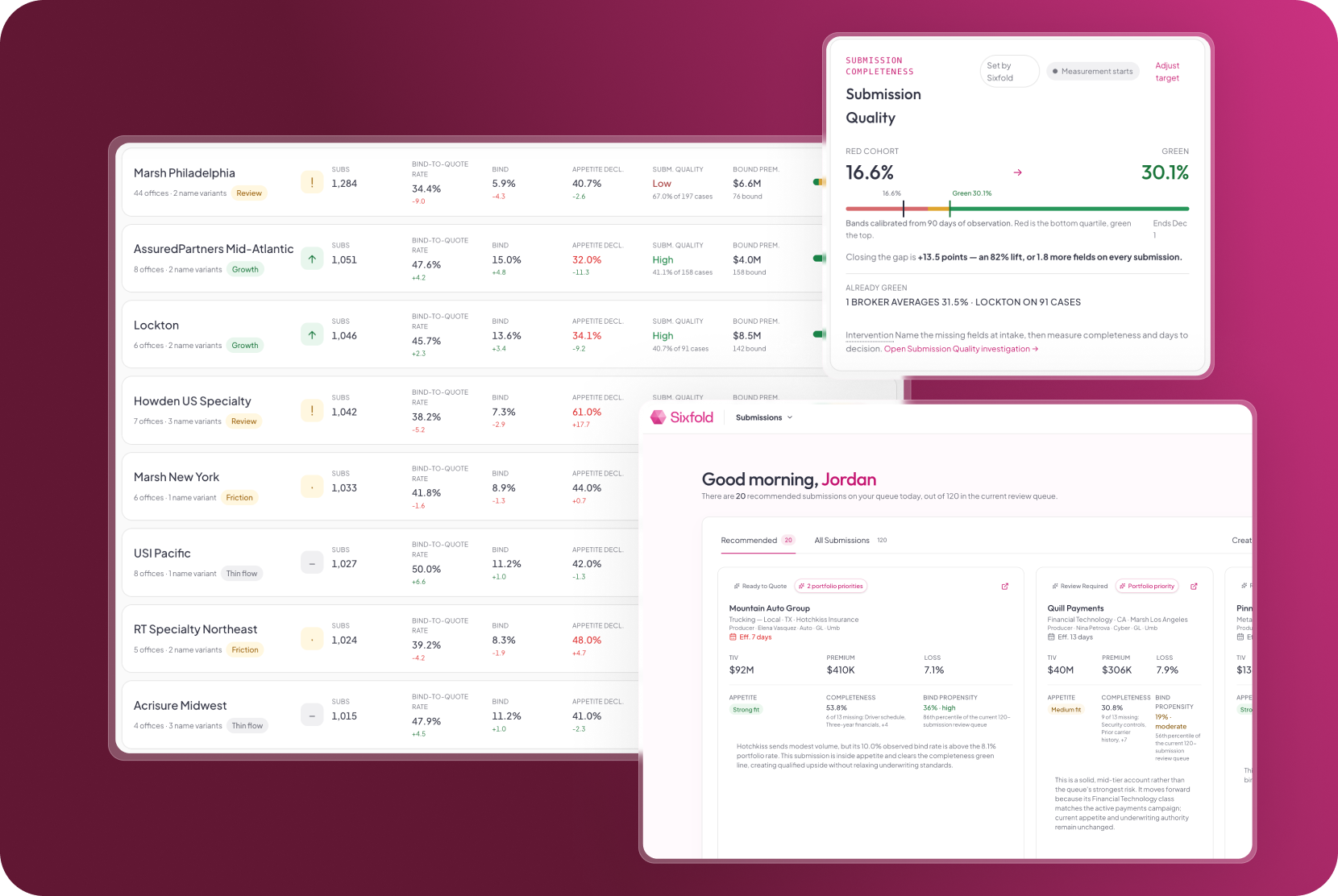
Introducing Distribution Intelligence
Sixfold is launching Distribution Intelligence, giving insurers the data and recommendations they need to proactively manage their distribution.



Explore all Resources
Stay informed, gain insights, and elevate your understanding of AI's role in the insurance industry with our comprehensive collection of articles, guides, and more.
.png)
A Guide to Life & Health Underwriting Technology in 2026
A practical breakdown of the five main AI and tech solutions available for Life & Health underwriting, and how to figure out which one actually fits what your team is trying to solve.
If you're a Chief Underwriting Officer, Innovation Lead, Head of IT, or have a similar role in the Life & Health underwriting space, you've probably come across all types of AI and tech solutions that claim to streamline life and health underwriting workflows. It can be overwhelming to understand the differences, what each solution actually does, how they help underwriters review cases more effectively, and whether they actually reduce mortality slippage and improve placement rates.
Most of them reduce the manual work involved in reviewing lengthy medical records and assessing cases, but they do it in different ways, addressing different parts of the underwriting process. For example, a solution built to increase straight-through processing rates of standard cases won't solve the same problem as one built to help underwriters assess table-rated cases faster.
Knowing which problem you're actually trying to solve is what determines which solution is right. Is it automating decision-making for standard risks? Is it getting a structured summary of all medical records? Or is it having risk insights and recommendations aligned to your underwriting guidelines?
This guide breaks down the main categories to help you understand what the best fit for you is.
When the Manual Approach Stops Scaling
Most Life & Health underwriting teams are facing some version of the same two core challenges. That’s what’s often driving the push toward new technology, even if those challenges might show up differently depending on team size or the mix of cases they underwrite.
- Capacity: There's a consistently high volume of applications that gets more intense during busy seasons, and not enough underwriters to handle them as quickly as needed. The capacity issues get compounded by an aging workforce, which means difficulties in hiring experienced underwriters. Straightforward cases sit in the same queue as complex ones, and turnaround times slow down. Failing to keep up can impact placement rates, giving other insurers the chance to get there first.
- Quality: The cases that actually reach underwriters take too long to assess, or two underwriters on the same case can reach different conclusions. Sometimes both. Slow decisions affect your bottom line. Inconsistent ones lead to mortality slippage and erode the value of your guidelines over time.
These are related problems, but they need different solutions: a tool that reduces the number of cases reaching your team does very little for the quality of decisions on the ones that do. A tool that helps underwriters read faster often doesn't make their decisions more consistent.
The Solutions Landscape
Here are the five main types of underwriting technology insurers use today to solve these problems.
Accelerated Underwriting Systems
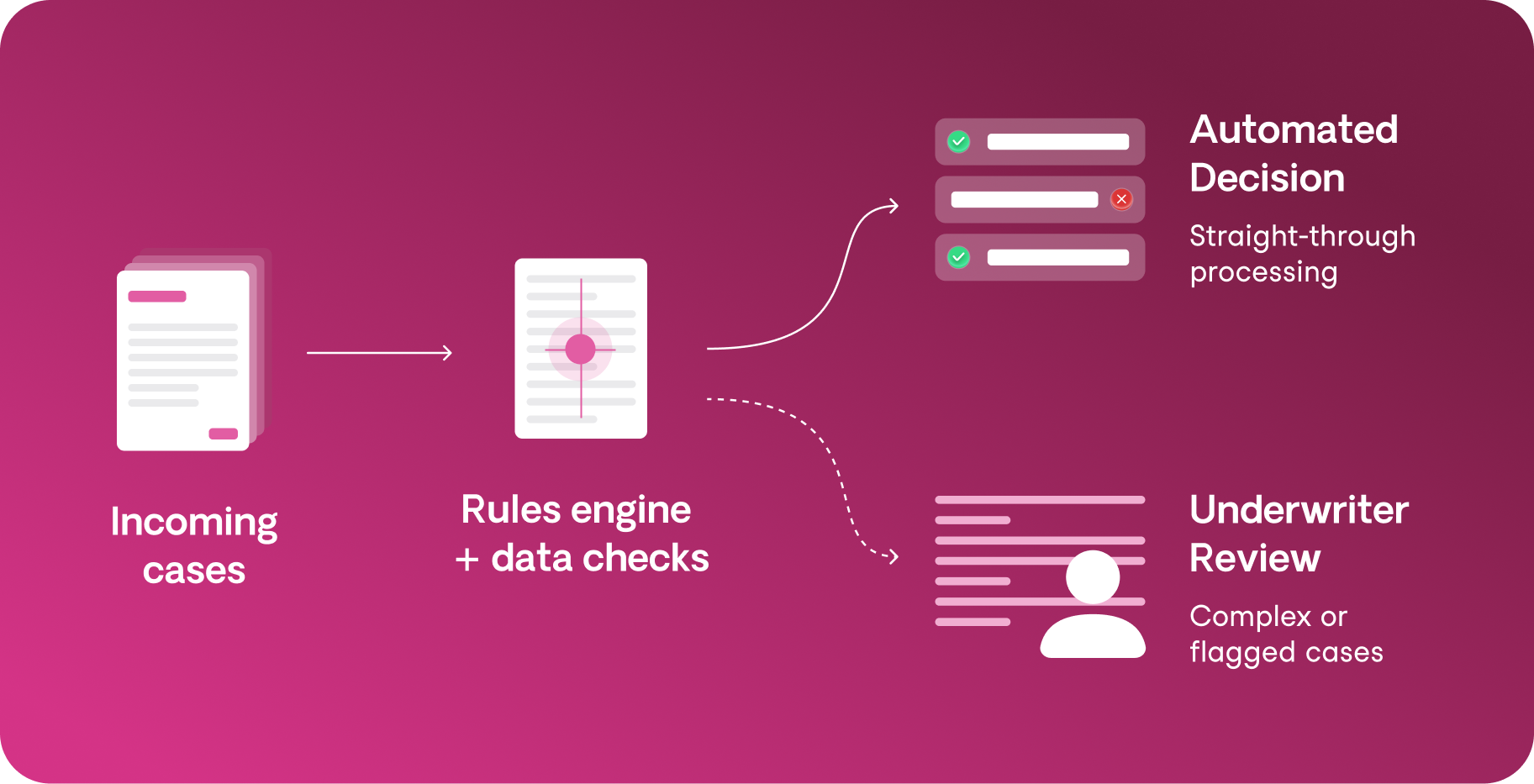
Description: Accelerated Underwriting (AU) systems are designed to maximize automated decision rates, allowing eligible applicants to get approved without requiring traditional medical exams and lab tests. Both large reinsurers and third-party technology vendors offer AU solutions that carriers can adopt and configure to their needs.
These systems handle straightforward cases quickly and consistently, and most insurers today already use this type of technology. But there are still many cases that are too complex for these solutions, whether it's because of a higher-risk diagnosis, the coverage amount needed, a medication flag, or missing information, and that require an underwriter's review. That's where AU reaches its limits.
With these systems, underwriters still have to assess complex cases manually, reviewing hundreds of pages of APS, EHRs, and lab results to understand the patient's clinical history.
Type of technology: Rules-based engine, often combined with predictive models and machine learning.
Best for: Insurers looking to increase the volume of applications that get decided automatically at point of sale, without manual underwriter involvement. Helps increase Straight Through Process rates, reduce turnaround time, and free up underwriters from reviewing less complex cases.
Watch out for: AU systems don't solve the complex case problem. The cases that get referred out still need to be reviewed by a human underwriter, and that process remains largely manual without additional tooling. With 41% of cases going straight to traditional underwriting and 88% of cases requiring some level of human review, that's a significant share that AU simply can't handle.¹
Reinsurer-Built Underwriting AI Assistants
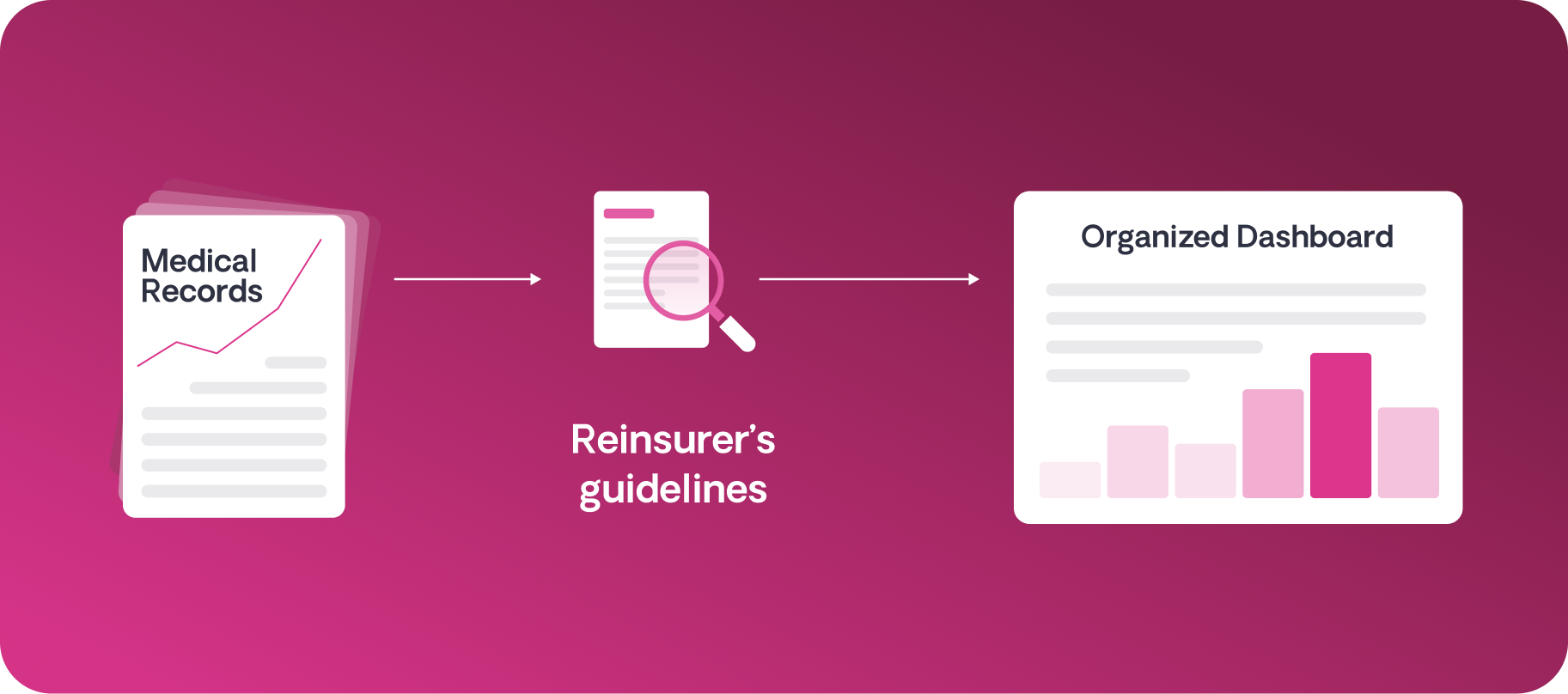
These tools are helpful if you're looking for an out-of-the-box summarization solution. The main thing to keep in mind is that they're typically anchored to the reinsurer's own guidelines, so customization options vary. They also often come bundled with the reinsurer's broader platform and services, so adopting one can mean a deeper commitment than just the tool itself.
With these systems, underwriters often still have to assess non-medical risks separately, manually leverage risk calculators, and return to the original APS or EHRs to fill in gaps.
Type of technology: OCR, NLP, and LLMsS for document ingestion and summarization, with some tools also incorporating structured decision logic for risk guidance.
Best for: Insurers who want a ready-to-use tool to help underwriters navigate referred cases faster, with medical information organized and presented in a structured, easy-to-read dashboard
Watch out for: These tools are typically built around the reinsurer's own guidelines, so customization options may vary. Adopting them often means signing up for the reinsurer's broader platform and services, which creates a level of vendor lock-in worth factoring in before making a decision.
Medical Record Summarization Tools
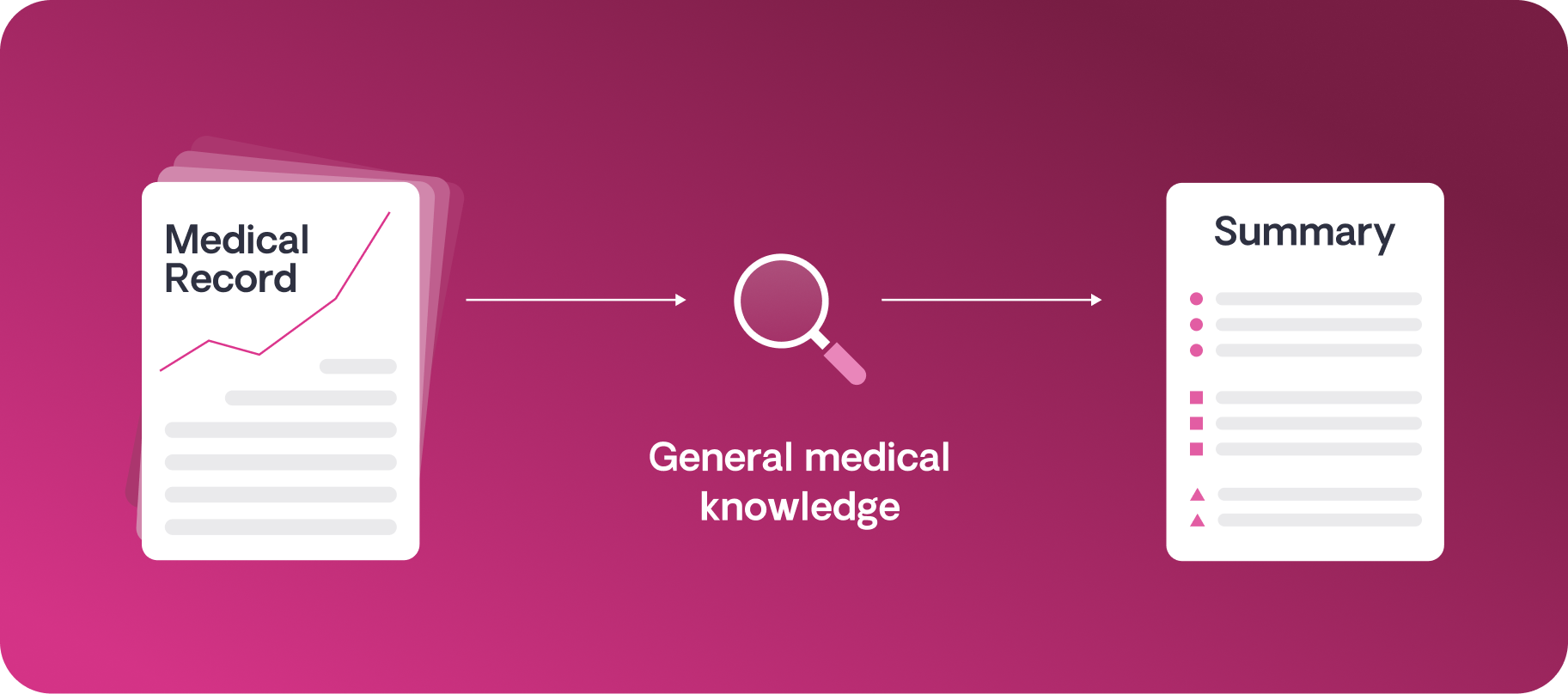
Beyond reinsurer-built tools, there are vendors focused specifically on medical record review. Not built exclusively for underwriting, these solutions are also used in claims, clinical, and legal workflows. They use AI to summarize and organize information from medical records, giving underwriters a more user-friendly view of an applicant's health history in one place.
Although they're good at giving an overall medical summary, all the information is surfaced regardless of relevance, which can still result in information overload. Underwriters still have to sift through often lengthy summaries to find what actually matters for their decision. These tools also aren't configured to a carrier's specific underwriting guidelines or appetite, so the insights they surface reflect a general medical view rather than what matters most to your team.
Type of technology: ML, NLP, LLMs, and AI agents, backed by a proprietary Medical Knowledge Base
Best for: Insurers looking for a standalone tool to help underwriters process medical records faster, without needing it to align with their specific underwriting guidelines
Watch out for: The information is comprehensive but not prioritized against your guidelines, and summaries can still be lengthy, so underwriters still have to figure out what's actually relevant to each case.
LLMs
.png)
Tools like ChatGPT or Claude are flexible, easy to use, and can analyze a wide range of documentation, including medical records. They're great for quick searches, general summarization, and easy enough to get started with so that an underwriter could set up a basic underwriting skill themselves.
The challenge is that they weren't built specifically for underwriting. Tailoring them for Life & Health underwriting requires significant time, money, and effort, and they may still not meet the explainability and auditability requirements that regulators increasingly expect.
Type of technology: LLMs
Best for: Quick searches, general summarization, or early-stage experimentation before committing to a purpose-built solution
Watch out for: Because they're not built for underwriting, outputs won't be as consistent or accurate as a purpose-built solution. Without significant customization, these tools won't align with your underwriting guidelines and won't be specifically designed to meet the regulatory and data protection standards required for use in production, increasing the risk of compliance issues.
Underwriting AI (Sixfold fits in here)
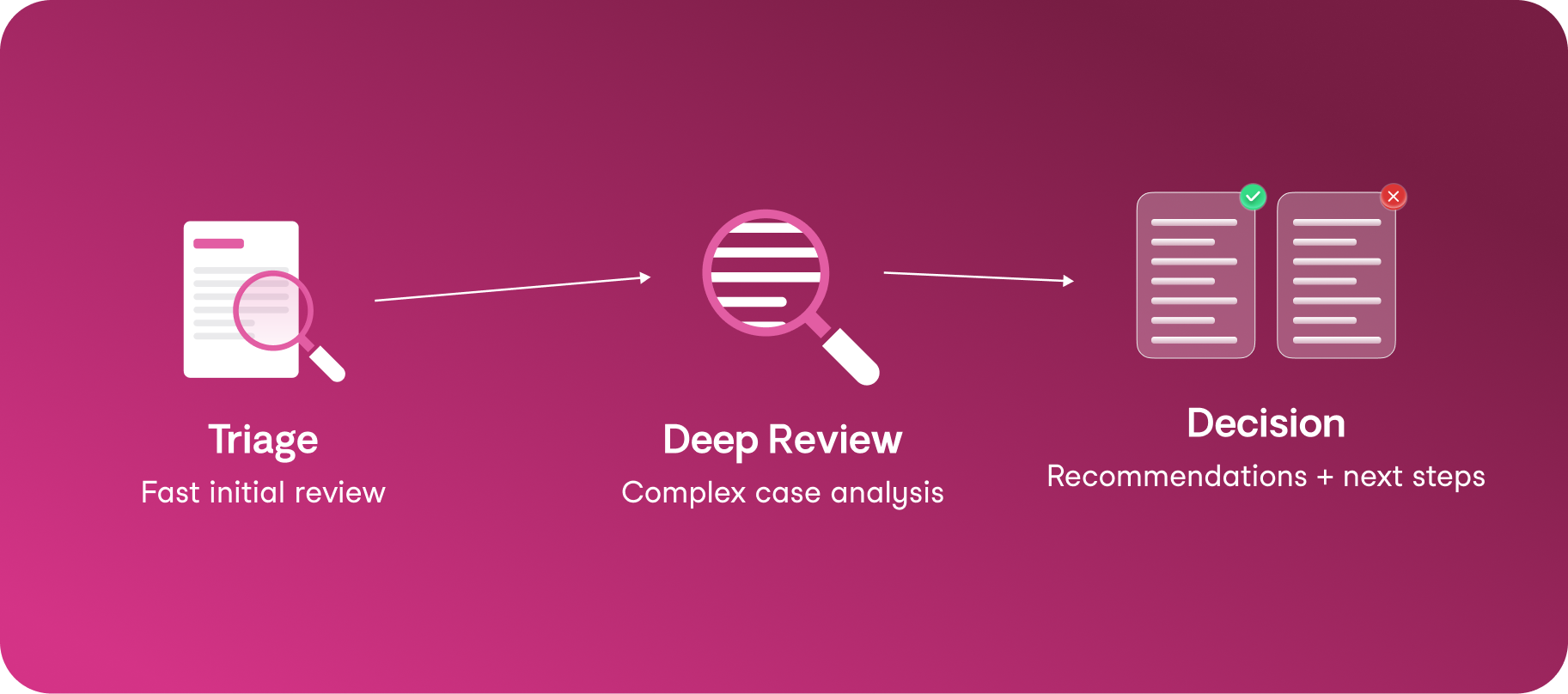
Sixfold generates risk insights and recommendations to support your team's decision-making, working directly within the systems you already use. It's designed to handle the full underwriting analysis of cases that reach your underwriters, from triage to deep review, including the most complex cases.
Rather than just summarizing information, Sixfold reasons across all relevant documents and surfaces the details your underwriters need, aligned to your specific guidelines. It works like a colleague that knows your book: tracking decisions over time, applying what it learns, and recommending best next steps. Keeping underwriters in control to agree or disagree with any assessment.
It can process any type of document, including messy, unstructured data, so there's no need for separate tools to extract and organize data first.
Type of technology: LLMs, AI agents, guideline-aligned risk engine
Best for: Insurers looking for underwriting AI that goes beyond summarization: improving speed without compromising underwriting quality. Aligns with your specific guidelines across the full underwriting workflow, with proven results (e.g. 50% efficiency gains for Guardian) and built to be compliant and fair for insurance underwriting from day one.
Watch out for: It's built for insurers who want AI that actually reasons and understands risk, not just summarizes information.
Side-by-Side Comparison
Below is a simple table showcasing the differences.
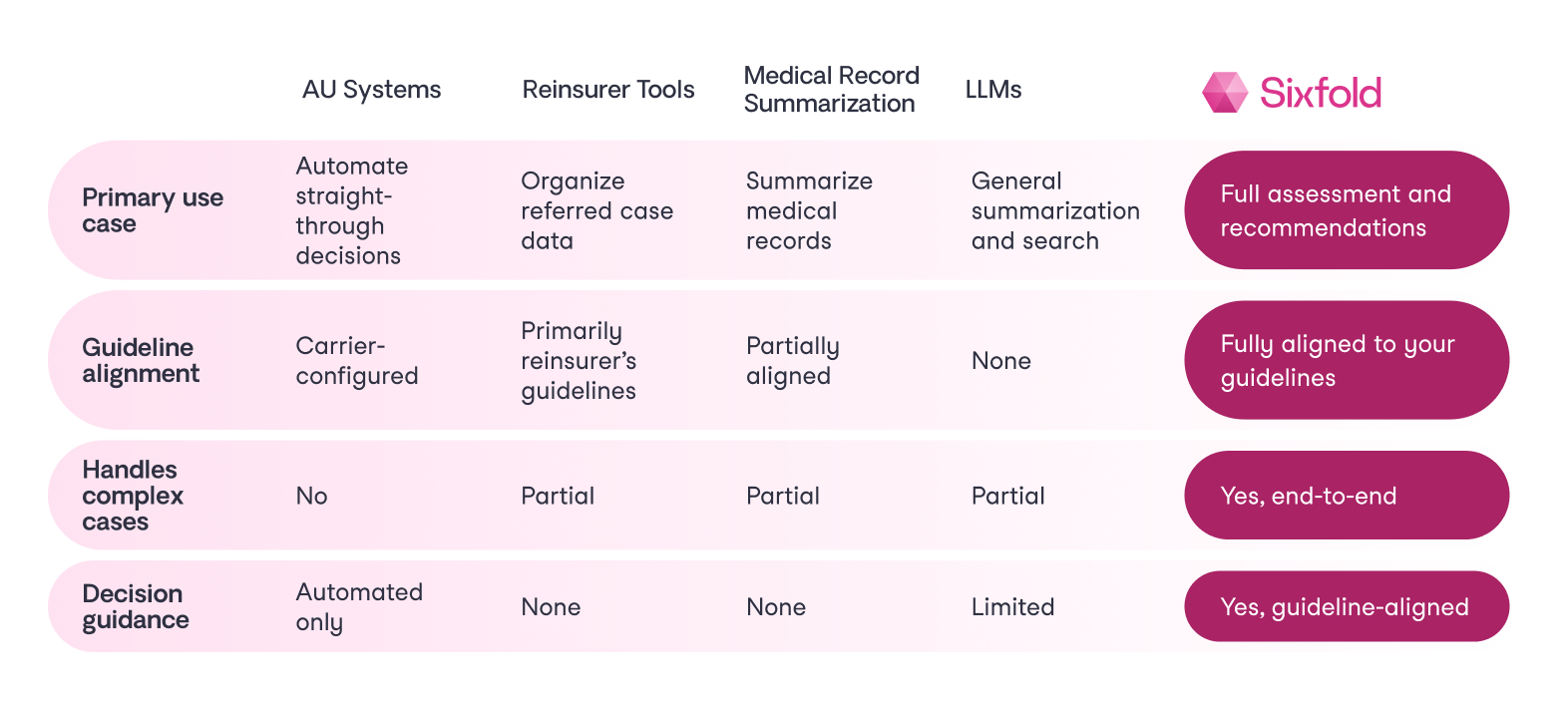
We hope this guide helped you better understand the different solutions in the market.
If Sixfold sounds like it could be the right fit for your team, reach out for a demo to see what it looks like in practice.
Learn more about Sixfold’s Life & Health product here.
━━━
FAQ
What is the difference between accelerated underwriting and automated underwriting in life insurance?
Accelerated underwriting (AU) is a Life & Health underwriting approach that allows eligible applicants to get approved faster, without requiring traditional medical exams and lab tests. It does this by using external data sources like electronic health records, prescription history, and MIB records to assess risk. Automated underwriting is a broader term referring to any rules-based system that makes decisions without manual underwriter involvement. In Life & Health, AU is the more precise term. According to Gen Re's 2025 survey, around 59% of individual life applications qualify for an accelerated underwriting path.
How long does it take to get value from an AI underwriting solution in L&H?
Purpose-built AI underwriting solutions are designed to deliver value faster than traditional technology implementations. Unlike legacy core system replacements that can take months or years, they integrate with existing systems and workflows, meaning carriers can reach production without lengthy implementation projects. The key variables are guideline configuration, data readiness, and how much the solution needs to be customized to the carrier's specific appetite and workflows.
What percentage of life and health cases still require human review despite automation?
According to Gen Re's 2025 U.S. Individual Life Next Gen Underwriting Survey of 30 carriers, 41% of applications were processed through a traditional underwriting path, 47% were eligible for accelerated underwriting, and only 12% qualified for fully automated decisioning. This means the vast majority of case volume still lands on underwriters' desks, making the quality of the manual review process as important as the automation layer above it.
What is mortality slippage in life insurance underwriting?
Mortality slippage is the financial loss that occurs when underwriters approve risks at better rate classes than their actual mortality profile warrants. It typically results from inconsistent decision-making across underwriters reviewing similar cases. According to Gen Re's 2025 Next Gen Analytics study, overall AU slippage improved to 12.3% in 2025 after several years of upward pressure. Over half of carriers estimate their mortality slippage at between 6% and 15%.
How do AI underwriting tools handle data protection in Life & Health?
Data protection standards vary significantly across solution types. General-purpose LLMs were not built with insurance-specific security or regulatory requirements in mind, making them unsuitable for production use without significant customization. Purpose-built underwriting AI solutions are designed to meet the data governance, auditability, and compliance standards that Life & Health regulators expect, including requirements under the EU AI Act and the NAIC Model Bulletin on AI Systems, which continues to be adopted by U.S. states.
What is vendor lock-in risk when adopting a reinsurer-built underwriting tool?
Vendor lock-in occurs when adopting a reinsurer's AI tool requires signing up for their broader platform and services, making it difficult to switch providers later without disrupting workflows. Reinsurer-built tools are anchored to the reinsurer's own guidelines and ecosystem, meaning the carrier's underwriting process becomes tied to that reinsurer relationship beyond just the tool itself.
How do placement rates connect to underwriting cycle times in life insurance?
Faster underwriting decisions directly improve placement rates. According to Gen Re's 2025 survey, 78% of applications approved through an accelerated workflow were ultimately placed, compared to 63% for fully underwritten cases. When cycle times slow, applicants may lapse, withdraw, or accept a competing offer from a carrier that moved faster, particularly healthy applicants who qualify for multiple carriers' accelerated underwriting programs simultaneously.
¹ Gen Re, 2025 U.S. Individual Life Next Gen Underwriting Survey
Working With the AI Underwriter
Hear directly from Melissa Butt, a 20+ year commercial property underwriter and VP of E&S Brokerage, Property, at Skyward Specialty, on what it's like to use the AI Underwriter.
Melissa Butt, Vice President E&S Brokerage, Property, at Skyward Specialty, has spent more than 20 years underwriting commercial property. She's been using the AI Underwriter on live submissions and we asked her what that’s been like.
First impressions
Melissa's assumption going in was that AI in underwriting meant workflow or operational automation, scrubbing data, prefilling fields. That assumption wasn't wrong, exactly. The tool does cut out a lot of manual legwork:
"It eliminated the screen jumping. You don't have to go from one system to another. Instead, it’s putting it all together so that you're reviewing the pertinent information, with the flexibility to align that information to your viewpoint."
For Melissa, what really changed her day-to-day life was what the AI Underwriter does after it's pulled relevant facts together, when it gets to the real underwriting work. It arrives with underwriting knowledge already built in, then layers in what it learns about a specific carrier's appetite and each underwriter's way of working. That combination is what builds a narrative shaped to underwriters’ own judgment:
"It applies what it knows and what it’s learned from you into a narrative aligned with your individual underwriting point of view."
That narrative comes paired with recommended next steps, and Melissa said she's acting on the next step recommendations more often than not. The AI Underwriter isn’t stopping at an appetite-aligned score or summary, it’s working through real underwriting considerations and next steps: declining a bad fit, flagging what's missing from a broker, initiating a referral.
"I frequently agree with the next steps. Maybe you have missing information and need to reach out to your broker, or an exposure is in a gray area and you should consult a peer or your guidelines. It can trigger a referral and help you narrate it, saving time, energy, clicks. All underwriters want to save clicks."
"Wow, it really knows underwriting” moments
When asked what moments stood out that made her excited to continue using Sixfold, here’s what Melissa had to say.
On a rare occupancy type her market doesn't see often:
"I got a very rare occupancy in one of my submissions, food irradiation. We don't see those a lot, even in our market. What really surprised me was not only did it understand what the food irradiation process was, it allowed me to understand the process, too. It said here's some additional information you may want or need, and here's some questions to go back and get answered from your broker."
On a routine loss-history check, where the AI Underwriter pulled in some surprising research:
"The system scrubbed the loss history we received, but it also went out and looked at the web for additional information. What it discovered was that the property was one of the few buildings on the block that did not recently have a fire, which was significant when writing property insurance."
A favorite feature
Melissa was most excited about the AI Underwriter’s chat interactivity:
"The chat interaction is huge. If I had to point to one thing that makes this tool the most functional, it’s the chat."
The reason: it lets her resolve a question the moment it comes up, without leaving the platform. The chat is connected to the same underlying analysis built for that submission, so digging deeper or providing additional context feeds right back into the narrative and next-step recommendations, as well as the AI Underwriter’s overall memory.
On one submission, the initial read on a recycling-related exposure was that the business was a metal processor. Melissa concluded it was actually a transfer station, and used the chat to guide the AI Underwriter in a new direction:
"I let the chat know it isn't a true recycling exposure, it's actually a transfer station, and asked how that changes the loss history, the rating, the narrative. It's similar to talking to a peer: hey, I'm not sure, what do you think? And the system responds."
Advice for a skeptical peer
We asked Melissa what she'd say to another underwriter who isn't sure what to make of something like this:
"Don't be afraid. Yes, it's technology. Yes, it's new. But it's not here for your job. It's here to make your job more efficient and to make your experience stronger. Treat it like you've treated every other tool in your arsenal as an underwriter: challenge it, try to break it, because then it's just going to become stronger. It's a tool. It's a peer. It will interact with you so that you are a stronger underwriter."
Learn more about Sixfold’s latest P&C offering, the AI Underwriter.
.png)
Meet the AI Underwriter
Sixfold is launching the AI Underwriter, an agentic colleague that does the analytical work, holds institutional memory, and tells underwriters what to do next.
Three years ago, Sixfold launched the first AI product built for insurance underwriting.
Since then, we’ve learned what it takes for AI to earn a place in an underwriter’s workflow. It has to do more than read and summarize a submission. It has to support judgment in context.
We learned this by processing more than 1.5 million submissions across more than 50 lines of business for carriers including Zurich, Skyward Specialty, Generali GC&C, Guardian, AXIS, and New York Life in North America, Europe, South America, and Australia.
A great underwriter holds an enormous amount in their head. The risk. The carrier’s appetite and guidelines. The broker’s history. The shape of the portfolio. Similar cases they have seen before. Where the carrier is willing to bet.
Even the best underwriters hit two limits.
First, no one can hold their entire book in memory. Every interaction with a broker. Every similar risk. Every detail of the underwriting guidelines. It’s too much information to carry and recall for every decision.
Second, underwriters mostly learn from the cases on their own desk. What the underwriter next to them knows often stays there. Institutional knowledge that should compound across a team doesn’t.
Today, we're launching something new to solve both. The AI Underwriter.
From Submission to Recommendation
The first version of Sixfold was about providing relevant risk insights. Since our launch, our AI has been exceptional at ingesting submission data straight from an inbox, enriching it, filling in the gaps, and pointing to what matters based on appetite fit. But, to solve the deeper problems preventing underwriters from binding more and better business, we needed to go further.
The AI Underwriter does exactly that. It’s an agentic colleague that receives a submission and produces real underwriting work product as the output, one that understands the risk, knows the broker, holds the portfolio in memory, and tells the underwriter what to do next.
The agent receives a submission, extracts and cleans the data, identifies what's missing, and evaluates appetite and portfolio fit. It reasons about the risk, but also about whether this risk, from this broker, belongs in this book right now. It draws on everything the carrier's team has ever learned about that broker and that risk class, surfaces portfolio context, and produces a recommendation and the rationale to back it up. The next step is always clear, whether that's a referral, a declination, or a broker follow-up drafted and ready to send.
At the center of the AI Underwriter is what we call the Underwriting Brain. It brings functional knowledge across lines, reasoning patterns from experienced underwriters, and a ground-truth library of what good underwriting looks like. It doesn't need months of ramp time. It already knows how to underwrite on day one.
Most AI Tools Digitize The Submission. This One Does the Work.
.png)
How is it different from other AI tools out there? The reality is that a great underwriter doesn't need a digitized version of the application or a dashboard with data that was current last week. They need to understand the risk in the full context of their current book, the broker relationship, and their guidelines, and what the next best action on the case is.
That's what the AI Underwriter does. And it's something no text ingestion, triage, or workflow tool was built to do, because none of them were designed to learn from the work itself.
After a short time with a carrier, the AI Underwriter holds institutional memory that compounds with every submission. The broker's history. Prior outcomes on similar risks. Portfolio context. Everything every colleague has ever learned, available the moment the next submission lands.
The Impact on Your Book
Sixfold customers have historically seen 50% to 97% faster processing, hit ratios up 15%, and 30% more GWP per underwriter. One carrier went from pilot with a handful of users to 500+ underwriters, reaching go/no-go decisions on submissions in 5 minutes and more than 2 hours saved per submission. Another one cut days-to-quote from 16 to 7 days, with more than 100 underwriters using Sixfold today.
Matthew Richardson, Global Head of Operations & IT, from Generali GC&C, summarized the impact well:
“Sixfold helps us quote risks in minutes instead of days or, in some cases, weeks. The work gets better for our underwriters. What sets Sixfold apart is how they build their product, alongside underwriters, shaped by how the job really works. That is why we believe they are building the future of underwriting.”
The AI Underwriter moves insurers further toward a better combined ratio and more profitable growth. Expense ratios fall as underwriters focus on judgment instead of analysis. Over time, loss ratios improve as fewer good risks get missed and appetite alignment tightens.
For a startup MGA writing complex specialty risks with a small team, it makes growth possible without hiring ahead of revenue. For a global carrier, it means every submission is evaluated the same way, with more context, and with better insights from your best-performing distribution channels.
What We're Hearing from Users
Before today's launch, a select group of insurers worked with the AI Underwriter on live submissions. At Skyward Specialty, early results show that the AI Underwriter performed the majority of the underwriting analysis needed to evaluate submissions, helping underwriters quote better risks, faster, with more consistent judgment across the book.
The feedback we’ve received speaks for itself. Melissa Butt, Vice President E&S Brokerage, Property at Skyward Specialty, said it best.
"The AI Underwriter does not just summarize what you are looking at, it gives you a point of view and a clear path forward. For more junior underwriters, it’s a powerful companion that gives them the perspectives of a more experienced underwriter and accelerates their development. Even veteran underwriters who are a little more skeptical of new technology see the AI as an added layer of intelligence. Plus, the ability to fully examine a submission and make better, more confident decisions without even leaving the tool is a huge benefit. The entire team is excited to work with it."
AI Colleague. The Underwriter in Charge.
I want to be very clear. Underwriters are not going anywhere.
But, we’re not automating the existing underwriting process either. We’ve invented (and patented) a new way to run a risk-taking shop.
The best underwriting teams will not remove human judgment. They will focus human judgment where it matters most. Complex risks. Exceptions. Broker relationships. Negotiation. Accountability. Where to take bets.
We recently surveyed more than 500 underwriters and underwriting leaders across North America and Europe, and nearly 80% said they wanted more time for exactly that work.
The AI Underwriter creates that time.
It does the analytical work. It surfaces what is missing. It explains its reasoning. It recommends the next action. The human underwriter directs it, corrects it, decides, and remains accountable.
That is the partnership we believe will define underwriting over the next five years.
And today, it is here.
That’s better #funderwriting.
This post was originally shared on LinkedIn.
.avif)
Sixfold Partners with Adnovum
Sixfold is teaming up with Adnovum, the Swiss technology and consulting company specializing in secure digital transformation for the insurance industry.
Sixfold is partnering with Adnovum, the Swiss technology and consulting company specializing in secure digital transformation for the insurance industry.
Insurers across Germany, Austria, and Switzerland can now access Sixfold's AI underwriting solution through Adnovum's established insurance transformation offering, with Adnovum's IT delivery teams leading implementation and integration.
This partnership brings globally proven underwriting AI together with deep local delivery expertise, giving DACH insurers a faster, lower-risk path to modernizing underwriting operations.
Why Adnovum
Our mission at Sixfold has been to make AI adoption in insurance faster and more accessible. A big part of achieving that is meeting insurers where they already are, working alongside the partners they already know and trust.
Adnovum brings more than 30 years of experience supporting insurers, reinsurers, brokers, and specialist providers across the insurance value chain. They understand the regulatory landscape, the operational realities, and the relationships that define the DACH market. That foundation is exactly what insurers need when adopting new technology with confidence.
"Europe is a priority market for Sixfold, and the DACH region in particular represents a significant opportunity. Adnovum gives us immediate credibility and reach with insurers who are ready to modernise but need a partner they already trust to lead the way."
— Roger Ferrandis, Head of Partnerships at Sixfold
What Changes for Insurers
Insurers across DACH are working to modernize their underwriting processes, and they're looking for solutions that are proven. They want AI that works at other carriers, and a delivery partner who knows their market.
This partnership gives them both. Carriers and MGAs across Germany, Austria, and Switzerland can now:
- Access Sixfold's AI underwriting solution through a regional partner they already know and trust
- Rely on Adnovum's IT delivery teams to lead implementation and integration
- Modernize underwriting operations with in-market delivery expertise and regulatory fluency
- Move from decision to deployment faster, with fewer unknowns and the right local support
"Insurers across DACH are under real pressure to modernise underwriting, and they are looking for solutions that are proven, not experimental. Sixfold already has a track record with some of the world's leading insurers. We can now bring that capability to our clients in this region. That combination of globally proven AI and local delivery is what makes this partnership genuinely compelling."
— Dr. Christian Straube, Head of Industry Insurance at Adnovum
How to Get Started
Sixfold is trusted by insurers globally including Zurich, Mosaic, Skyward, Generali, and many more. Together we've processed over one million submissions for carriers writing more than $265B in premiums.
Sixfold and Adnovum will make their first joint appearance at the HZ Insurance Forum on 11 June in Zurich, co-hosting an expert lunch on how insurers can build AI-fluent underwriting teams.
Curious to learn more about the partnership or how Sixfold can support your underwriting team? Get in touch with our team.
━━━
Frequently asked questions
Which insurers currently use Sixfold for AI underwriting?
Sixfold's AI underwriting platform is used by insurers including Zurich, Mosaic, Skyward, and Generali. The company has processed over one million submissions for carriers writing more than $265 billion in premiums globally. This client base spans both multinational carriers and specialty insurers, providing the production track record that regulated markets typically require before adopting new underwriting technology.
What does DACH mean in European insurance markets?
DACH refers to Germany (D), Austria (A), and Switzerland (CH), three German-speaking European countries grouped together in financial services strategy. The term is widely used by insurers and technology providers for regional go-to-market planning.
What role does Adnovum play in the Sixfold partnership?
Adnovum leads implementation and integration of Sixfold's AI underwriting solution for insurers across Germany, Austria, and Switzerland. Its IT delivery teams handle technical deployment while Sixfold provides the underlying AI platform. Adnovum brings more than 30 years of experience serving insurers, reinsurers, brokers, and specialist providers across the DACH insurance value chain.
How do DACH insurers get started with Sixfold?
DACH insurers can access Sixfold's AI underwriting solution through Adnovum's established insurance transformation offering, with Adnovum's IT delivery teams leading implementation and integration. Sixfold and Adnovum will appear together at the HZ Insurance Forum on 11 June 2026 in Zurich, co-hosting an expert lunch on building AI-fluent underwriting teams.
What languages does Sixfold support for underwriting submissions?
Sixfold supports all languages, processing underwriting submissions in any language a carrier receives them. This is directly relevant for the DACH region, where submissions arrive in German, Swiss German, French, and Italian alongside English across Germany, Austria, and Switzerland.
Sixfold’s AI Governance Program
Sixfold's AI Governance Program is an ongoing internal process for identifying, assessing, and mitigating the risks of deploying AI. It is organized into five focus areas with named owners, defined deliverables, and a regular cadence of reviews.
Sixfold's AI Governance Program is an ongoing internal process for identifying, assessing, and mitigating the risks of deploying AI. It is organized into five focus areas with named owners, defined deliverables, and a regular cadence of reviews.
This post explains what it covers and why we built it the way we did.
Why we established this now
Responsible AI is not a new territory for Sixfold. We have been thinking carefully about how we build and deploy AI in insurance underwriting since the day we launched in May 2023.
The honest answer to "why now?" is this: we wanted to formalize what we were already doing, and the regulatory environment gave us both the mandate and the structure to do it well.
The reality is that AI legislation is different from most compliance frameworks insurers and vendors are familiar with. AI compliance is process-based. It is about building the organizational muscle to understand whether your systems could cause harm, and then evaluating that question consistently over time.
That kind of ongoing work requires real ownership, clear processes, and people who are explicitly accountable for staying on top of it. We also made a deliberate choice not to chase specific legislation line by line. AI laws are still in progress across jurisdictions and contested at every level. Instead, we anchored the program around established industry reference points:
- The NIST AI Risk Management Framework (AI RMF 1.0), an industry framework that gives durable guidance for risk and oversight.
- The EU AI Act's high-risk provider requirements (Articles 9-17), which has concrete expectations on documentation, testing, and accountability
That approach is more durable and more honest about where regulation actually is today.
From principles to practice
Sixfold has had a set of responsible AI principles since early on, we formalized and launched our first Responsible AI approach in 2024 and established and launched an updated version in 2025. What the governance program does is translate those principles into organized action.
"Principles are well and good, but without action words they're just hot air."
– Noah Grosshandler, Product Manager and AI Governance Program Lead at Sixfold
The program gives us specific owners, defined deliverables, and a cadence for revisiting each area. It creates the connective tissue between what we believe and what we actually do. And critically, it builds the structure to change over time, because the landscape will constantly move forward, our product will change, and what it means to apply those principles responsibly will change with them.
We are building toward a complete Annex IV documentation package. That is the concrete output regulators and enterprise customers ask for. The program also addresses requirements to prevent algorithmic discrimination in much of the emerging global AI legislation, especially relevant to our customers operating in the life and health space. Bias and fairness testing is part of the program, with methodology tailored to each line of business.
How the program is structured
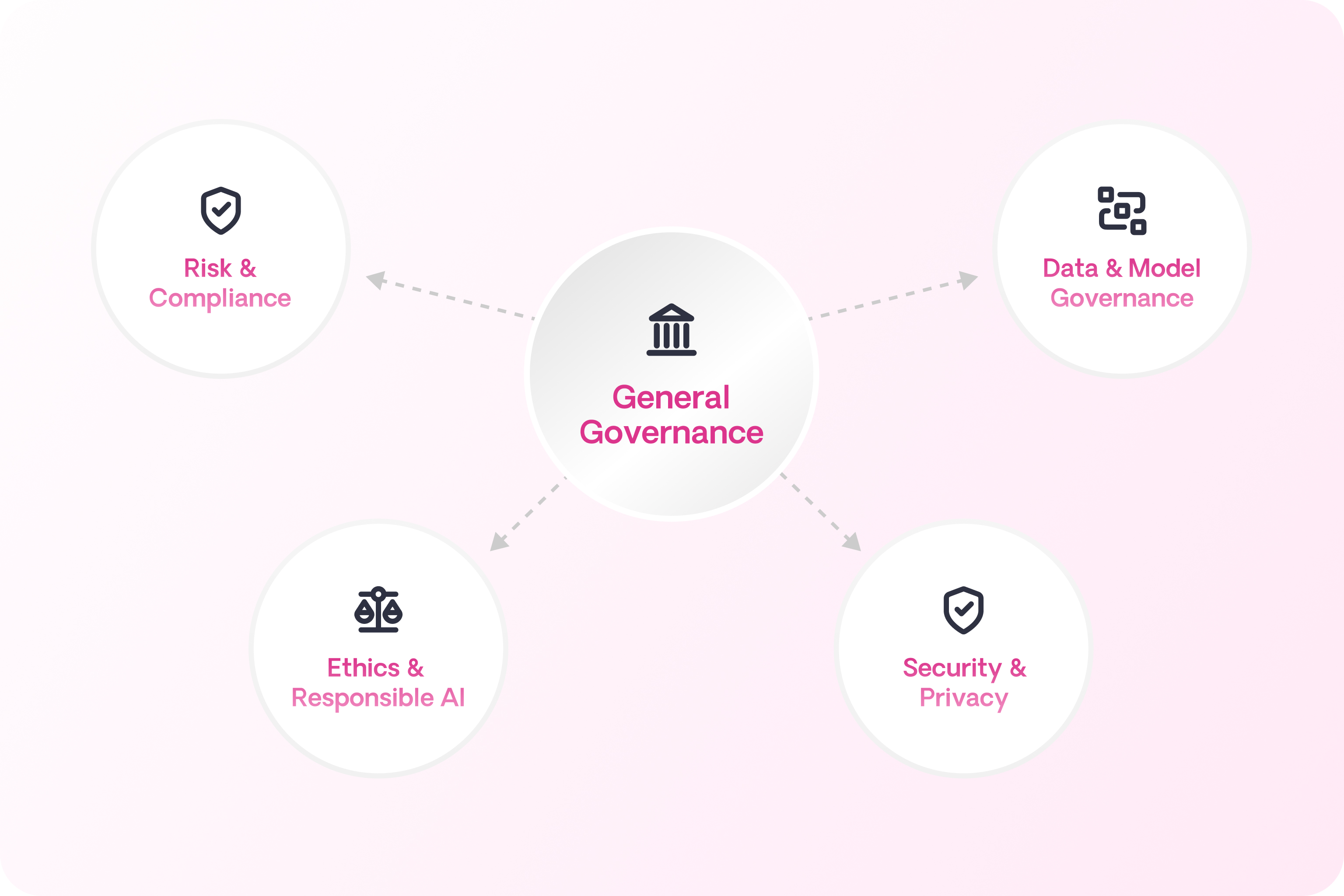
The program is organized around five focus areas, each with its own owners and activities:
General governance covers the program itself: keeping the right people informed, running annual retrospectives, and ensuring continuity when things change.
Risk and compliance is responsible for identifying and tracking AI-specific risks, reporting on them quarterly, and handling any ad hoc mitigation or incident response as needed.
Data and model governance focuses on the data used to develop and train our systems. This means understanding where data comes from, confirming it is used ethically, and being able to clearly explain how system behavior relates to the inputs that shaped it.
Ethics and responsible AI covers fairness, explainability, and human oversight. It is the function that asks where humans should stay in the loop, what our position is on where AI should and should not operate, and whether the way our system works is genuinely ethical, not just technically sound.
Security and privacy handles the technical infrastructure: making sure the underlying systems meet the security and privacy requirements of what we are building.
Each area has its own cadence. Risk and compliance runs quarterly reviews. The ethics function does the same, looking at new functionality and evaluating human oversight design. Between those cycles, the full group of program owners meets bi-weekly to stay coordinated.
"The different areas of focus don't need to change when a new regulation drops or a new product drops, we can slot new requirements into the existing structure."
– Noah Grosshandler, Product Manager and Facilitator of the AI Governance Program
One thing worth being explicit about: having dedicated program owners does not mean this is only their responsibility. At the end of the day, the company is accountable. Every person at Sixfold is responsible for building software that is honest, transparent, and ethical. The program owners exist to maintain the expertise and the process rigor that makes that possible at scale.
What this means for our customers
.avif)
We have customers in North America, EMEA, South America and Australia today. Across the globe our customers face their own compliance pressures as deployers, and we can support them with that. Many of them are being asked by their own regulators and partners to demonstrate responsible AI practices, and most are still working out what that means for them.
The governance program helps us support our customers directly:
- When a customer receives a compliance questionnaire about their AI vendor, we will have clear and documented answers.
- When they are trying to build their own responsible AI stance, we can share what we have learned. We are not just handing over a package of documents; we are trying to be a resource to support them build out their own AI Governance practices.
- Our customer success team works with each customer individually, because our customers operate across different jurisdictions, different product lines, and different regulatory environments. There is no one-size-fits-all approach here.
"The company is accountable. Just because there is this program and this charter doesn't mean that it is not every single person at this company's job to make sure that what we're building is built ethically, built honestly, built transparently."
– Noah Grosshandler, Product Manager and AI Governance Program Lead
What comes next
In the near term, we are focused on achieving the right baseline: making sure all documentation is in place, all processes are codified, and we are ready for the enforcement deadlines that matter.
The longer-term goal is bigger. We want to continue to be at the forefront of what responsible AI development actually looks like in insurance, not just compliant on paper but genuinely ahead of the problem. That means working with bodies like the NAIC to share what has worked and what has not. And it means making sure the program itself stays modular and adaptable, so when new regulations drop or our product evolves, we can slot in new requirements without rebuilding from scratch.
We built the governance program because Responsible AI is a core part of Sixfold. The structure the program provides is how we make sure that commitment holds.
Questions about Sixfold's AI governance approach? Reach out to your customer success representative or get in touch with our team.
Learn more about our commitment to being a Responsible AI organization here.
━━━
FAQ
What is an AI Governance Program? An AI Governance Program is a structured and ongoing internal process for identifying, assessing and mitigating risks. Sixfold developed the program to mitigate the risks of deploying our AI in insurance underwriting. It is organized into five focus areas, each with named owners, defined deliverables, and a regular review cadence.
Why did Sixfold create a formal AI governance program? To formalize responsible AI practices it had been following since launch, and to meet the requirements of emerging AI legislation. AI compliance is process-based and requires ongoing evaluation.
Is the AI Governance Program required by law? Not by a single law, but most emerging AI regulations require some form of oversight program. Rather than chasing specific legislation, Sixfold anchored the program in established frameworks like NIST AI RMF, which is more durable given how frequently AI laws are still changing.
How often does Sixfold review its AI governance program? Program owners meet bi-weekly. Risk and compliance runs quarterly reviews, as does the ethics and responsible AI function. Incident response is handled ad hoc as needed.
How does the AI Governance Program help insurance customers with their own compliance? Sixfold gives customers documented answers to vendor compliance questionnaires and a framework they can learn from as they build their own responsible AI practices. Sixfold's customer success team works with each customer individually given differences in jurisdiction and product line.
Who is responsible for AI governance at Sixfold? The whole company. Named owners across the five focus areas maintain the expertise and process rigor, but every person at Sixfold is accountable for building software that is honest, transparent, and ethical.
Sixfold Partners with Microsoft Azure
Sixfold and Microsoft are teaming up to make AI in insurance underwriting faster to deploy and easier to integrate within the Microsoft Azure Marketplace.
Exciting news! Sixfold is officially live on Microsoft Marketplace, the trusted online destination for enterprises to discover, purchase and deploy cloud solutions, AI apps and agents directly within their Microsoft ecosystem.
Carriers and MGAs can now discover and deploy Sixfold directly through Microsoft Marketplace with smooth integration and streamlined management
Now meeting insurers within their existing technology ecosystem. This partnership simplifies integration, streamlines management and reduces implementation timelines. Allowing carriers to leverage their existing Azure commitments to accelerate time-to-value.
Why Microsoft
Our mission at Sixfold has been to make AI adoption in insurance faster and more accessible. A big part of achieving this is meeting insurers where they already are, inside a technology infrastructure they know and trust.
By joining Microsoft Marketplace we’re doing exactly that. This partnership simplifies procurement, streamlines integration and lets insurers apply their existing Azure commitments toward deploying Sixfold. Removing the friction that typically slows adoption in enterprises.
"This collaboration with Microsoft marks a significant milestone in our growth journey. By integrating with the Microsoft Marketplace, we're making Sixfold and our Underwriting AI brain easier to discover and deploy. Insurers can implement our capabilities directly within their existing Azure environment, reducing integration complexity and accelerating time-to-value by streamlining procurement through their established Microsoft relationship."
– Roger Ferrandis, Head of Partnerships at Sixfold
What Changes for Insurers
Until now, adopting Sixfold meant navigating a standalone procurement process with separate contracts, separate timelines, and separate budget approvals. For enterprise insurers, that friction adds weeks and creates unnecessary approval cycles before a single submission gets processed.
With Sixfold on Microsoft Marketplace, that changes. Carriers and MGAs can now:
- Discover and deploy Sixfold directly within their existing Azure environment
- Apply existing Azure cloud commitments toward their Sixfold adoption
- Eliminate redundant approval cycles by consolidating procurement within an established Microsoft relationship
- Move faster from decision to deployment with fewer operational barriers
“We’re pleased to welcome Sixfold to Microsoft Marketplace,” said Cyril Belikoff, vice president, Microsoft Azure Product Marketing. “Marketplace connects trusted solutions from global partners with customers worldwide, making it easy to find and deploy apps that work seamlessly with Microsoft products.”
How to Get Started
Sixfold is trusted by insurers globally including Zurich, Mosaic, Skyward, Generali and many more. Together Sixfold has processed over one million submissions for carriers writing more than $265B in premiums.
Ready to get started? Explore Sixfold on Microsoft Marketplace
Questions about the partnership or curious to learn more about Sixfold? Reach out to your customer service representative or get in touch with our team
━━━
Frequently asked questions
How long does it take to deploy Sixfold through Microsoft Marketplace?
Deployment timelines are significantly shorter through Microsoft Marketplace than through standalone procurement. Traditional Sixfold adoption requires separate contracts, implementation cycles, and budget approvals each adding weeks to the process. By routing through an existing Azure relationship, insurers eliminate those parallel approval cycles and can simplify the process from procurement to deployment within their established cloud infrastructure.
What's the difference between buying Sixfold directly versus through Microsoft Marketplace?
Purchasing through Microsoft Marketplace lets insurers apply existing Azure cloud commitments to Sixfold, whereas a direct purchase requires a separate budget allocation and procurement cycle. The core AI underwriting functionality is the same either way. The Marketplace route removes the need for additional vendor approval processes and integrates billing within an insurer's existing Microsoft spend, which is a meaningful operational difference for enterprise finance and IT teams.
How much more productive do underwriters become after adopting AI underwriting tools?
Underwriters using Sixfold process up to 50% more submissions without additional manual research or administrative work, according to Sixfold's published performance data. That productivity gain translates to up to 30% more Gross Written Premium (GWP) per underwriter. The efficiency comes from automated submission screening and appetite-aligned insights, freeing underwriters to focus on judgment-intensive decisions and broker relationships.
What compliance and security standards does Sixfold meet for enterprise insurers?
Sixfold's deployment within Microsoft Azure inherits the governance, security, and compliance controls built into the Azure platform, which is designed to meet enterprise and regulated-industry requirements. This matters in insurance because carriers operate under strict data governance obligations. Deploying within an existing Azure environment means compliance postures already approved by IT and legal teams carry over, rather than requiring a separate security review for a new vendor environment.
How do AI underwriting tools handle transparent sourcing of recommendations?
Sixfold provides appetite-aligned insights with transparent, cited sources meaning underwriters can see the reasoning and reference material behind each recommendation, not just an output. This auditability is a specific design requirement in insurance, where underwriting decisions must be defensible to regulators, reinsurers, and internal governance teams.
FEATURED REPORTS
Guides and Reports
A closer look at AI adoption, governance, and the future of underwriting.