
Trust by Design: Behind the AI Underwriter for Life & Health
5 min read
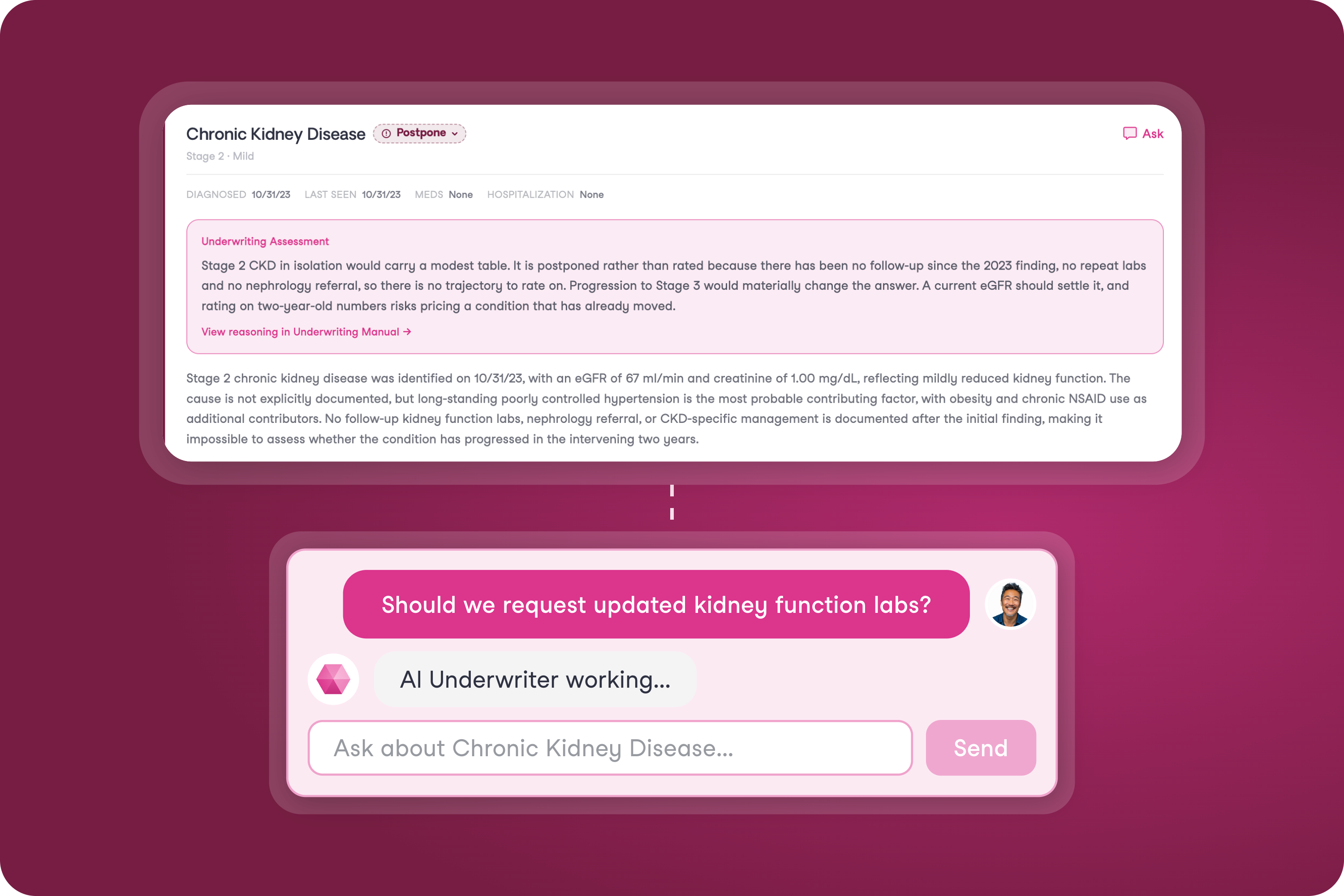
Sixfold’s AI Underwriter for Life & Health was designed with transparency, trust, and fairness embedded throughout the product.
The AI Underwriter works with the carrier’s or reinsurer’s underwriting manual, assesses case documents against those guidelines, and provides a recommendation for each impairment, such as a standard rating or a postponement, always showing the facts and rationale behind it.
Hear from Noah Grosshandler, Senior Product Manager, and Emile Premmereur, Senior Product Designer, on how underwriters helped develop it, why its recommendations can be trusted, and how fairness and governance are built in.
“Underwriter judgment shapes what we build and also how we measure whether it’s right.” Noah Grosshandler, Senior Product Manager
In this conversation
- How did you work with underwriters to build the AI Underwriter?
- What role does a carrier’s own manual play in its recommendations?
- What can an underwriter see behind a recommendation, and how does that help them trust it?
- How does an underwriter interact with a recommendation: questioning it, checking it, or overriding it?
- How is it tested for fairness, and how does it hold up as regulations change?

Use Case
Current Process
With Narratives
Quoting
Currently, risk factors are pulled together manually to decide if a case should be quoted.
Automatically summarizes key risk drivers upfront, providing a clear snapshot to prioritize cases faster.
Peer Reviews
Peer reviews are slowed by unstructured summaries; reviewers often have to go back to source documents.
Risk factors and case notes are presented clearly and consistently.
Referrals
Referral memos vary between underwriters; approvers often have to sort through inconsistent write-ups to understand the case.
Consistent case summaries make it easier for approvers to see the full risk story and sign off faster.
Decision Documentation
Underwriting rationale is often recorded unevenly; teams spend time cleaning up notes when preparing for audits.
A standardized record of underwriting rationale is created automatically, ready for audit without extra effort.
Business Impact
Faster decisions on which risks to quote.
More consistent risk appetite application and faster reviews.
Faster referral decisions.
Lower compliance risk and faster audit prep.
Quoting
use case
Current Process
Currently, risk factors are pulled together manually to decide if a case should be quoted.
With Narratives
Automatically summarizes key risk drivers upfront, providing a clear snapshot to prioritize cases faster.
Business Impact
Faster decisions on which risks to quote.
Peer Review
use case
Current Process
Peer reviews are slowed by unstructured summaries; reviewers often have to go back to source documents.
With Narratives
Risk factors and case notes are presented clearly and consistently.
Business Impact
More consistent risk appetite application and faster reviews.
Referrals
use case
Current Process
Referral memos vary between underwriters; approvers often have to sort through inconsistent write-ups to understand the case.
With Narratives
Consistent case summaries make it easier for approvers to see the full risk story and sign off faster.
Business Impact
Faster referral decisions.
Decisions Documentation & Audits
use case
Current Process
Underwriting rationale is often recorded unevenly; teams spend time cleaning up notes when preparing for audits.
With Narratives
A standardized record of underwriting rationale is created automatically, ready for audit without extra effort.
Business Impact
Lower compliance risk and faster audit prep.