What It Takes to Build an AI Underwriter
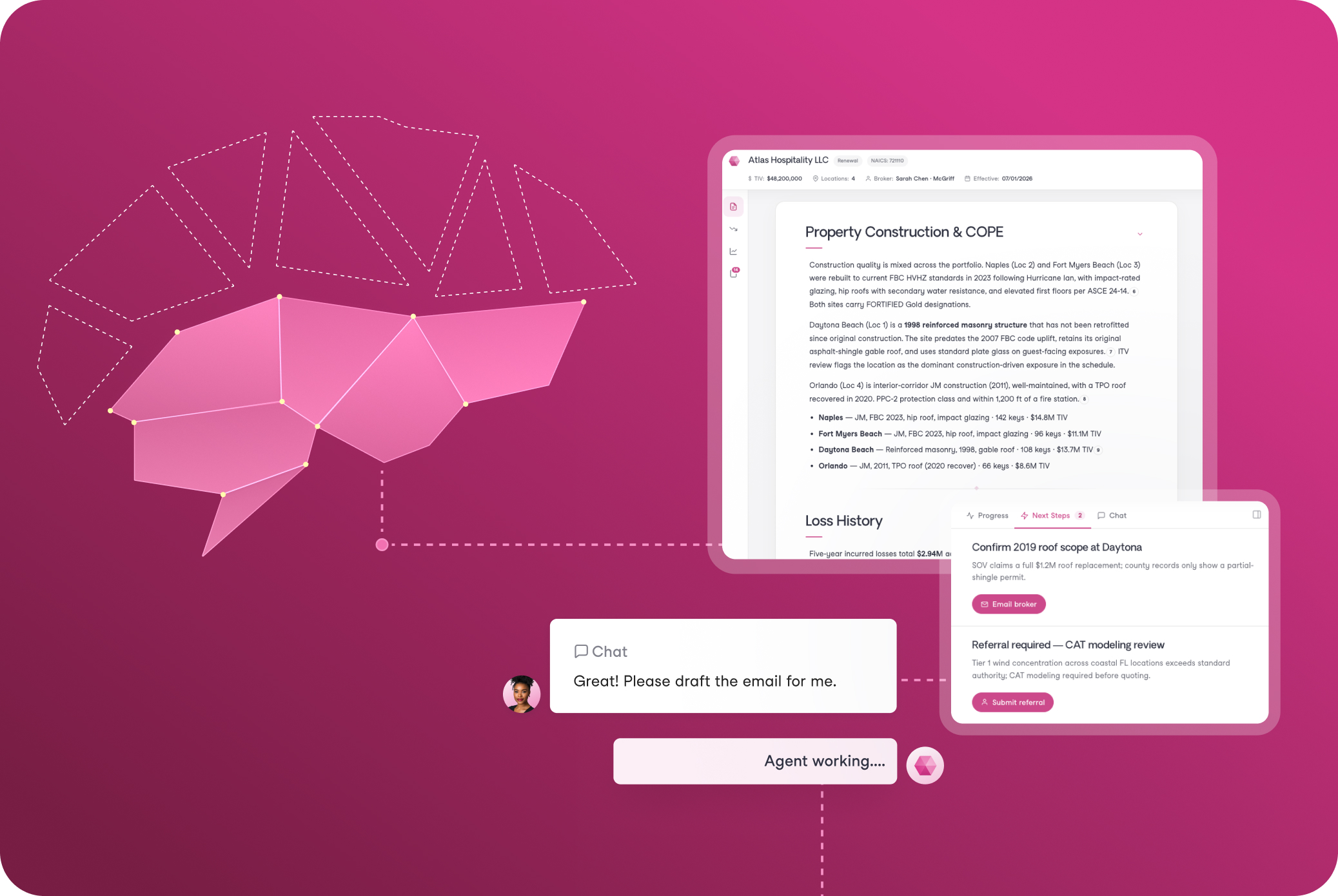
In June we launched the AI Underwriter, an agentic system capable of producing real underwriting work product. It reasons through risk evaluation and arrives at recommendations and next steps, approaching underwriting the same way an underwriter would. One of our early testers described it like working with a peer, and we love that perspective.
Building a fully agentic system for underwriting is complex. It requires reasoning across context that changes with every file: how a submission fits a book, what a broker's history signals, where a risk sits relative to appetite. Understanding that deeply influenced how we built the AI Underwriter. It's why we went fully agentic, why governance was built into the architecture from day one, and why we invested heavily in evaluation infrastructure to make sure the system behaves correctly across every line of business.
What we had to build
Underwriting submissions never arrive in perfect condition.
A property submission might include a schedule of values with a zip code transposition, a loss run that looks clean but covers a period that doesn't tell the whole story, and a broker application where the occupancy description doesn't match what's publicly known about the risk. Before our system could reason about a submission, it had to read it across every document type, in the form it actually arrives.
We built data infrastructure specifically for this: pipelines designed for the artifacts underwriters actually work with: SOVs, loss runs, medical evidence, broker applications, third-party and public data sources. That work alone, document processing, governance, security, integration across data sources, and the resource management that makes large language models run reliably at scale, was a significant engineering undertaking before we wrote a single line of underwriting logic.
A system that is capable but ungovernable is not deployable.
Governance was never an afterthought. Every recommendation the AI Underwriter produces has to be traceable from the output back through the reasoning to the guideline interpretation that drove it. The compliance team has to be able to explain it. The regulator has to be able to audit it. A system that is capable but ungovernable is not deployable.
And we wanted a system that could underwrite right out of the box. Not after weeks or months of additional configuration and training. A system that understands not just what good underwriting looks like, but what bad underwriting looks like, and that the answer is different by line of business, by carrier, by team. A workers comp underwriter and a property underwriter are reading the world differently. The red flags are different. The tolerance for ambiguity is different. Building evaluation frameworks that validate correct behavior across all of these contexts requires a testing discipline that’s taken years to build and refine.
And we wanted a system that could underwrite right out of the box. Not after weeks or months of additional configuration and training.
Here’s Shirley Shen, Lead Product Manager, and Ryan Garver, Staff Software Engineer, in their own words on what went into building this:
How the agent works
One of the things that took us the longest to get right is something that sounds simple: knowing what kind of work you're doing at any given moment.
The AI Underwriter sequences every step of the underwriting workflow itself, adapting as it goes. At every step, for every line of business and every submission, it sorts the work correctly. Some work is mechanical: pulling data, checking it against guidelines. Some work requires judgment: reasoning through how an exposure fits a book of business. Some work rises to the level of a recommendation, where the agent escalates to a human with a point of view. And some work is never the agent's call, full stop.
The AI Underwriter sequences every step of the underwriting workflow itself, adapting as it goes. At every step, for every line of business and every submission, it sorts the work correctly.
That sorting isn't static. Underwriting a named entity, a schedule of properties, and a list of assets are genuinely different problems. Property, cyber, and workers' comp each define risk differently. What's mechanical in one context is a judgment call or an escalation in another.
Getting that right is what separates an AI Underwriter from an AI that assists underwriting. It's also what makes it governable.
Why agentic mattered
Underwriting is not a checklist. A good underwriter reads a submission, forms a hypothesis, looks for what would change their mind, adjusts based on what they find, and arrives at a judgment. It is a long-horizon reasoning task, dynamic, iterative, and sensitive to context. Taking an agentic approach allowed us to build a system that models how underwriting actually happens.
Underwriting is not a checklist. A good underwriter reads a submission, forms a hypothesis, looks for what would change their mind, adjusts based on what they find, and arrives at a judgment. It is a long-horizon reasoning task, dynamic, iterative, and sensitive to context.
Early usage has shown just how valuable that is. For example, an underwriter had a submission come in with a mistyped zip code. We hadn't written an instruction for that scenario. The agent noticed the value didn't reconcile with the rest of the submission, did its own research to identify the correct location, and used that corrected geography in the risk assessment. Nobody gave it that path. It found it on its own, because it was reasoning toward a goal within the context of good underwriting.
What you can't shortcut
The question we often get is: why can't we just build this ourselves? Here's our honest answer.
Yes, it's buildable. We are proof of that. But here is what it actually takes.
World-class AI engineers who do nothing but this. Evaluating every new model as it comes out, determining the right model for the right task, building evaluation frameworks specific to underwriting, and doing it again and again.
Domain expertise deep enough to know what correct behavior looks like in the first place.
Governance infrastructure that satisfies model risk requirements.
The durability stakes are high. AI-powered technology depreciates fast. The models underneath change often, sometimes multiple times in a month. The patterns get superseded. For a carrier whose core business is insurance rather than AI research, that ongoing investment can be hard to justify.
This is all we do. We’ve processed more than 1.5 million submissions across 50+ lines of business. That experience has improved how we build: the edge cases we know to test for, the failure modes we've already solved, the LOB-specific nuances baked into our evaluation frameworks.
What this means for underwriters
Even the best underwriters are limited by working memory, bandwidth, and the boundary of their own desk. They can't hold an entire book of business in their head while evaluating a submission. They can't recall every broker pattern, every prior decision, every appetite shift. They learn mostly from their own cases, rarely from a colleague's.
The AI Underwriter gives underwriters what they don't have today: the carrier's full institutional memory at the moment of decision, on every file. It surfaces what is missing instead of summarizing what is there.
The AI Underwriter gives underwriters what they don't have today: the carrier's full institutional memory at the moment of decision, on every file. It surfaces what is missing instead of summarizing what is there. It brings in the broker history, the portfolio context, the prior decisions, the recommended next action. The underwriter makes the call. The AI Underwriter makes sure they are making it with everything they should know.
Reach out to us at hello@sixfold.ai to see how the AI Underwriter can work for your underwriting.